
Solar systems for farms in Thurgau: stable, barn and fruit store
When it comes to solar power from the farm, Thurgau is number 3 in Switzerland: 16,931 systems, 1,674 watts per capita, and the farm buildings between Lake Constance and the Thur carry a large share of it. For farms with daytime consumption – dairy with milking robots, fruit and vegetable growing with cold storage, poultry and pig farming – the system on the stable is the simplest calculation on the farm; for the empty barn roof without consumption, there is the high one-off feed-in incentive with full export. ecoEn plans and builds farm systems in Thurgau: asbestos question first, incentive route calculated, connection application to the municipal utility, our own electrical installation with ESTI installation authorisation (Art. 14 NIV). A direct specialist company, not a broker.
Farm and large-scale systems we have built
Our farm reference is in the neighbouring Canton of Aargau, the large-scale systems in the Canton of Zurich – the same installation crew works in Thurgau:

Farm with ZEV, Schneisingen AG
- 36.45 kWp · 90 modules
- Farmhouse and barn · ZEV with private metering · lightning protection
- Commissioned 2024
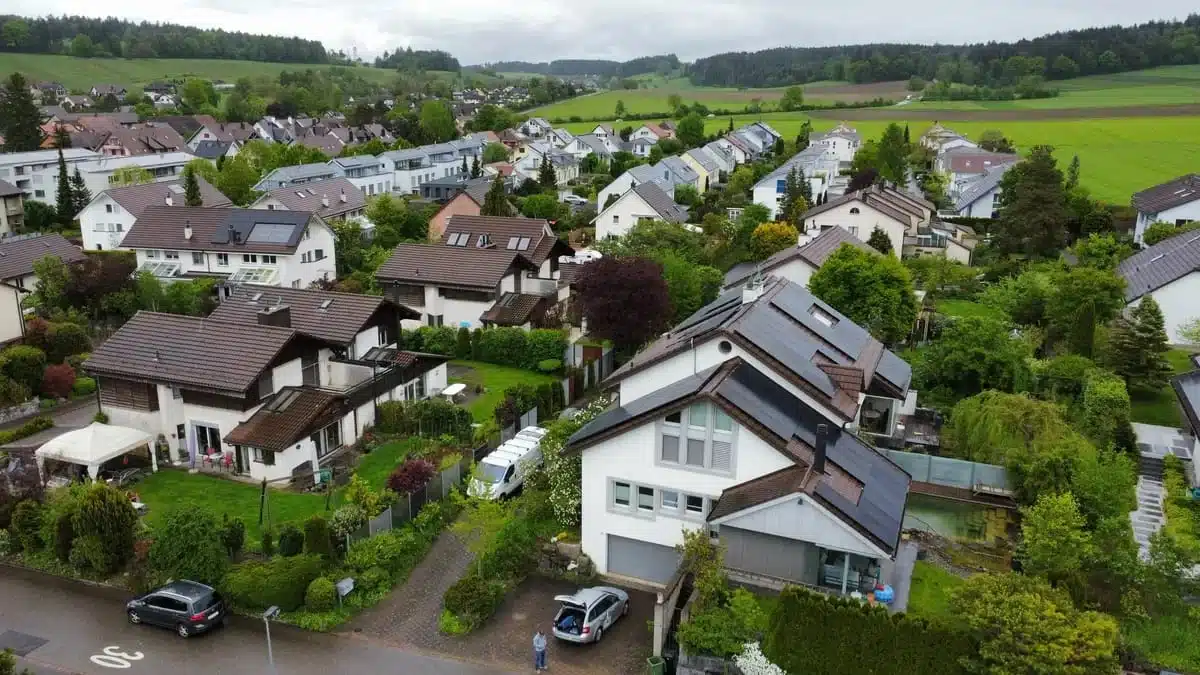
ZEV across two houses, Wiesendangen ZH
- 44.15 kWp · 109 modules
- ZEV with four private meters
- Commissioned 2023
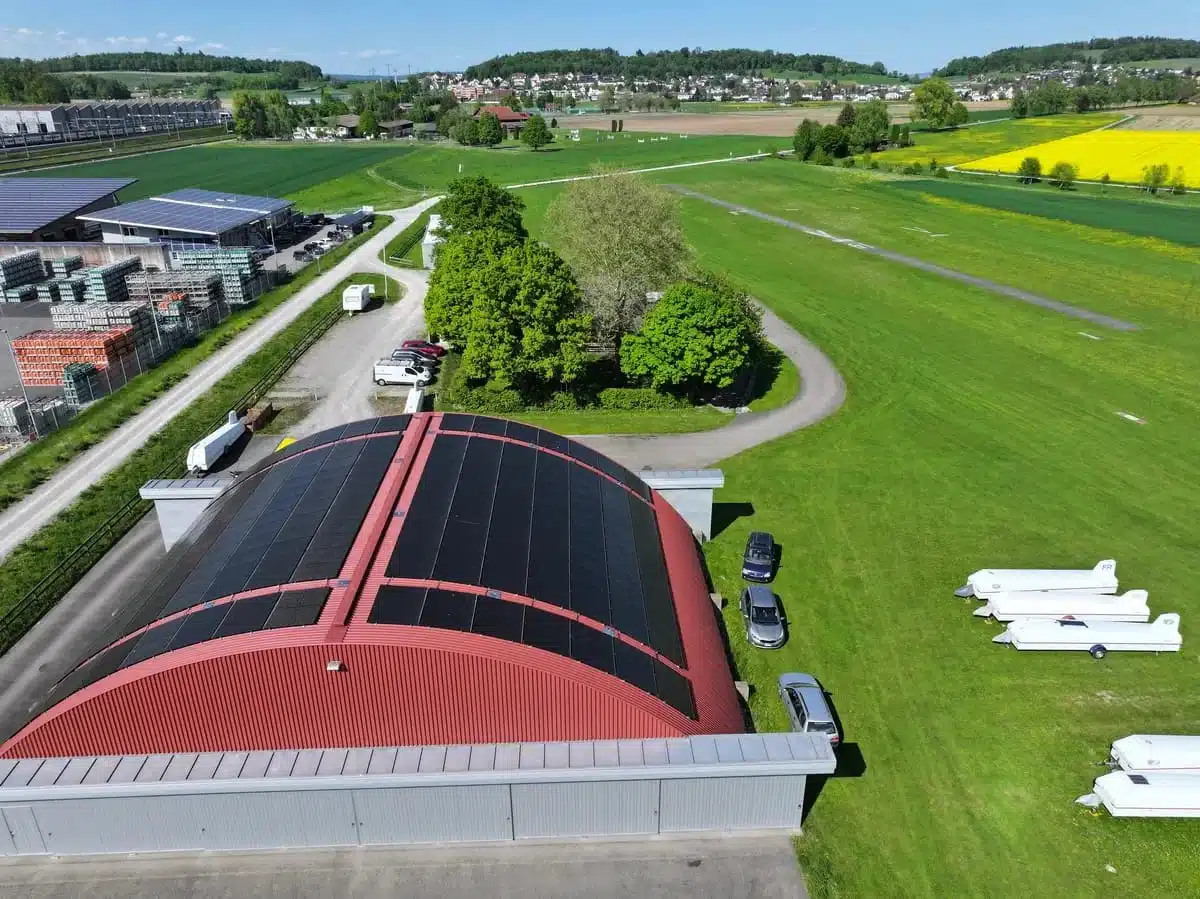
Large-scale system on hangar roof, Winterthur
- 89.6 kWp · 224 modules
- East-west layout on trapezoidal sheet metal
- Commissioned 2022
All completed systems with key data: Projects & references.
How a farm project in Thurgau works
- Guideline quote from your electricity bill and roof dimensions. The annual bill and the dimensions of the stable or barn are enough for an initial framework: system size, self-consumption, EIV or HEIV.
- Asbestos question and site visit. For Eternit and corrugated sheet roofs, a material sample first; then roof condition, substructure, service connection and cable routes on site.
- Concept and incentive route. Self-consumption with milking and cooling technology, or full export with HEIV – both routes calculated, plus LEG marketing if neighbours buy the power.
- Permit, connection, incentives. Notification procedure with the municipality, connection application to the municipal utility or Thurplus, incentive application to Pronovo before construction.
- Installation and electrical work. Installation scheduled between milking times and harvest, electrical installation and grid registration by our team with ESTI installation authorisation, acceptance.
- Operation. Monitoring set up, yield and self-consumption visible, responsibilities agreed in writing.
Thurgau in numbers: rank 3 for solar power from the farm
The federal public plant register shows where the farm system has long been standard – and Thurgau is at the very top in German-speaking Switzerland:
| Canton | Systems | Watts per capita | Rank (26 cantons) |
|---|---|---|---|
| Thurgau | 16’931 | 1’674 | 3 |
| Frauenfeld (town) | 1’025 | Ø 38.1 kWp per system | largest commercial and farming town in Thurgau |
| Canton of Zurich (comparison) | 32’829 | 566 | 24 |
Our own analysis of the SFOE register «Electricity production plants», data as of August 2026. All cantons: Photovoltaics Switzerland in numbers.
What this means: in Thurgau, the municipal utilities know the procedures, neighbours have practical experience, and anyone between Weinfelden, Amriswil and Lake Constance who still has an empty south-facing stable roof is in the minority. For fruit growing, there's a second reason: cold stores and CA stores need the most electricity when the sun is strongest – autumn storage falls in months that are still sunny. How cooling and sun fit together: Solar systems for cold stores.
Self-consumption or full export: EIV or HEIV?
On the farm, the consumption behind the roof decides the incentive route. Farms with daytime consumption almost always do better with the normal one-off feed-in incentive and self-consumption; for the barn roof without consumption, there is the high one-off feed-in incentive (HEIV) – a higher incentive rate in return for the obligation to export all power for 20 years. The HEIV question must be settled before implementation; re-categorising afterwards is laborious.
| Type of farm | Self-consumption without storage (empirical value) | What drives daytime consumption |
|---|---|---|
| Dairy farm with milking robot | 40–60 % | Milk cooling, milking technology, vacuum pump around the clock |
| Fruit and vegetable growing with cold storage | 60–80 % | Cooling load rises with the sun |
| Poultry and pig farming | 40–60 % | Ventilation, feeding, heating of the barns |
| Arable farming, hay drying | 20–40 % | Ventilation and drying in summer, otherwise little |
| Barn without consumption | under 20% | Full export with HEIV is the way to go here |
Empirical values as of September 2026; the farm's actual load profile is decisive. Incentive routes, LEG and Eternit in detail: Solar systems in agriculture.
Since 2026, there's a third route: in a local electricity community, the farm sells its power via the public grid to neighbours in the same municipality – an alternative to pure export for farms with a large roof and little consumption of their own.
The Eternit question: clarify first, then plan
Many farm buildings in Thurgau have corrugated sheets from the decades when asbestos was used. No reputable company mounts on asbestos-containing sheets; the route is professional remediation – ideally combined with the system in one project, because scaffolding and the roofer then come once instead of twice. With asbestos-free fibre cement, the condition of the roof decides. The assessment belongs at the start of every farm project: Photovoltaics on Eternit roofs.
What does a farm system cost?
Farm roofs are large and usually well pitched – the price per kilowatt falls with size:
| System size | Typical market guideline (fully installed, without storage) |
|---|---|
| ~30 kWp (shed, small stable) | CHF 1,400–1,700 per kWp |
| ~60 kWp (loose housing barn, barn) | CHF 1,500 per kWp and below |
| ~100 kWp (large farm building, fruit store) | CHF 1,100–1,400 per kWp |
Guideline values based on published Swiss market data, as of July 2026, fully installed, without storage, before incentives; the individual quote after a site visit is binding. Not included: roof renovation, asbestos disposal, scaffolding, changes to the service connection, lightning protection.
The federal one-off feed-in incentive is deducted from this – around CHF 360 per kWp up to 30 kWp and around CHF 300 per kWp above that, plus a base contribution (as of August 2026); for 100 kWp, in the order of CHF 30,000; correspondingly more on the HEIV route. The worked example for a dairy farm with 60 kWp and the ranges per farm type: Solar systems in agriculture. Financing and taxes from a business perspective: Financing a solar system as a business.
Incentives and feed-in in the Canton of Thurgau
Canton. There are no direct cantonal contributions per kWp in Thurgau – for solar power, the incentive programme refers to the federal government. There are still three side routes: battery storage with CHF 1,000 per system (from 10 kWh usable capacity; the 2026 annual quota was exhausted early, there is a waiting list), an extra CHF 20/m² for insulation combined with a PV system – relevant when renovating a stable – and municipal programmes; Frauenfeld, for example, automatically adds 30 percent to cantonal contributions. All details: Incentives in the Canton of Thurgau.
Feed-in. Thurgau is a patchwork of utilities: Frauenfeld, Kreuzlingen, Arbon, Amriswil, Weinfelden and many other municipalities operate their own utilities with their own tariffs – what counts for the calculation is the utility whose grid the farm is connected to. From 2026, Thurplus (Frauenfeld) switched from a fixed tariff to the quarterly reference market price, backed by the statutory minimum remuneration of 6.0 Rp./kWh for systems under 30 kW (6.2 Rp. for 30–150 kW without self-consumption); the guarantee of origin is sold separately there. Details: Feed-in tariff in Thurgau. The switch to the market model shifts the weight: today, the calculation is carried by self-consumption – milking, cooling, drying – or by the HEIV route for pure production.
Frequently asked questions
Does ecoEn build farm systems in Thurgau?
What does a 60 kWp system on a loose housing barn cost?
Is the empty barn roof without consumption worth it?
Can I have modules mounted on my old Eternit roof?
What does my municipal utility in Thurgau pay for solar power?
Are there cantonal incentives in Thurgau for a farm system?
When is it installed – between milking times and harvest?
Guides for farms
- Solar systems in agriculture: cost, incentives and rules for the farm
- Solar systems for cold stores
- Photovoltaics on Eternit roofs
- KLEIV or GREIV? The differences
- LEG: selling solar power to the neighbourhood
- Agri-PV: farming and electricity from the same field
- Incentives in the Canton of Thurgau
- Solar panels Thurgau: cost and incentives (residential)
Your electricity bill and roof dimensions are enough for an initial framework.
Send us your last annual bill and the dimensions of your stable or barn – we'll calculate system size, self-consumption, EIV or HEIV as a guideline quote. A direct specialist company, not a broker.