
Solar systems for apartment buildings, condominiums and ZEV in Zurich
Large roofs deserve a partner who has actually built large systems. ecoEn plans and installs PV systems for apartment buildings, condominium ownership, cooperatives, businesses and farms in the Zurich region – from 30 kWp systems to a condominium large-scale project with over 100 kWp, including a ZEV metering concept and resolution-ready documents for the owners' meeting. A direct installer, not a broker: planning, installation and grid registration from one hand. For commercial and industrial roofs without residential use, we have a separate page: Photovoltaics for business and industry in Zurich.
Built, not promised
Four real large-scale projects with key data – no stock images:
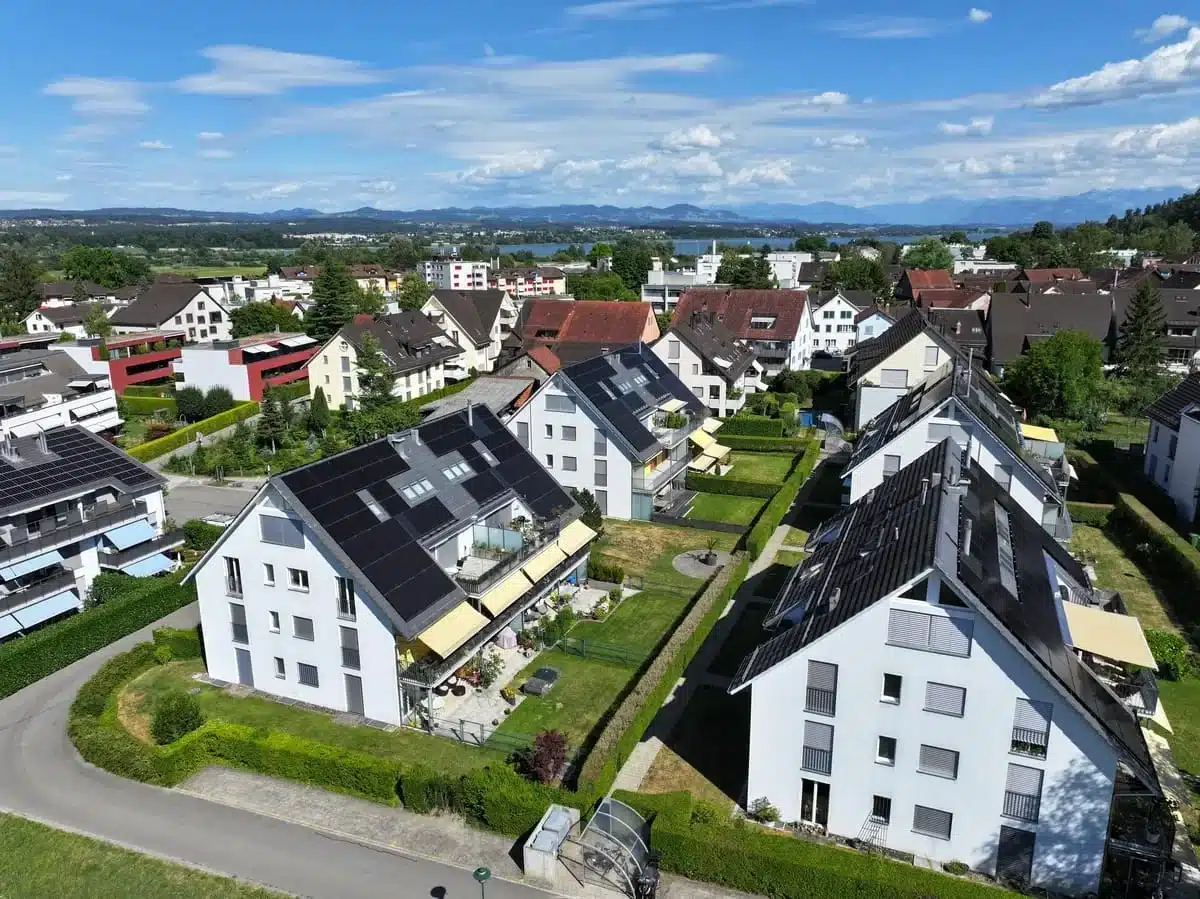
Condominium large-scale project, Fällanden
- over 100 kWp · 274 modules · 2 buildings
- ZEV with self-consumption optimisation · e-mobility with load management
- Commissioned 2023/2024
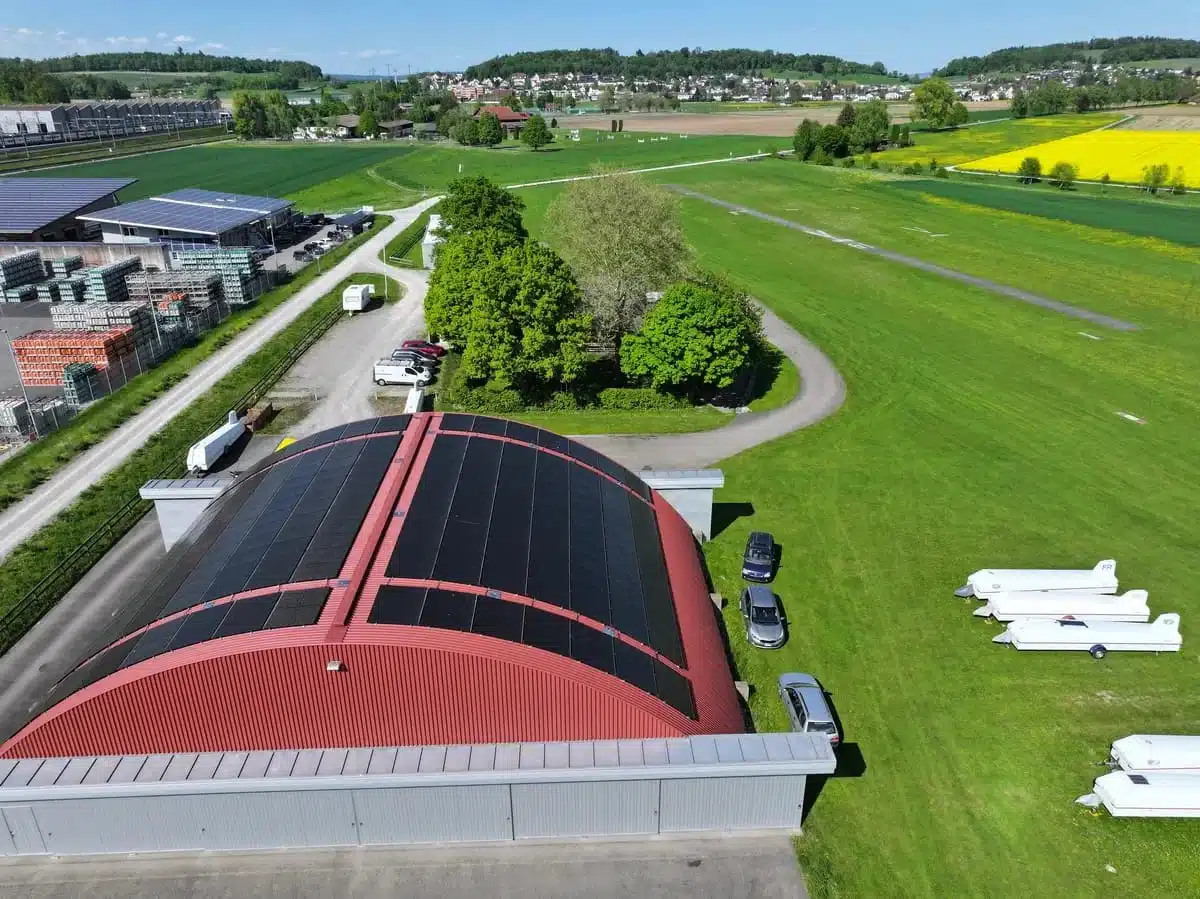
Winterthur gliding airfield
- 89.6 kWp · 224 modules
- East-west layout on an industrial roof
- Commissioned 2022

Farm with ZEV, Schneisingen AG
- 36.45 kWp · 90 modules
- ZEV with private metering
- Commissioned 2024
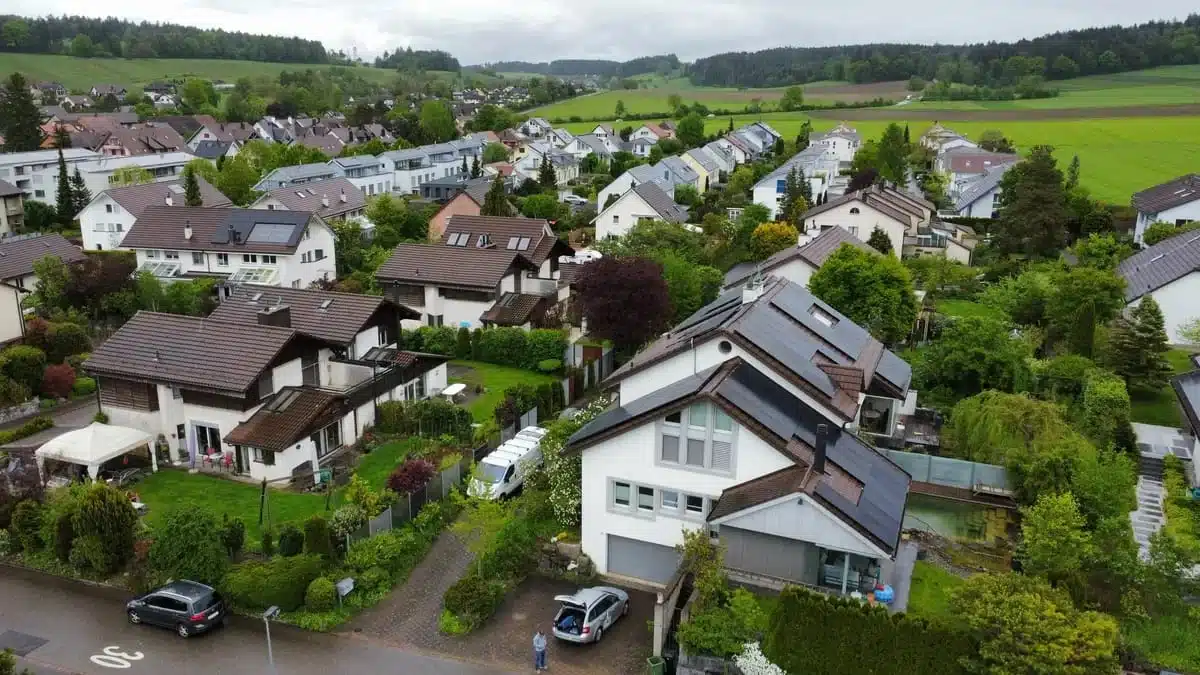
ZEV across two houses, Wiesendangen
- 44.15 kWp · 109 modules
- ZEV with 4 private meters
- Commissioned 2023
All completed systems with key data: Projects & references.
How your project gets approved – and onto the roof
- Potential analysis. Roof, service connection and consumption profiles – we calculate what the roof can do and what it costs.
- Resolution-ready documents. Technical report, quote with clear cost allocation and two financing options – prepared for the management and owners' meeting.
- Clarify the operating model. ZEV, vZEV or full export – with an honest comparison of what suits your property.
- Permit & incentives. Notification procedure or building application, incentive applications always before construction – we keep to the right sequence.
- Installation. Installation, electrical work, grid registration, acceptance – coordinated with the management and residents.
- Operation & billing. Monitoring set up, the right billing solution configured for the project, responsibilities agreed in writing.
Condominium ownership: the resolution is half the system
In a condominium association, solar projects rarely fail because of the technology – they fail at the meeting. A shared PV system usually requires the majority of all co-owners who at the same time represent the larger share of ownership quotas. That's exactly what we provide the foundation for: understandable documents, transparent cost allocation and answers to the questions that come up at the meeting. How the decision process works in detail: Solar systems in condominium ownership.
ZEV and vZEV: selling solar power to your own residents
Solar power from the shared roof is worth most when it stays in the building: in a self-consumption community, the parties buy the power directly – at a tariff that is attractive for tenants and profitable for the owners. We have built ZEV systems with private metering and know both routes: the classic ZEV with its own meters and the virtual vZEV via the grid operator's smart meters – often the easier entry point for existing buildings. We set up the right billing solution for the project – matched to the size and management of the property; roles are agreed in writing before construction. Which model suits your property: ZEV, vZEV or LEG?
From 150 kW: why self-consumption and ZEV pay off even more
A detail that's often overlooked with large roofs: the statutory minimum remuneration for export only applies up to 150 kW of system capacity. Above that, the floor disappears – remuneration follows the quarterly reference market price directly, without a safety net. Some grid operators now state this explicitly.
| System size | Reference market price Q2 2026 | Minimum remuneration? |
|---|---|---|
| Single-family home system (under 30 kWp) | around 6.00 Rp./kWh | yes, guaranteed by law |
| Large-scale system (over 150 kW) | around 3.90 Rp./kWh | no, pure market price |
Reference market prices according to the SFOE (Art. 15 EnFV), as of Q2 2026 – fluctuates quarterly and is not a fixed value for your system. Details and derivation: Feed-in tariff overview Switzerland.
As a result, a large system tends to earn less per kilowatt-hour than a small one as soon as it grows beyond 150 kW – precisely where the most electricity is produced. For commercial and apartment building roofs, this means: the economic lever lies not primarily in export, but in the self-consumption and ZEV described above.
What does a large system cost?
With large roofs, the price per kilowatt drops significantly – economies of scale are the economic trump card of every apartment building and commercial system:
| System size | Typical market guideline (fully installed, without storage) |
|---|---|
| ~30 kWp (typical apartment building) | CHF 1,400–1,700 per kWp |
| ~50 kWp | CHF 1,500 per kWp and below |
| ~100 kWp (commercial/large roof) | CHF 1,100–1,400 per kWp |
Guideline values based on published Swiss market data, as of July 2026, fully installed, without storage, before incentives; the project-specific quote after the potential analysis is binding. Federal incentives (Pronovo one-off incentive) and any municipal contributions are deducted; for systems without self-consumption, the higher HEIV may be interesting.
Depending on the property, there may also be: scaffolding/fall protection, changes to the main distribution board, ZEV metering and – for older roofs – the question of roof renovation before installation. These items belong individually in the quote, not in a lump sum. And for properties where external financing is to be considered: Purchase, rental or contracting compared.
For businesses without residential use, we have separate guides with worked examples: Solar systems for businesses and SMEs, Photovoltaics on industrial roofs, Solar systems for cold stores, Photovoltaics over the company car park and Solar systems in agriculture – and for financing, Purchase, leasing, contracting or roof rental from a business perspective.
A second use for the roof: charging infrastructure for employees and tenants
A large roof often serves more than just the building's electricity: company car parks and apartment building garages are the obvious second consumer. We plan charging infrastructure right from the start – from a single wallbox to load management for several charging points on the same service connection.
- Electrifying company car parks
- EV chargers in apartment buildings & condominiums
- EV chargers as a tenant: rights & procedure
- Load management: controlling multiple charging points
- Billing charging power: apartment buildings & employers
- Solar carport with charging station
What our quote includes – and what it doesn't
The most common worry before signing isn't the price but the question of what gets added at the end. That's why we show both.
Included: planning and design, materials (modules, inverter, mounting system, cabling), scaffolding, installation, the electrical connection by our own specialist company, commissioning and measurement, registration with the grid operator and the incentive application – we submit it for you.
Shown separately: anything added in individual cases appears as its own item in the quote, not in a lump sum. The most common case: if the existing meter distribution board – the fuse box – is not suitable for the system and needs to be adapted, we invoice this separately. Depending on the property, official fees and work provided by the client may also apply.
Payment in stages, linked to project progress. Under our terms and conditions (AGB), that's 30% on placing the order, 50% on delivery of the main components and 20% after commissioning and acceptance. We agree different terms on a project basis; the arrangement in your quote always applies.
Who is liable for what
After the company bankruptcies in the Swiss solar industry, this is the question that counts in the end – and it has three different answers:
- Product and performance warranties lie with the manufacturer of the modules, inverter and storage. A manufacturer's warranty is only ever as reliable as the manufacturer behind it – that's why, when choosing products, we also consider who will still be reachable if something goes wrong.
- The installation warranty lies with us: installation, electrical work, commissioning. That's the part we honour directly.
- Business liability insurance: as an installation company, we carry liability insurance.
In the event of a fault, you have one point of contact – us – regardless of whose component is affected.
Frequently asked questions
What majority does a condominium association need for a solar system?
How long does an apartment building solar project take?
ZEV or vZEV – which suits our building?
Do all tenants have to take part in the ZEV?
What does a solar system on an apartment building cost?
Does full export pay off instead of self-consumption?
Does ecoEn also offer contracting?
What does the 150 kW limit mean for feed-in remuneration?
Knowledge for decision-makers
- Solar systems in condominium ownership
- ZEV, vZEV or LEG?
- Forming a ZEV: the process
- ZEV in apartment buildings
- Solar systems for apartment buildings: the guide
- Storage in apartment buildings
- Commercial storage
- Feed-in tariff overview Switzerland
Does your roof have potential? We'll provide the figures.
Free potential analysis for apartment buildings, condominiums and businesses: feasibility, guideline costs, operating model and the path to the resolution – prepared for your management or meeting.