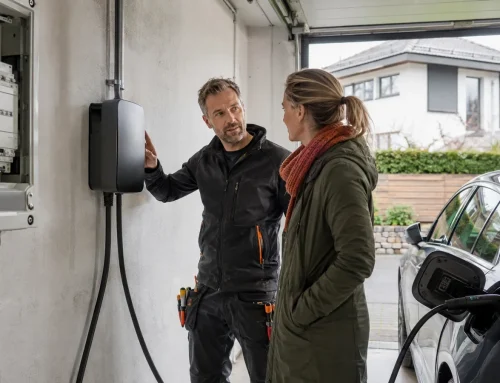
In the apartment building, the wallbox is less of a technical issue than an organisational one: the garage and house connection belong to everyone, so the solution requires a joint decision. The basic installation for all parking spaces with load management and billing per user has proven itself – individual island solutions «one after the other», on the other hand, reliably lead to a dead end because the house connection sets the limit. (As of: July 2026)

Key points in brief
- The garage and the house electrics are communal areas – in condominium ownership, the meeting has a say in the decision, not the individual party.
- The house connection is the physical limit: several unregulated wallboxes quickly overwhelm it – load management is practically mandatory in the apartment building.
- The basic installation (supply line and piping to all spaces) is the key: planned once, the system grows box by box.
- Every charging point needs a clean billing – a flat rate «via the general electricity» is not a long-term solution.
- Putting it on the agenda early pays off: the best time for the decision of principle is before the third electric car is in the estate.
Why is the apartment building the special case?
Because three things are shared that belong to one person alone in a single-family home: the parking area, the house electrics and the decision-making power. Technically, a wallbox in the apartment building is no different than in the single-family home – organisationally, however, every single box is connected to the joint house connection and mostly to communal components such as garage walls and riser zones.
Exactly from this arises the classic conflict pattern: the first party installs for itself, the second one too, for the third the electrician registers concerns about the connection – and from then on, individual solutions block each other. Whoever came first was lucky; whoever comes later pays for the conversion. This pattern can be avoided if the decision of principle is made before the third box instead of after it.
Who decides – and how does that work in condominium ownership (STWEG)?
In condominium ownership, the path leads via the meeting: wallbox installations touch communal parts, so the topic belongs as an agenda item on the invitation, neatly prepared with variants and costs. Which majority is necessary for which resolution depends on the specific design and the regulations – this is clarified by the management or a specialist; this guide does not replace legal advice. In the rental property, the ownership decides; how tenants proceed is covered in a separate article.
The practical advice for the meeting: do not let them vote on the individual box, but on the concept. A resolution of principle – basic installation for everyone, whoever charges pays for their box and their electricity – takes the edge off the topic because nobody pays for the neighbour's car and nobody has a worse hand later.
Why is the basic installation the key?
Because it builds the most expensive element – the path from the meter room to the parking spaces – only once. The basic installation typically includes the supply line from the house distribution board, the piping along all spaces and the preparation for the load management. After that, every single wallbox is a small, predictable step: mount the box, register it, charge.
| Island solutions «one after the other» | Basic installation + expansion as required | |
|---|---|---|
| Initial costs | low for the first one | higher, but shared |
| Costs per additional box | increasing, partly dismantling necessary | consistently low |
| House connection | becomes a point of contention | managed from the beginning |
| Fairness | first come, first served advantage | equal conditions for everyone |
| Future | Dead end from the third box onwards | grows with e-mobility |
Classification, as of: July 2026. Costs and distribution depend on the garage, distances and electrics – the quote after the site visit is binding.
What the incentives mean for the parking facility
In the Canton of Zurich, money depends on exactly this decision. The cantonal incentive programme pays CHF 500 per equipped parking space (up to 15 parking spaces, from the 16th another CHF 300) – so for ten spaces CHF 5,000, for fifteen CHF 7,500. Two rules from the regulations make the basic installation the setting of the course here:
- From two parking spaces equipped with electricity, the canton requires a local load management including communication connection. What is technically justified above is thus also a condition for incentives.
- Only a single application is permitted per parking facility; subsequent expansion applications are not permitted. Whoever equips four of twelve spaces today gets no more contribution for the later eight – the island solution therefore not only costs more to build, it also loses the incentives.
Added to this is the deadline: of the framework credit of 50 million francs, 96 percent was already claimed on 22 September 2026, and the programme ends at the latest at the end of 2026. Amounts, procedures and the question of who submits the application: Wallbox incentives in the Canton of Zurich.
Information according to the regulations and incentive brochure «Förderprogramm Ladeinfrastruktur» of the Canton of Zurich, July 2024 edition; as of: 22 September 2026.
The administration has a say in the decision – even if it does not own the car
In practice, almost every charging project in the apartment building runs via the property management: it sets the agenda item, procures the quotes, coordinates the clarifications with the grid operator and ultimately has to bring electricity and ancillary cost processes together. An application that is prepared without them rarely gets through.
What a meeting needs from experience to be able to decide at all: a technical report on the basic installation, the cost distribution with two financing variants, the statement on the load management – and the incentive deadline, because it determines the schedule. We put together a template ready for resolution for this; the template for the solar part in condominium ownership is available as a STWEG resolution folder.
How do load management and billing work?
Load management is not an option in the apartment building, but a prerequisite: the house connection is the limit, and as soon as several vehicles charge at the same time, a control system must distribute the available power – otherwise the main fuse will eventually do so. How static and dynamic load management work is in its own article; for the meeting, the core message is enough: with load management, everyone charges a little more slowly, but everyone charges reliably – and 11 kW per box is enough in everyday life anyway because cars are parked overnight.
Billing means: every charging point measures its consumption, and every party pays for its electricity. Modern wallboxes bring the measurement with them; depending on the solution, billing runs via the management, a service provider or directly via separate meters. What we advise against: the temporary measure «it just runs via the general electricity» – it is the birth of every subsequent distribution dispute. If the house produces its own solar power, for instance in the self-consumption community (ZEV), the charging current can also be integrated – a planning detail that belongs on the table early.
What does the step-by-step procedure look like?
First: assess demand – who drives electrically today, who is planning to? The answer regularly underestimates the future; it is planned for all spaces, built as needed. Second: have the specialist company check the house connection reserve and the paths – this results in the concept with variants. Third: agenda item with concept, cost division and operating rules (who pays for the box, electricity, maintenance?) in the meeting. Fourth: build the basic installation, have notifications to the utility carried out by the specialist company. Fifth: retrofit boxes individually whenever a vehicle arrives.
For larger properties with many charging points – businesses, large developments – this becomes a separate planning topic with professional operation; see the article Charging infrastructure for businesses.
The typical apartment building request does not reach us before the first wallbox, but after the second – when the third party requests and suddenly everyone realises that nobody thought of the big picture. Then the mood is tense and retrofitting is more expensive than necessary. The relaxed projects are those in which a forward-looking management has put the topic on the agenda before it was urgent: one concept, one resolution, and after that, every new box is a routine appointment instead of a meeting debate.
Frequently asked questions
Can a single condominium owner simply install a wallbox?
On communal parts, not on their own – the path leads via the meeting. The specific consent requirements depend on the regulations and design; clarify this with the management before quotes are obtained.
What if only one party drives electrically at all?
Even then, a look at the big picture is worthwhile: dimensioning and piping the supply line so that further spaces can follow suit costs little extra in the first project – and saves the community the later dismantling.
Is our house connection sufficient for several wallboxes?
Often yes – with load management, which distributes the power. Whether and how much reserve is available is checked by the specialist company; only then is a reliable statement possible.
How is the charging current billed?
Measured per charging point and charged to the respective party – via the ancillary costs statement, a billing service provider or separate meters. It is important that the measurement is part of the concept from the beginning.
Does the installation have to be reported to the utility?
Charging infrastructure is reported to the grid operator via the specialist company; in the case of higher outputs, the utility has a say in the design. The administration belongs in the hands of the installer – have the completed notifications confirmed to you.
Free initial consultation
Charging concept for the apartment building – before it is urgent.
We check the house connection and paths, calculate variants for the meeting and deliver the concept with which every subsequent box becomes routine. Free of charge and without obligation.
Prefer to talk? +41 78 830 83 35
Wallbox & charging solution for your home →
Swissolar-certified specialist company · ESTI installation authorisation (Art. 14 NIV) · in Zurich since 2017 · over 150 systems completed · a personal answer from the specialist company, no call centre
Sources: EnergieSchweiz (charging infrastructure in multi-party buildings), Swiss eMobility, ESTI.
Last updated: 9 July 2026 · Author: ecoEn editorial team