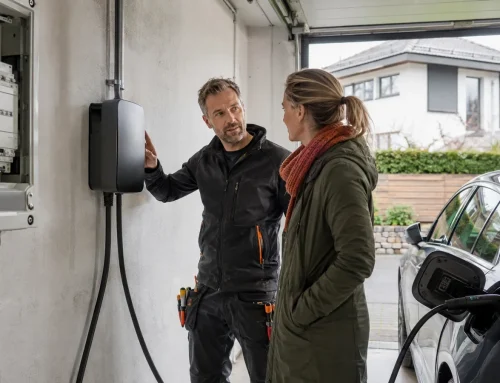
A wallbox is a high-performance continuous consumer and must therefore be reported to the local utility – before installation, not afterwards. In practice, the electrical specialist company handles the notification together with the installation; depending on the utility and charging power, it is a simple notification or requires a permit. Anyone who omits the notification risks trouble with the grid operator and problems in the event of damage. (As of: July 2026)
Key points in brief
- The wallbox belongs to the devices requiring notification: The utility must know which large consumers are connected to the grid.
- Notification is made before installation – the notification belongs at the beginning of the project, not at the end.
- In practice, the electrical specialist company handles the notification; the installation belongs in its hands anyway.
- Depending on the utility and power, a notification is sufficient, sometimes conditions apply – for instance regarding controllability.
- An unreported wallbox is not a trivial offence: In the event of a malfunction or damage, it becomes a problem.
Why do I have to report my wallbox at all?
For the same reason that a solar system needs a connection request: The grid operator is responsible for the stability of the local grid – and for that it must know what is connected to it. A wallbox draws power over hours that is on the scale of an entire household. If several of them charge at the same time in a neighbourhood, this noticeably changes the load on the lines.
The notification requirement is therefore not bureaucracy for its own sake, but the flip side of a shared grid. The utility uses the notifications to plan its grid: Where are charging points being added, where is reinforcement needed in the medium term, where are controllable loads present. For you as a customer, the notification is also the assurance that the installation was carried out officially and cleanly – a point that counts at the latest in the event of damage.
The fact that the notification is often forgotten has a simple reason: The wallbox feels like a household appliance – buy, connect, charge. In fact, it is a permanently installed high-power consumer whose installation belongs in expert hands; the basics for this can be found in the article Wallbox basics.
How does the registration work – and who does it?
The good news first: In practice, you hardly have to worry about it. The registration with the grid operator – depending on the utility referred to as a technical connection request or installation notification – is part of the standard scope of a professional installation. The electrical specialist company knows the forms and specifications of the local utility and submits them.
A prerequisite here is something that a layperson does not see: The installation may only be carried out by a company with an installation authorisation according to NIV – at ecoEn the own authorisation of the ESTI, verifiable in the ESTI directory. Anyone who has the wallbox connected by someone without this authorisation has not only a notification problem, but a liability problem.
The process in brief:
1. Planning: The specialist company checks the house connection and supply line – is the existing power sufficient, or is load management needed? 2. Notification to the utility: before installation, with details on charging power, location and controllability. 3. Possible feedback from the utility: depending on power and grid situation, with conditions.
A second application that is often forgotten: In the Canton of Zurich there is an incentive contribution for charging infrastructure, and there the sequence decides. From five parking spaces, the incentive application must be submitted before the start of construction – for up to four parking spaces, it is sufficient up to six months after completion. We clarify both together with the registration: Wallbox incentives in the Canton of Zurich. 4. Installation and completion notification by the licensed company.
The timing is important: before installation. As with the solar system – the notification is not retrospective paperwork, but part of the planning. It is no coincidence that exactly this point appears in the list of the most common wallbox planning mistakes: The forgotten notification is a classic.
What do the utilities require – and what happens without notification?
The requirements differ depending on the grid operator, but follow a common pattern:
| Aspect | Typical handling |
|---|---|
| Small charging power | simple notification |
| Higher charging power | Notification, partly with permit and conditions |
| Controllability | increasingly required or desired (load management, ripple control) |
| Multiple charging points | Overall concept with load management |
Orientation, As of: July 2026. The utility regulations of your grid operator are decisive – the specialist company knows the local practice.
A trend is clearly emerging here: The utilities are increasingly interested in the controllability of the charging points. A wallbox that can be briefly throttled during grid bottlenecks is a completely different participant for the grid than one that stubbornly draws full power. Some utilities attach requirements to this, others reward controllable charging via tariffs – the details are regulated by the utility regulations of the respective utility.
And without notification? Formally, there is then an unnotified installation. This is not necessarily noticed immediately – but at the latest during a fault, a meter replacement, a periodic inspection or a claim, the gap becomes visible. The consequences range from retroactive regularisation to unpleasant discussions with insurance and grid operator. The effort of the proper notification procedure is negligible in comparison – there is simply no good reason to skip it.
We almost never encounter the forgotten wallbox notification with our own installations – but regularly with systems that we later expand or check. The pattern is always the same: the box was «quickly connected» at some point, often in the course of buying a car, and nobody thought about the utility. At the next point of contact with the utility – meter replacement, solar system, connection request – the question arises as to what is hanging in the basement. Our recommendation is unspectacular: catch up on the notification, document it properly, done. And for every new installation, the notification belongs in the same week as the order – not in the week after assembly.
Frequently asked questions
Do I also have to notify a simple charging station at the socket?
Continuous charging at the household socket is not recommended anyway – the socket is not built for hours of full load. Anyone who regularly charges at home installs a wallbox, and this is subject to notification. For details on the distinction, a conversation with the electrical specialist company helps.
Who is responsible for the notification – me or the installer?
Ultimately, the ownership of the installation is responsible; in practice, the notification is carried out by the electrical specialist company. With a serious installation, it is part of the order. If in doubt, ask – «is the notification to the utility included?» is a justified quote question.
Can the utility reject my wallbox?
For a single charging point at a single-family home, this is the great exception. However, the utility can impose conditions – for example regarding charging power or controllability – if the grid situation requires it. That is exactly what the notification is for: problems are solved in the planning stage, not after assembly.
Do I also have to re-notify the wallbox in the event of a change of tenant or sale?
The installation remains notified – it belongs to the building. It is important that the documentation (notification, installation certificate) is kept with the house files and handed over upon sale, like all documents relating to the electrical installation.
Does the notification of the wallbox belong with the solar system registration?
It is handled by the same utility, but as a separate point: the solar system is notified as a producer, the wallbox as a consumer. If both are installed together, the specialist company bundles the notifications – one more reason to plan the system and charging point together.
Free initial consultation
Wallbox planned? Notification included.
At ecoEn, utility notification, professional installation and coordination with your solar system are part of the package – you charge, we take care of the rest.
Prefer to talk? +41 78 830 83 35
Have a wallbox installed – charge with solar power →
Swissolar-certified specialist company · ESTI installation authorisation (Art. 14 NIV) · in Zurich since 2017 · over 150 systems completed · a personal answer from the specialist company, no call centre
Sources: Utility regulations and connection conditions of the regional grid operators, low-voltage installation regulations, practical experience of ecoEn GmbH, Zurich region.
Last updated: 9 July 2026 · Author: ecoEn editorial team