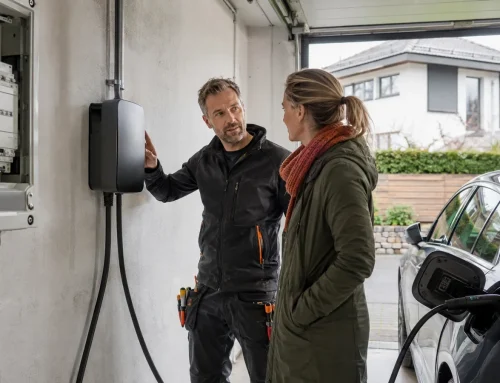
An e-car that charges at home with solar power is one of the biggest self-consumption levers of all – provided it is at the house during the day. The technology for this is a controllable wallbox that preferentially charges with surplus. Therefore, the hardware is less decisive than your everyday life: if you only charge at night, you charge grid power – even the most beautiful roof won't change that. (As of: July 2026)
Key points in brief
- Depending on the mileage, an e-car increases electricity consumption by a four-figure kWh amount per year – and therefore belongs in the planning of the system size.
- Surpslus charging means: the wallbox charges when the system delivers more than the house needs – and throttles when a cloud passes. The control system takes care of this, not you.
- The honest prerequisite is parking times during daylight: home office, second car and weekends benefit the most, the classic commuter the least.
- The e-car charges directly from the system – not via the home battery. Filling one battery from another only costs losses.
- Wallbox installation is the electrician's job and is reported to the grid operator; whoever plans the PV system lays the empty conduit at the same time.
Why do e-cars and solar systems belong together?
The e-car is – alongside the heat pump – the largest new electricity consumer that a household can get: depending on the mileage, a four-figure kilowatt hour amount per year. This consumption comes one way or another; the only question is where the electricity comes from. From the public fast charger it is most expensive, from the house connection it is cheaper – and from your own roof it is cheapest: self-consumed solar power is two to four times as valuable as fed-in power, and hardly any consumer can take off as much of it on a sunny day as a car with a half-empty battery.
Added to this is the planning effect in the other direction: anyone who builds a solar system and drives or considers an e-car factors the future consumption into the system size – otherwise the roof is dimensioned for a house that will soon no longer exist. The combination is therefore not an additional option, but part of the basic planning – in both directions.
The fundamental question: when is your car at home?
Before it gets to technology, the most uncomfortable question belongs at the beginning, because it decides the whole benefit: is the car at the house during the day? The system produces between morning and evening – a car that is in the company car park during this time cannot charge solar power at home. No wallbox changes that.
Three profiles, three honest answers:
Home office, second car, pensioner household – the ideal cases. The car is regularly at the house over midday, the surplus charging takes effect almost daily. Here the e-car is often the biggest self-consumption lever of all – bigger and cheaper than a battery.
The weekend charger. The car commutes during the week, but charges on Saturday and Sunday with the sun. This is less than the ideal case, but more than nothing: two charging days a week with surplus are a relevant amount over the year – and cost no adjustment other than the habit of plugging in the cable at the weekend.
The classic commuter with night charging. Here the car mainly charges grid power – at the night tariff, which is fine, but has little to do with solar. To be honest: for this profile, the PV-controlled wallbox is not a must. Other ways then become interesting – charging at work, where more and more companies offer charging points, or a battery that buffers the daily surplus for night charging; whether this pays off is a separate consideration.
How exactly does surplus charging work?
The mechanism is the same as with all self-consumption levers, only automated: a PV-controlled wallbox monitors how much power the system is currently delivering beyond the house consumption – and charges exactly with this surplus. If a cloud passes, it throttles; if the sky clears, it increases. You plug in the car and leave the rest to the control system.
Two operating modes have proven themselves, and good systems master both:
- Pure surplus charging for days without time pressure: only what the roof yields is charged. On cloudy days it takes correspondingly longer – if that doesn't bother you, you drive maximally solar.
- Target time charging for everyday life: "I want 80 per cent tomorrow at 7 a.m." The control system uses as much surplus as possible and fills the gap in good time with grid power. This is the mode that reconciles solar optimisation and everyday practicality.
Two physical limits belong to the honest description. Firstly, the lower limit: vehicles have a minimum charging power below which charging cannot be throttled – with a small surplus (transition period, mixed weather), pure surplus charging therefore pauses or mixes in grid power. Secondly, the winter: as with the heat pump, it also applies here that the dark months deliver little surplus – solar charging is a summer and transition period programme, winter charging remains predominantly grid power. Over the year, the balance still remains clearly positive; only the expectation "always solar" would be incorrectly calibrated.
Which wallbox is needed for this?
The short answer: a controllable one – the rest is secondary. For surplus charging to work, the wallbox and the system must talk to each other: either directly with the inverter system or via an energy management system. This communication capability is the one feature that should not be skimped on; it determines whether the wallbox is a solar charging system or just a better socket.
When it comes to power: wallboxes up to 11 kW are common, and this is almost always sufficient in a single-family home – a car that is parked overnight or for an afternoon needs no rush. We advise against 22 kW boxes in most single-family homes: the additional costs and the higher demands on the installation bring hardly anything in everyday life if the car is parked for hours anyway – the same logic as for company car parks, only one size smaller.
On the formalities: the wallbox is installed by the electrician, and the installation is reported to the grid operator – this is handled via the specialist company, as with the system itself. And anyone who is just planning the solar system, even without an e-car today: an empty conduit to the parking space and a reserve at the meter box cost little in the ongoing project – retrofitting as a separate construction site costs significantly more. What the wallbox itself costs is covered in a separate article.
Wallbox, battery, heat pump: who gets the surplus?
As soon as several large consumers are attached to the house, the distribution question arises – and it has a proven answer:
The e-car charges directly, not via the home battery. The car itself is the largest battery in the household; filling it from the basement battery would mean transferring with losses at every step. The control system therefore prioritises: as long as the car is plugged in and there is a surplus, it goes there – the home battery takes over what is left afterwards, for light and appliances in the evening. Anyone planning both therefore does not dimension the battery larger "because of the e-car", but calculates the consideration cleanly.
The car shares the day with the heat pump. Both want the midday surplus; an energy management system coordinates this according to your priorities – usually hot water first (smaller, quickly done), then the car. And at the capacity limit, the reminder from the combination planning helps: heat pump plus wallbox can challenge older house connections – the electrician checks the reserve, a load management system prevents the simultaneous maximum.
And bidirectional? The car as a battery for the house is technically on the rise, but not yet a broad standard – vehicle, wallbox and billing must match. Anyone planning today treats the e-car as a consumer and keeps the option open; more on this in the battery guide.
Does solar charging pay off?
The calculation is pleasingly simple, because the expensive part – the car – is there anyway: every kilowatt hour charged from the roof replaces grid purchase and is therefore worth the difference between your purchase tariff and your feed-in tariff. The additional costs of solar capability are limited to the controllable wallbox and at most the energy management system – a one-off, while the benefit recurs with every sunny charging day.
How much comes out of this depends almost entirely on the parking time profile – which is why this question is at the beginning of this guide and every serious consultation. A blanket savings figure would be dubious; the honest statement is: with the right profile, the e-car is one of the most effective self-consumption levers there is – and with the commuter profile it is not, no matter what the brochure promises.
The wallbox question now comes up in practically every PV consultation – often before we ask it. What is striking is how strongly satisfaction is later sorted according to the everyday profile, not the technology: the most enthusiastic feedback comes from households with a home office or second car, where the car practically only charges from the roof for weeks in the summer. The disillusioned ones come from commuters who were promised a "you then charge for free with the sun" somewhere along the way – at eight in the evening the roof simply doesn't deliver anything. That is why for us the question "When is the car at home?" comes before every wallbox recommendation. And a second habit has proven itself: to lay the empty conduit to the parking space with every system planning – even for customers who "certainly never" want an e-car. A few years later, we have often enough been there again.
Frequently asked questions
Can I also charge the e-car at a normal socket?
As an occasional solution yes, as a permanent solution not recommended: household sockets are not built for hours of full load, and the charging losses are higher. For everyday life, a professionally installed wallbox belongs at the house – for surplus charging anyway, because the socket cannot be controlled.
Do I need a permit for the wallbox?
The installation is the electrician's job and is reported to the grid operator; depending on the utility, there are specifications for registration and controllability. For you, this practically means: the specialist company handles the formalities – simply ask whether the notification is included in the scope of services.
How much does the car charge in winter with solar power?
Little – the dark months deliver hardly any surplus, the winter charging comes predominantly from the grid. Solar charging is a summer and transition period programme; calculated over the year, the effect still remains significant, because the sunny half of the year can cover the majority of the charges with solar.
Is a 22 kW wallbox worth it?
Rarely in a single-family home: a car that is parked overnight or for an afternoon does not need double the power – and for surplus charging it is even counterproductive, because the roof surplus is rarely that high. 11 kW with good controllability beat 22 kW without – in almost every everyday scenario.
Can the e-car supply my house with electricity?
Bidirectional charging makes this possible in principle, but is not yet a broad standard – it requires a suitable vehicle, the right wallbox and clarified billing. Anyone planning today calculates the car as a consumer and keeps the option open; the capability cannot be retrofitted through the wallbox alone.
Does my solar system have to be larger if an e-car comes?
Usually yes – the additional annual consumption is four figures and belongs in the dimensioning, ideally already during planning. How the future demand flows into the system size is shown step by step in the article on system size.
Free initial consultation
Roof, wallbox and control from a single source.
We plan the system with the car in mind right away: appropriate size, controllable wallbox, empty conduit in the right place – and an honest answer as to what your everyday profile really yields.
Prefer to talk? +41 78 830 83 35
Wallbox & charging solution for your home →
Swissolar-certified specialist company · ESTI installation authorisation (Art. 14 NIV) · in Zurich since 2017 · over 150 systems completed · a personal answer from the specialist company, no call centre
Sources: EnergieSchweiz (electromobility and photovoltaics, basics); empirical values from the planning and installation practice of ecoEn GmbH, Zurich region.
Last updated: 9 July 2026 · Author: ecoEn editorial team