
The heat pump is the largest electricity consumer in the house, the solar system the cheapest electricity supplier – together they are the economic heart of a modern home. For the combination to deliver on its promise, three things are needed: a PV system that accounts for the additional consumption, a control system that shifts the heat pump to sunny hours – and realistic expectations for the winter. (As of: July 2026)
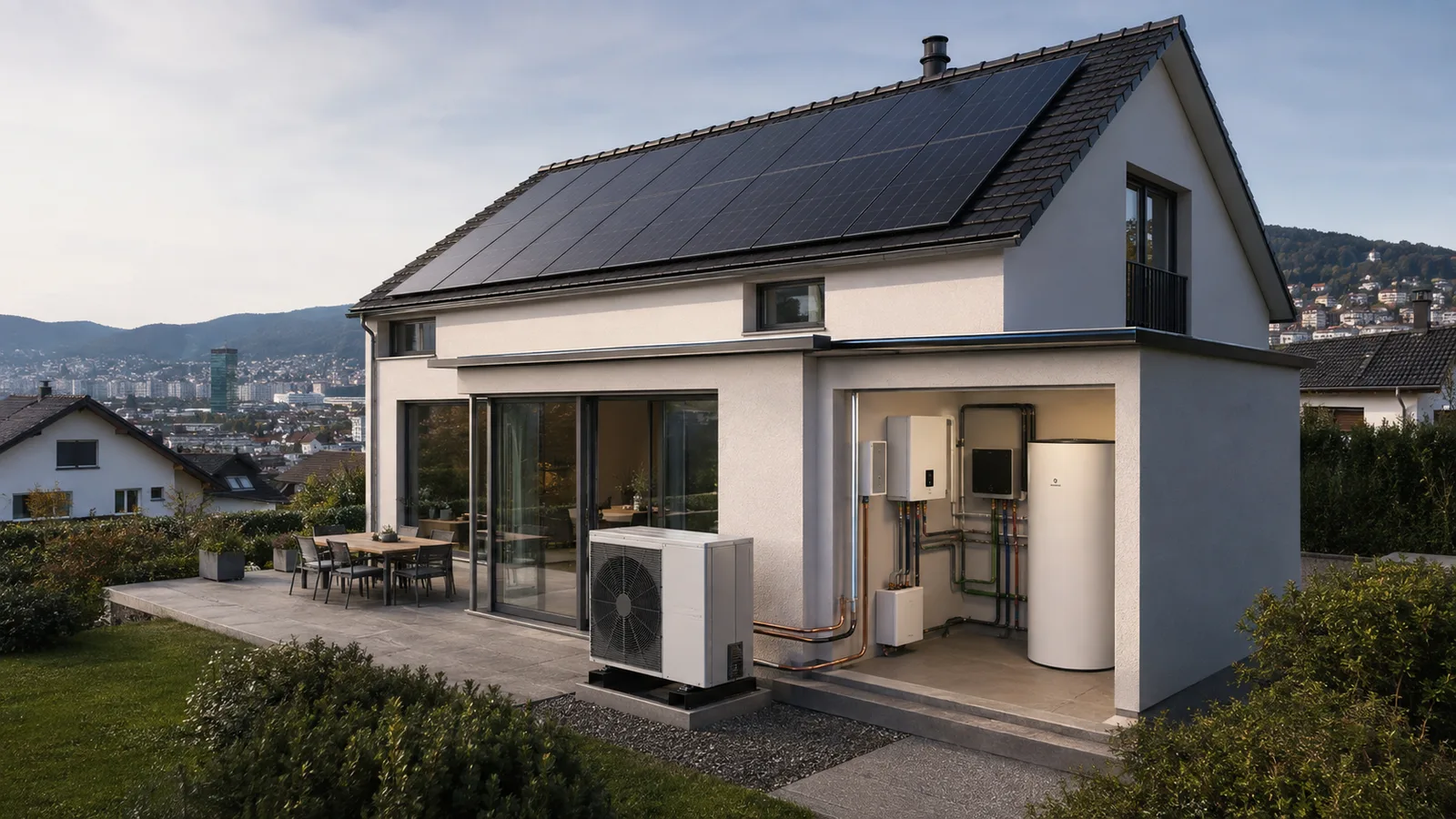
Key points in brief
- A heat pump increases the electricity consumption of the house as a guideline value by several thousand kilowatt hours per year – the PV system should be planned correspondingly larger.
- The value of the combination lies in self-consumption: self-generated electricity is worth two to four times as much as fed-in electricity, and no consumer can take up as much of it as the heat pump.
- The balance only remains honest with the winter reservation: when the heat pump needs the most, the system delivers the least. The combination is still worthwhile – but over the year, not in January.
- The control system makes the difference: charging hot water and heating buffer at midday instead of in the evening – an energy management system does this automatically.
- The best time for the combination is the heating replacement: electrician, planning and incentive applications can be bundled.
Why do heat pump and photovoltaics go so well together?
The logic is quickly told. A heat pump heats with electricity – efficiently, because it turns one kilowatt hour of electricity into a multiple of heat, but the electricity still has to come from somewhere. If it draws it from the grid, you pay the full supply tariff. If it comes from your own roof, it only costs you the lost feed-in tariff – and exactly this difference makes self-consumed solar electricity two to four times as valuable as fed-in electricity.
Now, the catch with any solar system is that the electricity comes when it comes – and not when the TV is on. A household alone therefore rarely manages to consume a large part of the production itself. The heat pump changes the game: it is the largest single electricity consumer in the house, it runs over many hours instead of in short peaks, and – crucially – its consumption can be shifted in time because the house and the hot water cylinder hold heat for hours. No other consumer brings these three characteristics together.
Therefore, the combination is not an eco-coincidence, but the economic core of many well-planned systems: the heat pump transforms solar electricity, which would otherwise have flowed cheaply into the grid, into heating and hot water – and at the same time lowers the most expensive item on the electricity bill.
The honest annual balance: summer delivers, winter consumes
Before we get into optimising, a reservation belongs on the table that brochures like to leave out: heat pump and solar system have opposing annual curves. The system delivers the most between April and September – the heat pump needs the most between November and February, when production is at its lowest. Anyone who imagines the combination as «heating with own solar electricity, all year round» will be disappointed by the first of January.
What the combination actually achieves is distributed differently over the year:
- In the summer half-year, the system largely covers the hot water – the heat pump produces domestic hot water almost for free, day after day.
- In the transition period – spring and autumn, when heating is needed and the sun is already or still delivering – the combination plays at its strongest: heating operation with usable production.
- In deep winter, the system helps out on clear days, nothing more. The majority of winter electricity remains grid supply – slightly less with a battery, but no home battery bridges the winter.
Calculated over the year, the balance remains clearly positive, and for an often overlooked reason: the fed-in summer surplus is also worth money, and the avoided supply in the transition period and summer hits exactly the months in which the heat pump would otherwise run at the medium supply tariff. It is just that the benefit is distributed differently than intuition expects – and a serious consultation says this before signing, not afterwards.
How large should the PV system with a heat pump be?
The short answer: larger than the current electricity consumption suggests – and when in doubt, as large as the roof reasonably allows.
For context, the guideline values from system planning: A single-family home without a heat pump and electric car is often around 4,000 to 5,000 kWh annual consumption. A heat pump increases the requirement as a guideline value by several thousand kilowatt hours – depending on the building, insulation and system. With the rule of thumb of around 1 kWp per 1,000 kWh annual consumption, the suitable system thus quickly grows by several kilowatts peak compared to planning without a heat pump.
Two planning rules have proven themselves here:
Plan for the future house, not the current one. Anyone considering a heat pump «in a few years» is better off calculating it into the system size today – adding modules later is more expensive than sizing it correctly right away. The same applies to the electric car.
Think of the roof as full. The additional costs per additional kWp decrease with size, and a surplus is not a loss – it is remunerated. In addition, in combination with a heat pump, additional production is more likely to find a consumer in your own house than with a pure household system.
This can only be calculated concretely on the property – with consumption, roof area and heating system. The method for this can be found in the article calculating PV system size; for the combination, it simply applies: do not forget the heat pump requirement.
How does the solar electricity get into the heat pump? The control system
Without a control system, the system and heat pump only share the house by chance: the pump starts up when the thermostat calls – maybe at midday, maybe at midnight. The combination begins to work when someone ensures that the two meet. Three levels, ordered by effort:
Level 1: Time programmes. Shifting the hot water preparation – the easiest item to shift – to the midday hours instead of the early morning. Practically all heat pumps can do this ex works, it costs nothing and works every sunny day.
Level 2: Solar-guided control. Many modern heat pumps can be controlled by the inverter or an energy management system and preferably run when there is a surplus – they then raise the hot water or buffer temperature when the system is delivering. The house becomes a heat storage unit: the energy is stored as heat at midday and consumed in the evening, without a battery. Whether your pump can do this is in the data sheet – for new purchases, controllability belongs on the list of requirements.
Level 3: Energy management with forecast. Systems that incorporate weather forecasts and consumption patterns plan the day ahead – for example, only charging the hot water around midday because the sun is coming. This is the advanced level; it is especially worthwhile when several large consumers (heat pump, wallbox, battery storage) need to be coordinated.
Remarkable about this list: the largest part of the effect is in the first two levels, and both are cheap. The sequence coincides with the general self-consumption logic – first behaviour and control, then investments. Incidentally, a battery storage competes less with the heat pump than many think: the pump uses the surplus as heat, the battery saves the rest for light and appliances in the evening. Anyone considering both plans the battery after the heat pump control, not before it.
What does the combination mean for electricity tariff and grid connection?
The heat pump not only changes consumption, but also the relationship with the grid operator – three points belong on the radar:
The heat pump tariff. Many utilities have discounted tariffs for heat pumps, sometimes linked to blocking periods during which the utility may control the pump remotely. How these models work and what changes in 2026 with the new flexibility regulation can be found in the article heat pump and electricity tariff. Important for the PV combination: a separately metered heat pump tariff and the solar-guided control system can get in each other's way – this needs to be clarified before installation, not afterwards.
The meter. Depending on the tariff model, the heat pump runs via its own meter or the house meter; with the Smart Meter, the measurement data becomes available exactly to the quarter of an hour – the basis for any intelligent control system.
The connection capacity. Heat pump plus wallbox plus continuous flow water heater can push older house connections to the limit. That is no reason to worry, but a reason to plan: the electrician checks the reserve, and load management prevents everything from drawing power at the same time.
Planning in practice: sequence, permit, incentives
The most common trigger for the combination is the heating replacement – the oil or gas heating is at its end, the heat pump is coming, and the roof question arises at the same time. This is also the best moment: planning, electrician and applications can be bundled, and in the Canton of Zurich the Energy Act for heating replacement leads to clear requirements for the new heating system anyway.
Administratively, the two projects run separately, but in parallel:
| Topic | Heat pump | Solar system |
|---|---|---|
| Procedure | mostly notification procedure, noise certificate | mostly notification procedure (depending on the municipality) |
| Location questions | Noise and distances | Roof layout, statics |
| Incentives | cantonal programmes, substantial in Zurich | One-off feed-in incentive Pronovo, partly municipality |
| Taxes | mostly deductible as maintenance/energy-related measure | likewise – details |
Simplified overview, As of: July 2026. The provisions of your municipality, the canton and Pronovo are decisive.
Incidentally, an obligation to build the solar system at the same time does not arise with a pure heating replacement – the legal requirements concern the heating system itself. The combination remains an economic decision, not a regulatory one. And as for the sequence, if both cannot be done at the same time: first the project with the time pressure. A dead heating system does not wait; a roof does not run away. Conversely, anyone who builds the system first simply plans for the future heat pump consumption – see above.
Is the combination economically worthwhile?
The building blocks of the calculation are known after the previous chapters: the heat pump significantly raises the self-consumption of the system – especially in the transition period and summer –, every kilowatt hour shifted in this way is worth the difference between the supply and feed-in tariff, and the control system for it costs little. Added to this are incentive funds on both sides and the tax deduction.
We deliberately do not give a blanket amortisation figure – it would depend on the building, insulation, tariff area and consumption profile and would be wrong for your house. What can be said: the combination improves the calculation of both investments. The solar system gets a major consumer for its electricity, the heat pump a cheaper energy price for part of its consumption. Anyone who is planning both anyway gives away money with separate planning – and anyone who is only planning one keeps the other open with little effort: the system through generous sizing, the heat pump through ex works controllability.
For us, the classic path to the combination does not lead via solar consulting, but via the broken heating: the heating replacement has been decided, and at some point in the conversation the sentence falls «while we are at it – what about the roof anyway?» From a project perspective, this is the best sentence of the entire undertaking. Because with the heating replacement, the electrician is in the house anyway, the meter box is touched anyway, and the incentive applications are running anyway – the solar system docks onto a building site that already exists. What we have taken away from these projects: today we ask the question about the controllability of the heat pump in every initial consultation, even if the PV system comes «perhaps later». A tick in the data sheet costs nothing at the time of purchase – not having ticked it retrospectively costs half the combination.
Frequently asked questions
Can the heat pump run entirely on solar electricity in winter?
No – in deep winter the system delivers the least, while the heat pump needs the most. On clear winter days the production helps out, but the majority remains grid supply. The strength of the combination lies in the transition period and summer; calculated over the year the balance remains clearly positive.
Does the combination also work with my existing heat pump?
Basically yes – every heat pump consumes solar electricity as soon as it is there. For the active control system, it depends on whether the pump is controllable; on many newer models this can be retrofitted or at least approximated via a time programme. A specialist company clarifies this based on model and year of construction.
What first: heat pump or solar system?
If both are pending: plan together – this saves electrician, planning and duplicated efforts. Otherwise: first the urgent thing. A defective heating system takes priority; the solar system can be added at any time, if its future consumer has already been calculated in.
Do I additionally need a battery storage?
Not necessarily – the heat pump with hot water cylinder takes over a part of the storage function thermally and significantly more cheaply. A battery storage supplements the combination for the evening consumption of light and appliances; sensibly calculated it comes after the heat pump control system, not instead of it.
Do I lose the cheap heat pump tariff if I use solar electricity?
Usually not – but tariff model, meter concept and solar control system must fit together, especially for separately metered heat pumps with blocking periods. Clarify the interaction before installation with the utility or the installer; the models differ depending on the grid operator.
Do I have to build a solar system when replacing a heating system in the Canton of Zurich?
No – the requirements for heating replacement concern the heating system (replacement with climate-neutral solutions, with defined exceptions), not the roof. Solar obligations apply separately and primarily for new buildings. The combination remains voluntary – and is worthwhile precisely because it can be freely optimised.
Is it worthwhile combining a heat pump with a solar system in Switzerland?
Yes, in most cases – with an honest limitation. The heat pump is the largest electricity consumer in the house and makes the solar electricity more valuable because more of it is self-consumed instead of being fed in at the low feed-in tariff. Over the year, the system covers a noticeable part of the heat pump electricity, but in winter only a small one; the exact balance is in the article above. Economically, the difference between your electricity price and the feed-in tariff counts – the larger it is, the more clearly the combination pays off.
Free initial consultation
Heating replacement, roof – or both together?
We plan the heat pump and solar system from a single source: coordinated sizing, control system from day one, and all applications and incentive applications included.
Prefer to talk? +41 78 830 83 35
Swissolar-certified specialist company · ESTI installation authorisation (Art. 14 NIV) · in Zurich since 2017 · over 150 systems completed · a personal answer from the specialist company, no call centre
Sources: EnergieSchweiz (heat pumps and photovoltaics, basics); Swiss Heat Pump Association FWS; Pronovo (one-off feed-in incentive); empirical values from the planning and installation practice of ecoEn GmbH, Zurich region.
Last updated: 9 July 2026 · Author: ecoEn editorial team