
What a heat pump costs depends on the system type – and on what the quote actually covers. SwissEnergy's official reference figures for a single-family home are CHF 45,000 to 60,000 for an air-to-water heat pump and CHF 55,000 to 80,000 for brine-to-water with a ground probe – each including installation, storage and hydraulics. Noticeably lower offers aren't automatically wrong: they usually cover a smaller scope of work. Cantonal incentives are deducted from the gross cost – depending on the canton and system, anywhere from zero to over CHF 20,000. The exact price is decided at the building. (As of July 2026)
Key points in brief
- The system type determines the price: air-to-water is cheaper, brine-to-water with a ground probe more expensive.
- Official reference (SwissEnergy): air-to-water CHF 45,000–60,000, brine-to-water with ground probe CHF 55,000–80,000 – including storage and hydraulics.
- Lower market offers often cover less – compare line items, not final totals.
- The incentive depends heavily on the canton: from zero (air-to-water in Thurgau) to over CHF 20,000 (ground probe in the Canton of Zug).
- The industry's order books are well filled – anyone planning a heating replacement is better off enquiring early.
What does a heat pump cost by type?
The biggest cost difference isn't the brand, but the system – specifically, where the heat pump draws its ambient heat from. The article Air-to-water or brine-to-water explains the technical differences; for cost, the basic rule is: air is free and easily accessible, ground heat needs a borehole – and that costs money.
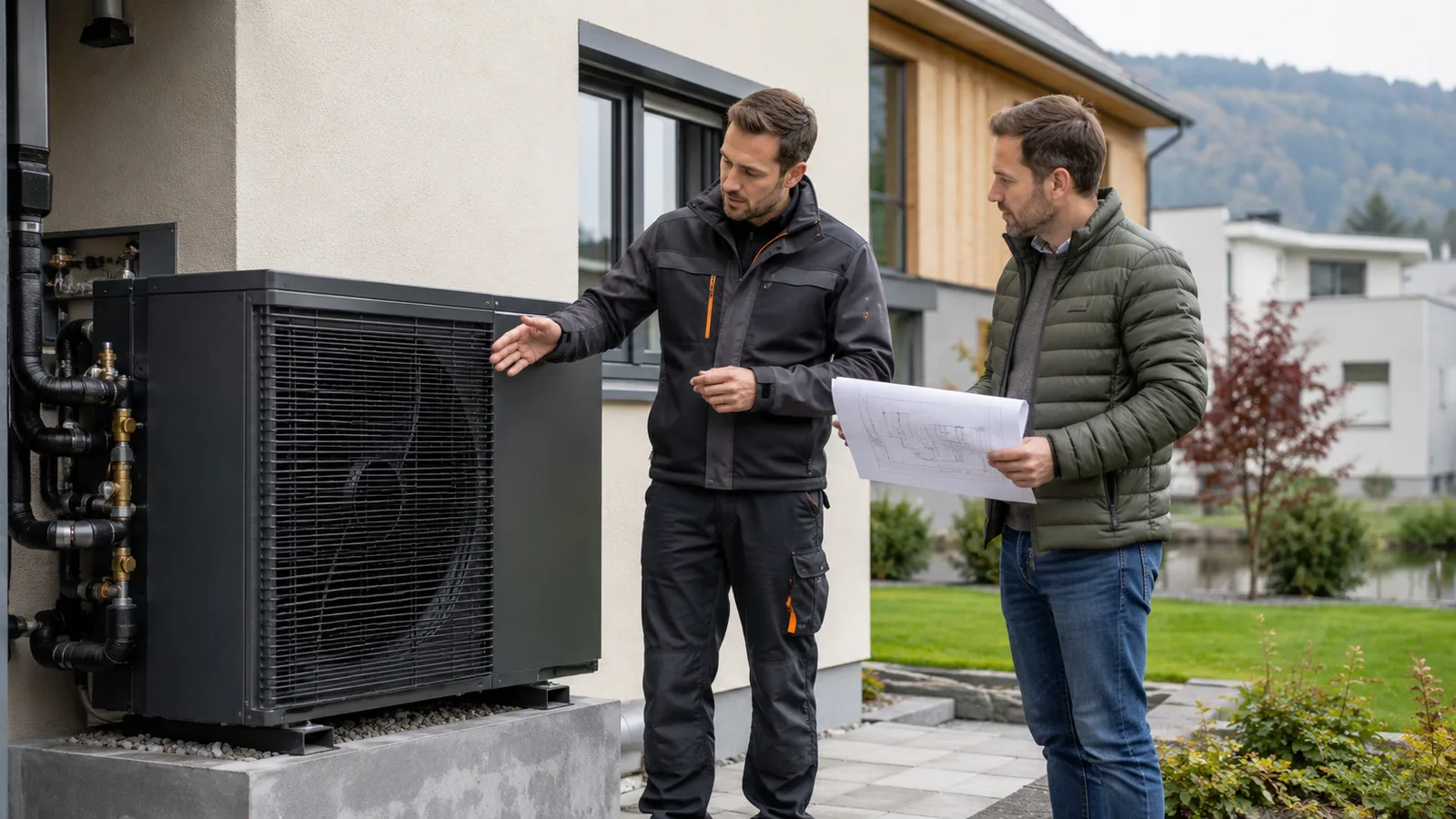
The air-to-water heat pump extracts heat from the outside air. It's the most common system in single-family homes, and the cheaper one: SwissEnergy's official reference figure is CHF 45,000 to 60,000 – including installation, hot water storage and hydraulic integration. Market quotes also come with noticeably lower amounts; more on that shortly.
The brine-to-water heat pump with a ground probe uses the constant temperature in the ground. It's more efficient, but more expensive – the SwissEnergy reference figure is CHF 55,000 to 80,000, including the borehole. The reason is precisely that borehole: it alone accounts for a significant part of the cost and depends heavily on depth and subsoil.
| System | SwissEnergy reference (single-family home, complete) | Cost drivers |
|---|---|---|
| Air-to-water | CHF 45,000–60,000 | Unit, installation, hydraulics, boiler room adaptation |
| Brine-to-water (ground probe) | CHF 55,000–80,000 (incl. drilling) | Ground probe drilling |
Guideline figures according to SwissEnergy (Swiss empirical figures, as of 2024/25), before incentives; heat pump, installation, storage and hydraulics are included – removal of the old heating system and permits aren't explicitly named there. The individual quote is decisive.
These ranges are deliberately wide: whether an older building first needs hydraulic upgrading, how long the pipe runs are, and how deep the drilling goes, shift the calculation considerably. Anyone who needs a precise figure can't avoid an on-site visit.
Why are the published prices so far apart?
Anyone comparing heat pump prices finds figures between CHF 25,000 and 60,000 for the same system – and the main reason is rarely the brand, but the scope of work. The low figures often cover only the device and basic installation; the SwissEnergy reference includes storage and hydraulics; and what actually arises in a specific project covers even more items:
- Heat pump (device) and accessories
- Installation, hydraulic integration, hot water storage
- Adjustments in the boiler room
- Electrical work (sometimes including a connection upgrade)
- Removal and disposal of the old heating system – when switching from oil, also tank cleaning or decommissioning
- Permit or notification procedure, planning, commissioning and documentation
- for ground probes: drilling plus assessments
A quote that leaves out some of these items isn't disreputable – it's just not comparable unless that's stated. Our advice, therefore: compare line items, not final totals, and for any noticeably cheap quote, ask which of the points above are included. The same logic as comparing solar quotes – except that with heating replacement, the edges (removal, tank, electrics) add up to even more money.
What do I deduct from these costs?
The incentive – and for replacing a fossil heating system, this is substantial, though strongly canton-dependent. For a typical single-family home, the range in 2026 for air-to-water systems runs from zero francs (Thurgau discontinued this incentive in 2026) through CHF 2,900 in the Canton of Zurich to CHF 8,500 in the Canton of Zug; for ground-probe systems, from CHF 6,800 (Zurich) to CHF 20,000 and more (Zug). Individual cantons attach conditions – Schaffhausen, for example, only subsidises air-to-water in single-family homes together with sufficient photovoltaics. The programmes at a glance, with a canton table: Heat pump incentives in Switzerland; the Zurich details: Heat pump incentives Canton of Zurich.
That noticeably lowers the net cost – provided the order is right: the contribution must be applied for and approved before construction starts, otherwise it's lost.
How quickly can I even get a heat pump?
One cost factor that appears on no price list: time. The Swiss Heat Pump Association (FWS) reported in its 2025 industry survey that more than half of companies have a backlog of three to six months' work – the skilled-labour shortage is a constant theme in the industry. That doesn't mean every customer waits that long for installation; but it does mean: anyone who only enquires once the old heating has already failed pays the emergency surcharge – financially, or in the form of stopgap solutions.
For orientation, here's what an orderly process looks like: device delivery, depending on the manufacturer, a few weeks to around three months; the actual installation without ground-probe drilling, about one to two weeks; plus a notification procedure or building application depending on the municipality. The whole path from decision to a warm home is described in the article Heating replacement with a heat pump – the short version is: plan the replacement before the old heating forces it.
And the running costs – is the surcharge for a ground probe worth it?
This is where the second calculation comes in, and it mustn't be forgotten: running costs. The brine-to-water heat pump is more expensive to buy, but more efficient to operate – it needs less electricity for the same amount of heat, because the ground is warmer in winter than the cold outside air. Over its service life, it recoups part of the surcharge through lower electricity costs.
Whether the surcharge pays off is therefore not purely a question of purchase price, but an overall calculation of investment, incentives and operation – and it depends heavily on the plot: drilling isn't possible or permitted everywhere. The lever gets even bigger when the heat pump is combined with a solar system and draws part of its electricity from your own roof. And the fundamental question of whether switching pays off compared with the old heating is covered by the comparison Heat pump or gas heating.
The first question after the price is almost always «so what does that actually cost?» – and the most honest answer is: only a site visit will tell you. The ranges you read online are wide, and for good reason: there's a world of difference between an air-to-water heat pump in a well-insulated house with existing underfloor heating and a ground-probe system in an older building with old radiators. What we tell everyone: don't just calculate the purchase price, factor in incentives and running costs too – an efficient system that draws little electricity in winter is often cheaper over twenty years than the one that's cheaper to buy. And submit the incentive application before the first digger arrives.
Frequently asked questions
What does a heat pump cost in Switzerland?
SwissEnergy's official reference figures for a single-family home are CHF 45,000 to 60,000 for an air-to-water heat pump and CHF 55,000 to 80,000 for brine-to-water with a ground probe – including installation, storage and hydraulics. Cantonal incentives are deducted from that. Lower market offers usually cover a smaller scope of work; the individual quote is decisive.
Why are some quotes so much cheaper?
Usually because of the scope of work, not the technology: cheap offers often include only the device and basic installation – without storage, removal of the old heating system, tank decommissioning, electrical work or permit costs. So compare line items instead of final totals, and ask exactly what's included.
Why is a ground-source heat pump so much more expensive?
Because of the drilling. The ground probe has to be drilled deep into the ground, and this drilling is the single biggest item – depending on depth and subsoil. In return, the brine-to-water system works more efficiently and has lower running costs. Whether the surcharge is worth it is an overall calculation, not just a question of purchase price.
How much incentive is there for a heat pump?
That's set by your canton, and the differences are large: for replacing a fossil heating system in a single-family home, the range in 2026 runs from zero (air-to-water in Thurgau) through CHF 2,900 (Canton of Zurich) to CHF 8,500 (Canton of Zug) – for ground-probe systems, up to CHF 20,000 and more. Important: the application must be approved before construction starts, otherwise the contribution is lost.
What does it cost to run a heat pump per year?
Annual electricity costs, depending on the system, building and consumption, are in the order of a few hundred to over a thousand francs. Efficient brine-to-water systems tend to be lower than air-to-water systems. Anyone who pairs the heat pump with a solar system lowers running costs further.
Free initial consultation
What your heat pump actually costs – after a site visit.
We look at your building, your heating load and the incentive options, and honestly weigh air-to-water against brine-to-water – including running costs.
Prefer to talk? +41 78 830 83 35
Heat pump Zurich – heating replacement from a specialist company →
Swissolar-certified specialist company · ESTI installation authorisation (Art. 14 NIV) · in Zurich since 2017 · over 150 systems completed · a personal answer from the specialist company, no call centre
Sources: SwissEnergy/SFOE (empirical heat pump cost figures), cantonal energy incentive programmes 2026 (ZH, AG, ZG, SZ, TG, SH), FWS Swiss Heat Pump Association (2025 industry survey), market observation of Swiss providers (as of July 2026).
Last updated: 9 July 2026 · Author: ecoEn editorial team