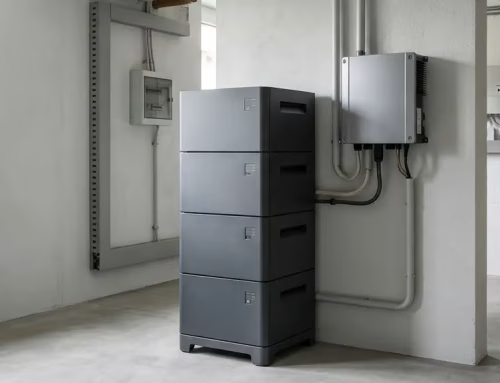
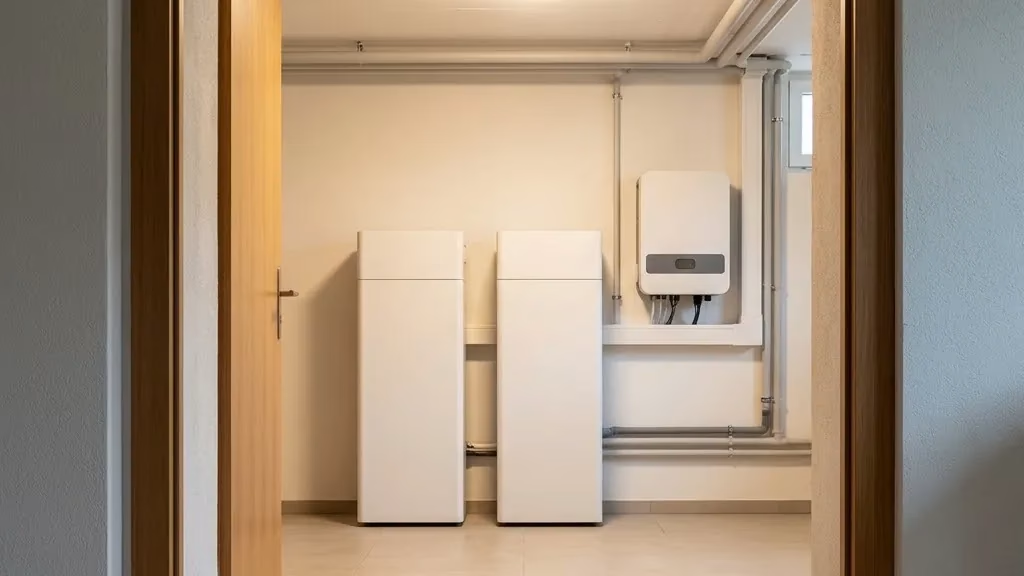
A battery storage shifts your solar power from midday to the evening and thus increases self-consumption – nothing more, but also nothing less. Installed, it currently costs roughly CHF 800 to 1,200 per kilowatt-hour of capacity; for many single-family homes, 8 to 12 kWh is suitable. Whether it pays off is determined by the consumption profile, tariff area and incentives – not the brochure. (Guideline values, As of: July 2026)
Key points in brief
- A battery does not produce electricity, it shifts it: from the solar surplus at midday to consumption in the evening. Its value is the difference between the supply tariff and the feed-in tariff.
- Guideline value for the size: daily evening and night consumption – for many single-family homes 8 to 12 kWh. Batteries bought too large are the most common planning error.
- Cost anchor: around CHF 800–1,200 per kWh of usable capacity, installed. Planned together with the system, the battery is significantly cheaper than retrofitted.
- Backup power is a separate function with separate wiring – no battery can do it «just like that».
- The honest assessment: For many households, the battery today is a question of priorities (self-sufficiency, independence), not a pure yield automatic.
What does a battery storage do – and what does it not do?
The functional principle fits into one sentence: At midday, when the solar system provides more than the house needs, the battery charges – in the evening, when the sun is gone and consumption rises, it discharges. Every kilowatt-hour shifted in this way replaces grid supply at 25 to 35 Rp./kWh with your own electricity, which would otherwise have flowed into the grid for significantly less. This difference is the entire economic core of the product; the honest calculation for this has its own article.
The typical rhythm is a daily cycle: charging during the day, discharging in the evening and at night, starting again the next morning. It also follows from this what a home battery is not:
Not a seasonal storage. The idea of saving the summer surplus for the winter fails due to the magnitude – the battery would have to be hundreds of times larger for that. Winter electricity continues to come predominantly from the grid; the battery shifts within the day, not between seasons.
Not a self-sufficiency machine. A battery noticeably increases the degree of self-sufficiency, but does not make you independent of the grid. Anyone whose main motive is «independent of the utility» should know the realistic expectation: more self-consumption, less supply – connection and basic fees remain.
No backup power supply ex works. The fact that the lights stay on during a power cut thanks to the battery only applies to systems explicitly designed for backup power – more on this below.
Properly assessed, the battery is thus the last and largest lever of self-consumption optimisation: It does the same as the timer on the washing machine, only automatically, around the clock – and for a five-figure sum instead of for free. Exactly why it belongs at the back of the sequence, not at the front.
Which battery size suits which household?
The rule of thumb from planning: The battery capacity should roughly correspond to daily evening and night consumption – that is, the electricity you need after sunset until the next morning. For many single-family homes, this is 8 to 12 kWh.
Why not bigger, if you are at it? Because an oversized battery runs empty at both ends of the year – in the literal sense: In winter it never gets full due to a lack of surplus, in summer it never gets empty due to a lack of evening consumption. You still paid for the unused kilowatt-hours, at the full price per kWh. In our observation, the battery that is too large is the most common planning error on the topic – more common than the one that is too small, which is barely noticeable in everyday life.
Serious sizing therefore means: starting from the real consumption profile, not from the module power on the roof. A household with a heat pump and electric car that charges at night also reliably fills a larger battery; an economical two-person household with a home office often needs less than the brochure recommends. Where your profile lies is shown by a look at electricity consumption by time of day – and in case of doubt, a consultation with honest assumptions instead of round sales figures.
What does a battery storage cost in Switzerland?
The most reliable cost anchor is the price per usable kilowatt-hour of capacity, installed: currently roughly CHF 800 to 1’200 (incl. VAT). Larger systems sit at the lower end of the range, small or backup-capable ones at the upper end. For the common package of a 10 kWp system and about 10 kWh of storage, this gives:
| Item | Guideline |
|---|---|
| 10 kWp PV system, turnkey | CHF 20,000–27,000 |
| Battery storage ~10 kWh usable, installed | CHF 8,000–12,000 |
| Total investment | CHF 28,000–39,000 |
Guideline values, As of: July 2026, before incentives and tax deduction, without obligation – the individual quote is decisive. The complete sample calculation including one-off feed-in incentive (EIV): Solar system with battery: Costs.
Guideline values by storage size
| Usable capacity | Installed guideline price | Typical case |
|---|---|---|
| ~5 kWh | CHF 4,000–6,000 | small household, low evening consumption |
| ~10 kWh | CHF 8,000–12,000 | common single-family home size |
| ~15 kWh | CHF 12,000–18,000 | large household, high evening/night consumption |
| ~20 kWh | CHF 16’000–24’000 | very high evening/night consumption, e.g. with a heat pump and an EV |
| ~30 kWh | from CHF 24,000 | upper edge of the home battery market: large multi-family building, commercial premises with evening load – per kWh at the lower end of the range |
All storage guideline values in this table incl. VAT, as of October 2026, before subsidies and tax deduction, non-binding – the individual quote is what counts. All sizes in detail: Battery storage: costs.
From 30 kWh: commercial premises, multi-family buildings and agriculture
Above around 30 kWh you leave the home battery market – and with it the pricing logic of the table above. Anyone looking for the price of 50, 100 or 200 kWh hits a genuine gap in Switzerland: for commercial batteries behind the meter there is currently no published guideline value per kilowatt-hour. Only the two outer edges are published.
| Reference point | Guideline value per kWh | Basis |
|---|---|---|
| Home battery 15 kWh, installed (2025) | approx. CHF 586 | Swissolar Battery Monitor 2026 |
| Commercial batteries 50–200 kWh behind the meter | no published guideline value | – |
| Grid-scale batteries from 5 MWh, in front of the meter | approx. CHF 300 | Swissolar Battery Monitor 2026, as of August 2025 |
The figure of around CHF 300 per kWh applies to large batteries connected directly to the medium- or high-voltage grid (front-of-the-meter) – not to a 50 kWh battery on commercial premises. Scaling it down to commercial size would be wrong: the gap lies precisely in between.
That the order of magnitude has nonetheless become everyday is shown by the same source: the average newly installed storage capacity in industry and commerce rose from around 37.5 kWh in 2023 to 96.5 kWh in 2024 – almost three times as much. Anyone planning 100 kWh today is therefore in the middle of their segment, not at its edge.
What determines the price in this range – and why a blanket figure misleads:
- The load profile, not the roof area. In a commercial setting, alongside self-consumption it is the demand peak that counts: where a demand charge applies, the battery also earns its keep by capping the highest quarter-hour of the month. That shifts the economically correct size – and thus the price – more than any equipment price does.
- The grid connection. If an additional transformer station is needed, connection fees of up to CHF 100 per kW are added on top (Swissolar Battery Monitor 2026). This is the item that pulls two otherwise identical projects furthest apart.
- Energy management and metering concept. From this size upwards an EMS is the rule, and where there are several consumption units the metering concept is added – both are planning work that is not contained in the home battery price.
- New build or retrofit. The same lever as with a home battery, only with a bigger swing: planned together with the system, the battery shares the inverter, mounting and electrical work.
- Incentives largely fall away here. There are no national contributions towards battery storage, neither in the residential sector nor for commercial premises (Swissolar Battery Monitor 2026), and the municipal programmes are tailored to home batteries: the City of Zurich supports at most 100 kWh per battery and a maximum of 1.5 kWh per installed kWp – a 100 kWh battery would need around 67 kWp on the roof for that.
That is why we deliberately give no range for this area that we cannot substantiate. What we do instead: we work through your load profile and size the system accordingly. More on our approach for commercial premises: Solar system for commercial premises and SMEs and Solar solutions for commercial premises & multi-family buildings.
Why you may see lower figures elsewhere
The Swissolar Battery Monitor 2026 puts a typical 15 kWh home battery at around CHF 8’800 including installation (≈ CHF 590 per kWh) – clearly less than our range of CHF 12’000–18’000. This is a market average. The source does not say whether the figure refers to nominal or usable capacity, or whether VAT is included; we calculate per usable kilowatt-hour, installed and including VAT. A quote below our range is possible and not automatically bad. In that case, compare four things: usable rather than nominal kWh, backup or emergency power function, adjustments to the inverter and meter cabinet, and warranty and service.
Three things shift these figures in a specific case. Firstly, the timing: Anyone who installs the battery together with the system shares the inverter, installation and electrician – retrofitting as a separate second construction site costs noticeably more. Secondly, the equipment: Backup power or emergency power function is an extra cost topic, not a standard. Thirdly, incentives: For the battery – unlike for the PV system itself – this is a matter for cantons and municipalities and correspondingly non-uniform. The City of Zurich, for example, is paying a battery incentive for the first time since 1 August 2026; in Thurgau there are contributions with an annual quota. A look at the regulations of your own municipality therefore belongs in every battery calculation.
Is a battery storage worthwhile?
The short version of the detailed assessment: It depends on four factors, and all four affect the same difference between supply and feed-in tariff.
1. Consumption profile – whoever consumes a lot in the evening and at night gets a lot out of it; whoever already consumes well during the day has little to shift. 2. Battery price – calculated per kWh, and installed right away instead of retrofitted. 3. Tariff area – the lower the feed-in remuneration of your grid operator, the more valuable every non-fed-in kilowatt-hour is. The same battery pays off differently depending on the utility area. 4. Incentives – where they exist, they sometimes noticeably tip the calculation.
And the honest additional line that is not in any brochure: For many households today, the battery is not a pure yield automatic, but a question of priorities. Degree of self-sufficiency, independence from future tariff developments and backup power have a value that is not fully reflected in the amortisation table – but it is a value that one consciously wants to afford, not a return that arises by itself. Every blanket statement «pays for itself in X years» without a look at your profile belongs in the category warning signal.
The technology: battery, coupling, installation location
For the purchase decision, three basic technical lines suffice – the deep dives follow in separate articles of the battery guide.
The battery. Home batteries today work almost exclusively with lithium batteries; the common cell chemistries differ in lifespan, temperature behaviour and safety profile, less so in everyday life. Current systems are designed for several thousand charging cycles; manufacturers usually guarantee ten years or a defined residual capacity. In daily cycle operation, this goes a long way mathematically – the battery ages more slowly than feared in most systems.
The coupling. The battery either hangs on the direct current side on the same hybrid inverter as the modules (DC-coupled – efficient, ideal for new systems) or with its own battery inverter on the alternating current side (AC-coupled – flexible, standard for retrofits). Which concept fits is decided by the initial situation: For a new system, much speaks for the hybrid inverter, for an existing one, AC coupling is usually the pragmatic route.
The installation location. Basement, plant room or garage – what is required is a frost-free, dry space, some wall space or floor space and proximity to the meter box. Home batteries are devices the size of a boiler or smaller and work quietly; the requirements for ventilation and clearances are regulated by installation practice, not living comfort. Installation including registration with the grid operator is the responsibility of the specialist company – a battery is a part of the electrical installation, not a household appliance.
Backup power, winter, lifespan: the three most common questions in operation
Backup power: only if explicitly built that way. Without a backup power function, the battery switches off in the event of a grid failure – for safety reasons, like the whole system. Anyone who wants to continue to be supplied during a power cut needs a backup-power or emergency-power-capable system with corresponding wiring and must include this in the planning right from the start. Retrospectively this is complex, it is never «automatically included».
Winter: less operation is normal. In the winter half-year, the system provides less surplus – accordingly, the battery is full less often. This is not a defect, but physics: The battery lives off the summer half-year, in which it works daily, and does part-time in December. This is priced into the annual calculation; in the monitoring app in January, it still looks like a problem every year.
Lifespan and maintenance: unspectacular. Mechanically nothing moves, practically nothing needs to be maintained – like the rest of the system, the battery belongs in monitoring and the annual check, nothing more. The end of life comes creeping as a loss of capacity, not as a failure; the manufacturers' guarantee values are consciously set conservatively.
Buy now, retrofit later – or wait?
The question arises in almost every system project, and the answer has three clean variants:
Buy right away, if the decision has been made anyway: One inverter, one installation, one electrician appointment – it does not get more economical.
Plan battery-ready, if you are unsure: Hybrid inverter with battery connection, reserve space in the plant room, empty conduit – the extra costs in the project are small, the savings on later retrofitting are large. This is the variant we most frequently recommend when the calculation turns out tight today: It keeps the door open without you committing yourself.
Consciously wait, if profile or tariff area argue against it today: Battery prices have moved downwards over the years, the incentive situation and tariffs change – and a year of real consumption data from the new system makes every later battery calculation more honest. Waiting is not a missed opportunity, but often the cleanest data basis.
Only one variant is not free: the unprepared retrospective purchase. Anyone who today chooses the cheapest inverter without a battery option pays double for the decision when retrofitting.
Batteries beyond the single-family home
For the sake of completeness – because the battery market is larger than the home battery in the basement:
Apartment building and ZEV: In a self-consumption community, a shared battery can raise the self-consumption rate of the entire property; dimensioning and billing are planning topics there that go beyond the single-family home case.
Business: For commercial batteries, what counts is not just self-consumption, but above all the shaving of load peaks – a business model of its own with its own logic, described in the article Commercial batteries.
Marketing flexibility: Since 2026, electricity supply law has explicitly regulated how battery owners make their flexibility available to the grid operator or third parties – and get paid for it. For home batteries, this topic is just starting; the fundamentals are in: When the battery earns money too.
And the electric car? Bidirectional charging – the car as a battery for the house – is on the rise technically, but not yet a broad standard: it requires a vehicle, wallbox and billing system that all play along. Anyone planning today realistically treats the electric car as a large consumer, not as a replacement for the home battery – and keeps the option in sight.
There is a call that comes to us every year in late autumn, as reliable as the fog: «The battery is no longer charging properly – in summer it was full every day, now almost never.» The diagnosis is almost always the same: The battery is fine, November too, only the expectation was calibrated to July. We then show the annual curve in the app instead of the weekly view, and usually the matter is settled with that. For planning, we draw a firm rule from this: We consistently calculate batteries over the course of the year and state during the consultation what December will look like – not just June. A battery whose winter face the owner knows is operated with peace of mind. One that was sold with summer figures produces a disappointed call in the first November. In both cases, the device is not at fault.
Frequently asked questions
Can I store summer electricity for the winter?
No – home batteries are daily storage units: they shift electricity from midday to the evening, not from August to January. For seasonal storage, batteries would have to be orders of magnitude larger. Winter electricity procurement therefore remains predominantly grid electricity even with a battery.
What happens to the battery during a power outage?
Without an explicit backup power function, it shuts down – like the entire system, for safety reasons. Systems capable of backup power or replacement power can continue to supply defined circuits, but require separate technology and cabling for this that needs to be planned from the very beginning.
How long does a battery storage system last?
Current lithium systems are designed for several thousand charge cycles; manufacturers typically guarantee ten years or a defined residual capacity. In daily cycle operation, the battery ages insidiously as a loss of capacity – a sudden end of life is the exception, not the rule.
Does a power storage unit need maintenance?
Practically none – there are no moving parts and no service appointments. What it needs is the same as the rest of the system: activated fault messages and the occasional glance at the monitoring. The battery simply belongs in the annual check of the system.
Can my electric car replace the home battery?
Partially in prospect – bidirectional charging makes the car a battery for the house. Today this is not yet a broad standard: vehicle model, wallbox and billing questions must match. Anyone planning now calculates the electric car as a consumer and keeps the option open.
Where is the battery installed – and is it disturbing?
Basements, utility rooms or garages are usual: frost-free, dry, close to the meter box. Today's home batteries are about the format of a water heater or hang on the wall and work quietly. Installation and connection are the responsibility of the specialist company – including registration with the grid operator.
Free initial consultation
Battery yes, no – or later?
We calculate your situation with proven assumptions: consumption profile, tariff area, incentives at your location. And we tell you the honest answer even if it is «battery-ready is enough for now».
Want to calculate yourself first? Solar calculator with official roof data →
Prefer to talk? +41 78 830 83 35
Your battery storage system from a specialist company →
Swissolar member and Solarprofi · ESTI installation authorisation (Art. 14 NIV) · in Zurich since 2017 · over 150 systems completed · a personal answer from the specialist company, no call centre
Further guides
 Lohnt sich ein Stromspeicher?
 Solaranlage mit Speicher: Kosten
 Eigenverbrauch optimieren: Die sechs Hebel
 Eigenverbrauch oder Einspeisen?
 Wenn der Speicher mitverdient
Sources: SwissEnergy (battery storage fundamentals); Pronovo (one-off feed-in incentive); incentive programmes of the City of Zurich and Canton of Thurgau (respective current regulations); empirical values from the planning and installation practice of ecoEn GmbH, Zurich region.
Last updated: 9 July 2026 · Author: ecoEn editorial team