
The Huawei LUNA2000 is a modular home battery with LFP cells, which is connected on the DC side to the Huawei hybrid inverter SUN2000. The current S1 generation starts at 6.9 kWh usable and grows in modules from 6.9 kWh to 20.7 kWh per tower; emergency power is possible with the appropriate switchover device. The battery is suitable if the inverter and battery should come from one ecosystem – we install it in the Zurich region, but work independently of the manufacturer. (As of: September 2026)
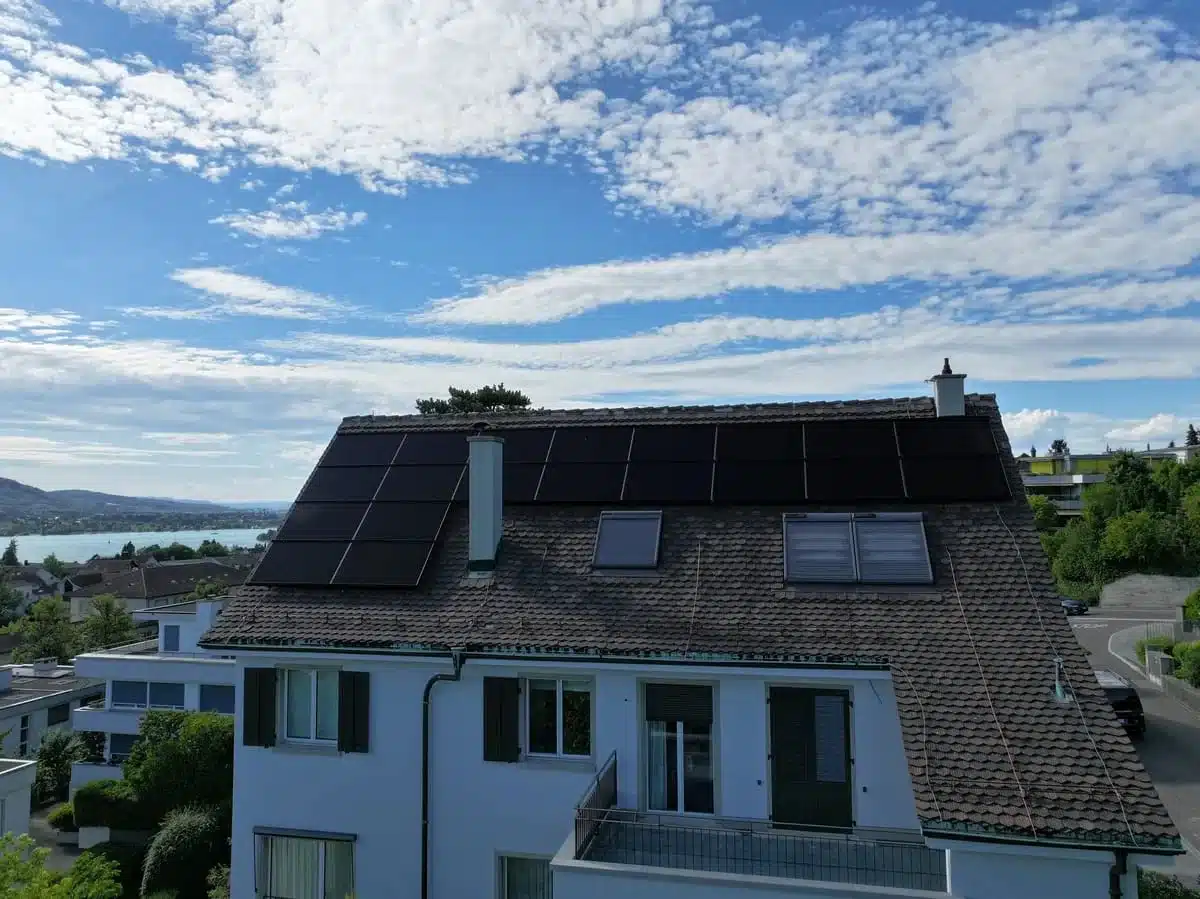
Key points in brief
- LUNA2000 S1: modules of 6.9 kWh usable, one to three modules per tower (6.9 / 13.8 / 20.7 kWh), several towers in parallel possible.
- LFP cell chemistry, manufacturer warranty according to Huawei currently 15 years (observe conditions).
- Emergency power: single or three-phase, depending on the inverter and switchover device (Backup Box or SmartGuard) – must be planned from the beginning.
- Suits Huawei SUN2000 hybrid inverters; for Fronius, Kostal or SMA systems it is not the right choice.
- From our projects: LUNA2000 with 14 kWh and emergency power in Zollikon (2026).
What is the Huawei LUNA2000 – and who is it intended for?
The LUNA2000 is the home battery from the Huawei FusionSolar system: inverter, battery, optimisers, wallbox and energy management come from a single source. The battery is operated DC-coupled, i.e. directly on the hybrid inverter SUN2000, without a second inverter. This saves conversion losses and keeps the installation tidy; how DC and AC coupling differ is explained in the article DC or AC-coupled battery.
The LUNA2000 is intended for households that are building a new solar system with a Huawei inverter or want to add a battery to an existing Huawei system. It is widespread in Switzerland: according to the Swissolar battery monitor 2026, Huawei and BYD are among the battery brands that a large majority of the surveyed installation companies use (as of: September 2026). Anyone who, on the other hand, already has a Fronius, Kostal or SMA inverter is better served with an open system like the BYD Battery-Box – the LUNA2000 cannot be connected to third-party inverters.
What are the system specifications of the LUNA2000 S1?
| Feature | LUNA2000 S1 (manufacturer specifications) |
|---|---|
| Module | LUNA2000-7-E1, 6.9 kWh usable |
| Tower | 1–3 modules: 6.9 / 13.8 / 20.7 kWh |
| Expansion | up to 4 towers in parallel (max. 82.8 kWh) |
| Cell chemistry | Lithium iron phosphate (LFP) |
| Coupling | DC, on the Huawei SUN2000 hybrid inverter (e.g. MAP0 series, 5–12 kW three-phase) |
| Emergency power | yes – single-phase via Backup Box, three-phase via SmartGuard |
| Operation | −20 to +55 °C, module with its own heating for cold installation locations |
| Warranty | 15 years according to Huawei warranty conditions |
Manufacturer specifications according to the data sheet, as of: September 2026. Model series and warranty conditions change; the currently delivered system and the quote are authoritative.
The predecessor LUNA2000 S0 (modules of 5 kWh) is still installed in many systems. S0 and S1 modules cannot be mixed in one tower; anyone who wants to expand an S0 battery needs S0 modules or a second tower – we clarify this before the quote using the serial number.
Who is the LUNA2000 suitable for – and who is it not for?
Suitable:
- New solar system, where inverter and battery should come from one system – one app, one contact person for the warranty.
- Households with a heat pump or electric car, that want to expand the battery later by a module (retrofitting possible module by module).
- Emergency power wish: with SmartGuard, a three-phase house also continues to run in the event of a power cut – how realistic this is, is explained in the article Battery storage with emergency power.
Less suitable:
- Existing system with Fronius, Kostal, SMA or SolarEdge: the LUNA2000 is not a manufacturer-open battery.
- Very small households with under 3,000 kWh annual consumption: even the smallest module with 6.9 kWh is then often too large – the right size is shown in the article How large should the battery storage be?.
- Anyone looking for a salt battery or an AC complete system for retrofitting.
How much does an installed Huawei LUNA2000 cost?
We deliberately do not mention a catalogue price here, but the guideline value that we also use in our cost article: CHF 800 to 1,200 per usable kilowatt-hour, installed – for a LUNA2000 with 13.8 kWh this means roughly CHF 11,000 to 16,500, larger systems at the lower end, emergency power equipment at the upper. If the battery is built together with the solar system, the installation portion is significantly smaller than with a later retrofit. All cost drivers in detail: How much does a battery storage cost?
Guideline values, As of: September 2026, without obligation. The individual quote is decisive.
Incentives: The City of Zurich supports batteries with its own contribution – details in the article Battery incentives City of Zurich.
From our projects
In Zollikon in 2026, we built a 9.6 kWp system with 20 LONGi Anti-Glare modules, a Huawei SUN2000-12K-MAP0 with optimisers and a LUNA2000 with 14 kWh on an apartment building – including emergency power and lightning protection system. Huawei inverters of the SUN2000 series run in seven of our documented systems, from 4 kWp on a cooperative roof in Zurich to the 90 kWp system on the Winterthur glider airfield. You can find the key data of all systems on the Projects page.
What alternatives are there to the LUNA2000?
- BYD Battery-Box – open system for Fronius, Kostal, SMA and other inverters.
- FENECON Home 20/30 – DC hybrid system with three-phase emergency power, for larger houses.
- sonnenBatterie – AC complete system for retrofitting, see BYD or sonnen.
- Salt battery – without lithium, requires more space; classification in the article Saltwater battery storage.
An overview of all relevant systems is provided by the Battery storage comparison; you can find the inverter comparison Huawei versus SolarEdge here.
With the LUNA2000, the most frequent question is not the brand, but the emergency power question – and this is decided before the first cable. Single-phase emergency power via the Backup Box is quickly installed, but only supplies selected circuits. Anyone who wants to keep the whole house running on three phases needs the SmartGuard and wiring that we coordinate with the electrical plan. Retrospectively, this is time-consuming. That is why we ask first for every Huawei system: what should run in the event of a power cut? Fridge and router – or also the heat pump? The answer determines the switchover device, battery size and a good part of the costs.
Frequently asked questions
Is the Huawei LUNA2000 capable of emergency power?
Yes, with the appropriate switchover device. Single-phase emergency power runs via the Huawei Backup Box and supplies selected circuits; for three-phase emergency power for the whole house, the SmartGuard and a three-phase hybrid inverter are required. Without these components, even a house with a full battery switches off in the event of a power cut – emergency power must therefore be planned from the beginning.
Can the Huawei LUNA2000 battery be expanded?
Yes, module by module: a tower of the S1 generation holds up to three modules of 6.9 kWh each, several towers can be operated in parallel. The generation is important – S0 and S1 modules must not be mixed in the same tower. Before an expansion, we check the inverter firmware, free capacity on the inverter and the warranty conditions.
What is the difference between Huawei LUNA2000 S0 and S1?
The S0 generation works with modules of 5 kWh, the current S1 generation with 6.9 kWh per module, higher charging and discharging capacity and integrated heating for cold installation locations. S1 is newly delivered; S0 systems remain expandable, but only with S0 modules.
How long does a Huawei LUNA2000 last?
Huawei currently gives a 15-year warranty for the S1 generation in Europe (residual capacity according to warranty conditions). The LFP cells are designed for several thousand full cycles; for a single-family home with around 250 cycles per year, the calendar lifespan is usually the limiting factor. What this means for the real lifespan is explained in the article Lifespan of battery storage.
Can I retrofit the Huawei LUNA2000 myself?
No. The connection to the hybrid inverter, the protection and the notification to the grid operator are the responsibility of a company with an installation authorisation in Switzerland; for emergency power, the switchover in the house connection is added. We take care of planning, installation, commissioning in the FusionSolar app and the registration with the grid operator.
What are the disadvantages of the Huawei LUNA2000?
It is tied to the Huawei ecosystem: without a SUN2000 hybrid inverter it does not run, a change of the inverter brand is only possible later with a new battery. Three-phase emergency power requires the SmartGuard as an additional device, and the smallest module with 6.9 kWh is already large for very small households. In return, you get a coordinated system with one app and one warranty provider.
Free initial consultation
LUNA2000 – planned, installed, registered.
We check whether the LUNA2000 suits your system, size it according to your consumption and clarify the emergency power question before the quote. Independent of manufacturer – if another system fits better, we will say so.
Want to calculate yourself first? Solar calculator with official roof data →
Prefer to talk? +41 78 830 83 35
Your battery storage system from a specialist company →
Swissolar-certified specialist company · ESTI installation authorisation (Art. 14 NIV) · in Zurich since 2017 · over 150 systems completed · a personal answer from the specialist company, no call centre
Sources: Huawei FusionSolar, data sheets LUNA2000-S1 and SUN2000-MAP0 (as of September 2026); Swissolar, Battery Monitor Switzerland 2026; project documentation of ecoEn GmbH (Zollikon 2026). Model series and warranty conditions change – as of September 2026.
Last updated: 9 July 2026 · Author: ecoEn editorial team