
FENECON Home 20 and Home 30 are three-phase DC hybrid systems from the German manufacturer FENECON: hybrid inverter with 20 or 30 kW, LFP battery tower with 5 to 15 modules (14 to 42 kWh usable per tower, up to 4 towers) and three-phase emergency power with black start and solar recharging in one system. The energy management FEMS is based on the open platform OpenEMS. The system is intended for large single-family homes with heat pump and e-car, apartment buildings and small business – we have realised it in Watt and Affoltern am Albis and offer it independent of manufacturers. (As of: September 2026)
Key points in brief
- Hybrid inverter 20 or 30 kW three-phase, battery DC-coupled – one device instead of inverter plus battery inverter.
- Battery tower: modules at 2.8 kWh usable, 5 to 15 modules (14–42 kWh); up to 4 towers in parallel.
- Three-phase emergency power for the whole house, black-start capable, with recharging from the solar system in island operation.
- FEMS based on OpenEMS: open for heat pump, wallbox, dynamic tariffs and grid utility, without cloud obligation.
- From our projects: Home 20 with around 20 kWh (Watt, 2024) and Home 30 with 20 kWh on an apartment building in-roof (Affoltern am Albis, 2026), both with emergency power.
What is FENECON Home – and who is behind it?
FENECON is a manufacturer from Deggendorf (Bavaria) founded in 2011, which emerged from a solar specialist company and has specialised in battery storage systems and energy management. The Home series includes the smaller Home 10 for single-family homes and the large classes Home 20 and Home 30, which are the subject here. The core is always the same: a hybrid inverter, a modular LFP battery tower and the energy management system FEMS, which FENECON develops on the open platform OpenEMS and expands with new functions («FEMS Apps») even after years.
For us, the system is interesting because it closes the gap between the classic single-family home battery (10 to 15 kWh, an inverter up to 10 kW) and the business solution: 20 to 30 kW inverter power, 20 to 40 kWh battery storage and real three-phase emergency power – in one cabinet, from a single source. How a DC hybrid system differs from AC-coupled solutions is explained in the article DC or AC-coupled battery storage.
What system data do Home 20 and Home 30 have?
| Feature | FENECON Home 20 | FENECON Home 30 |
|---|---|---|
| Inverter | 20 kW, three-phase, hybrid | 29.9 kW, three-phase, hybrid |
| MPP tracker | 2 | 3 |
| Battery module | 2.87 kWh nominal / 2.8 kWh usable (LFP) | same |
| Tower | 5–15 modules: 14.0–42.0 kWh usable | same |
| Expansion | up to 4 towers (max. 168 kWh usable) | same |
| Emergency power | three-phase, 20 kW (6.7 kW per phase), black-start capable, solar recharging | three-phase, 29.9 kW (10 kW per phase) |
| Energy management | FEMS on OpenEMS, LAN, relay board with 2 switching contacts, Cloud REST API | same |
| Warranty | 10 years product, capacity 12 years or 6,000 cycles | same |
| Efficiency | 97.5% (European) | same |
Manufacturer specifications according to FENECON product sheet Home 20|30 (2025), as of: September 2026. Older systems (like ours in Watt) use modules of the previous generation with 2.2 kWh; generations cannot be mixed in one tower. The currently delivered system is authoritative.
Who is FENECON Home 20/30 suitable for – and who is it not suitable for?
Suitable:
- Large single-family homes with a heat pump, electric car and systems from around 15 kWp, where a 10 kW hybrid inverter becomes too small.
- Apartment buildings and self-consumption community (ZEV) with a shared battery – the basics are provided in the article Battery in an apartment building.
- Households for which emergency power should be more than one socket: the whole house continues to run on three phases, including recharging from the sun.
- Anyone who wants their energy management to be open and local – FEMS controls the heat pump, wallbox and dynamic tariffs without tying consumers to a specific manufacturer.
Less suitable:
- Small single-family homes with 5 to 10 kWp, whose evening and night consumption is covered by an 8 to 12 kWh battery: the smallest tower with 14 kWh and a 20 kW inverter are then oversized; here a system like the Huawei LUNA2000 or a BYD Battery-Box on a smaller hybrid inverter makes more sense.
- Retrofitting on an existing system with a third-party inverter: Home 20/30 replaces the inverter – this is only worthwhile if it is at the end of its life anyway (see Replacing the inverter).
- Cramped plant rooms: a tower with 7 modules is around 1.4 m high, plus the inverter cabinet.
What does a FENECON Home 20/30 cost?
Home 20/30 is quoted as a package consisting of inverter, battery and FEMS – a price per kilowatt-hour is therefore short-sighted because the 20 or 30 kW hybrid inverter replaces the solar inverter. Our general guideline value for installed home batteries of CHF 800 to 1,200 per usable kilowatt-hour serves as an orientation, with larger systems like a 20 kWh tower at the lower end; the emergency power switchover and the adaptation of the house distribution are added as a separate item. The cost drivers in detail: How much does a battery storage cost?
Guideline values, As of: September 2026, without obligation. The individual quote is decisive.
From our projects
Watt (Regensdorf), 2024: Single-family home with 22.7 kWp on an east-west roof, FENECON Home 20 with around 20 kWh, 13 optimisers for partial shading and emergency power function.
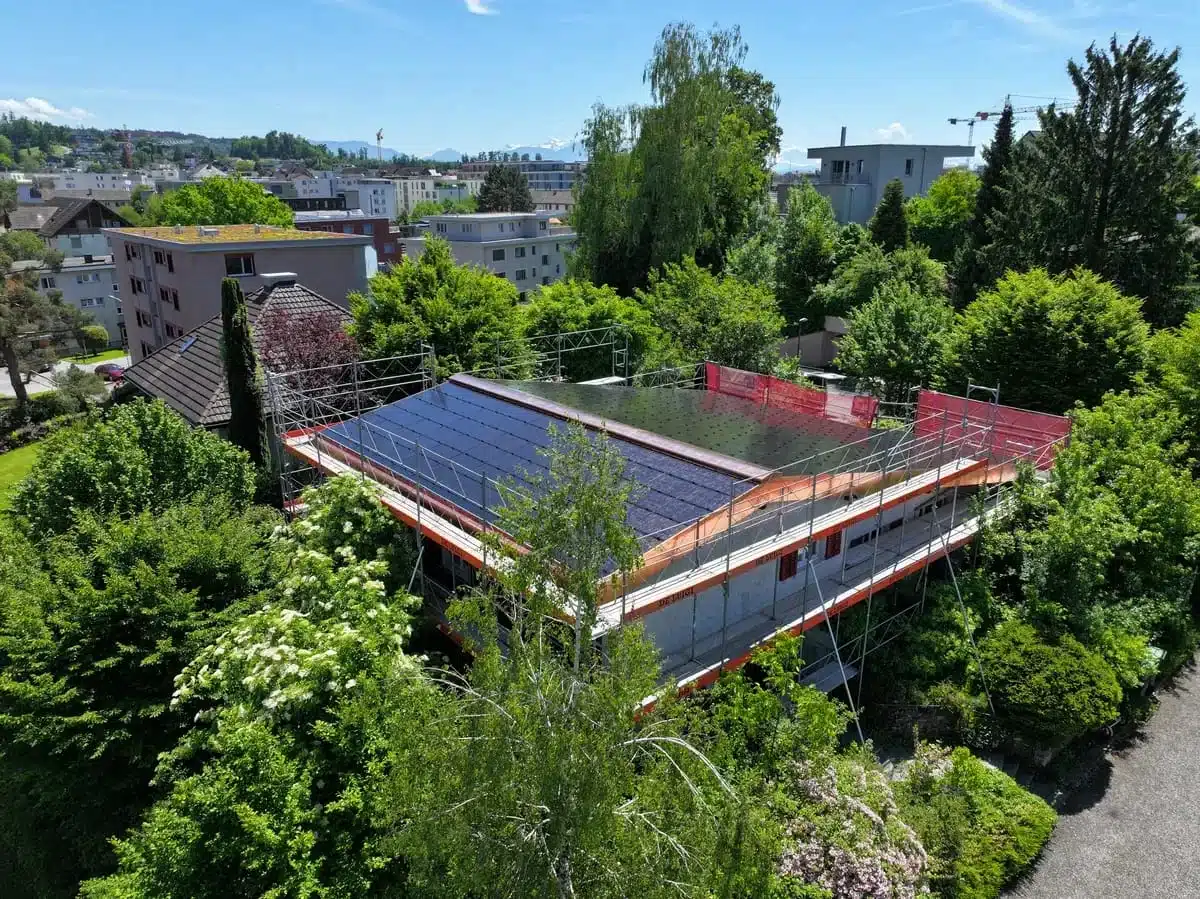
Affoltern am Albis, 2026: Apartment building with 31.7 kWp MegaSlate in-roof (276 modules), FENECON Home 30 with 20 kWh battery and emergency power – one of the largest in-roof systems we have built.
Both systems run with FEMS; you can find all key data on the Projects page.
What alternatives are there to FENECON Home?
- Fronius Verto Plus (15–33 kW) with BYD or Fronius Reserva – the Fronius answer to the same size class, see Fronius GEN24 Plus.
- Huawei SUN2000 MAP0 with LUNA2000 – up to 12 kW, closed ecosystem.
- Kostal Plenticore with BYD Battery-Box – open combination, in use in our apartment building (Piko CI).
- Commercial battery storage from 50 kWh for businesses: Commercial battery storage.
The system overview is provided by the Battery storage comparison.
With systems of this size, the trigger is usually the same: in the event of a power cut, not only the fridge should run, but the house. Three-phase emergency power with black start is an additional device with its own logic in most single-family home systems; with Home 20/30 it is part of the concept. What we have learned: the emergency power scenario is decided in the house distribution, not in the battery – which groups are supplied, how the heat pump is connected, where the grid separator is located. We plan this with the electrical plan before the battery is ordered. And the open control system FEMS has proven itself because the heat pump and wallbox do not have to be from the same manufacturer.
Frequently asked questions
What is FENECON Home?
FENECON Home is a range of home battery systems from the German manufacturer FENECON: hybrid inverter, modular LFP battery tower and the energy management FEMS in one system. Home 10 is intended for single-family homes, Home 20 and Home 30 with 20 and 30 kW inverter capacity respectively for large houses, apartment buildings and small businesses.
Who is behind FENECON – and where is it produced?
FENECON GmbH was founded in 2011 in Deggendorf (Bavaria) and emerged from a solar specialist company. Development, energy management software FEMS and sales are based in Germany; the battery modules are – as with practically all home batteries – built from purchased LFP cells. The systems are available in Switzerland via the specialist trade and are planned and commissioned by installation companies like us.
Does FENECON Home have an emergency power function?
Yes. Home 20 and Home 30 are three-phase emergency power capable, black-start capable and recharge the battery in island mode from the solar system – with 20 or 29.9 kW respectively for the whole house. With the smaller Home 10, the emergency power function depends on the version. In any case, a switchover is required in the house connection, which must be taken into account during electrical planning; the basics are explained in the article Battery storage with emergency power.
How long does a FENECON battery last?
FENECON gives a 10-year product warranty and a capacity warranty of 12 years or 6,000 cycles (manufacturer specifications, as of September 2026). For a household with 250 to 300 full cycles per year, calendar time is therefore the limiting factor, not the number of cycles. What this means for the real lifespan is shown in the article Lifespan of battery storage.
Which inverter does FENECON use?
Home 20/30 is an integrated hybrid system: the three-phase hybrid inverter with 20 and 29.9 kW respectively is part of the system and is not chosen separately. It takes over the solar system, battery charging and emergency power; an additional solar inverter is not required. For very large roofs, several systems can be operated in parallel.
Is a 20 kWh battery worthwhile for my house?
Only if your evening and night consumption fills and empties it daily – this is the amount that the battery can actually shift. For many single-family homes, 8 to 12 kWh is sufficient; a 20 kWh tower suits large houses with a heat pump and electric car, apartment buildings and businesses. A battery that is too large sits around expensively and half-empty. The method is explained in the article How large should the battery storage be?.
Free initial consultation
FENECON Home – battery, inverter and emergency power from one system.
We check whether Home 20 or 30 suits the system, consumption and emergency power target, plan the house distribution and commission the system including FEMS. Independent of manufacturer – for smaller houses we recommend the smaller system.
Want to calculate yourself first? Solar calculator with official roof data →
Prefer to talk? +41 78 830 83 35
Your battery storage system from a specialist company →
Swissolar-certified specialist company · ESTI installation authorisation (Art. 14 NIV) · in Zurich since 2017 · over 150 systems completed · a personal answer from the specialist company, no call centre
Sources: FENECON GmbH, product sheet Home 20|30 (2025) and operating and service manual Home 20/30 (docs.fenecon.de, as of September 2026); OpenEMS Association; project documentation of ecoEn GmbH (Watt 2024, Affoltern am Albis 2026). As of September 2026.
Last updated: 9 July 2026 · Author: ecoEn editorial team