
The storage market in 2026 is large and mature. Relevant names include BYD (modular, combinable with many inverters), Huawei (integrated ecosystem), Tesla Powerwall (complete system with emergency power), sonnen (premium with software focus) as well as providers like Pylontech, Sungrow or Fox. Almost all good systems today rely on the safe LFP cell chemistry. More important than the brand is that the battery, inverter and your consumption profile match – and that the battery is correctly dimensioned, not as large as possible. (As of: July 2026)
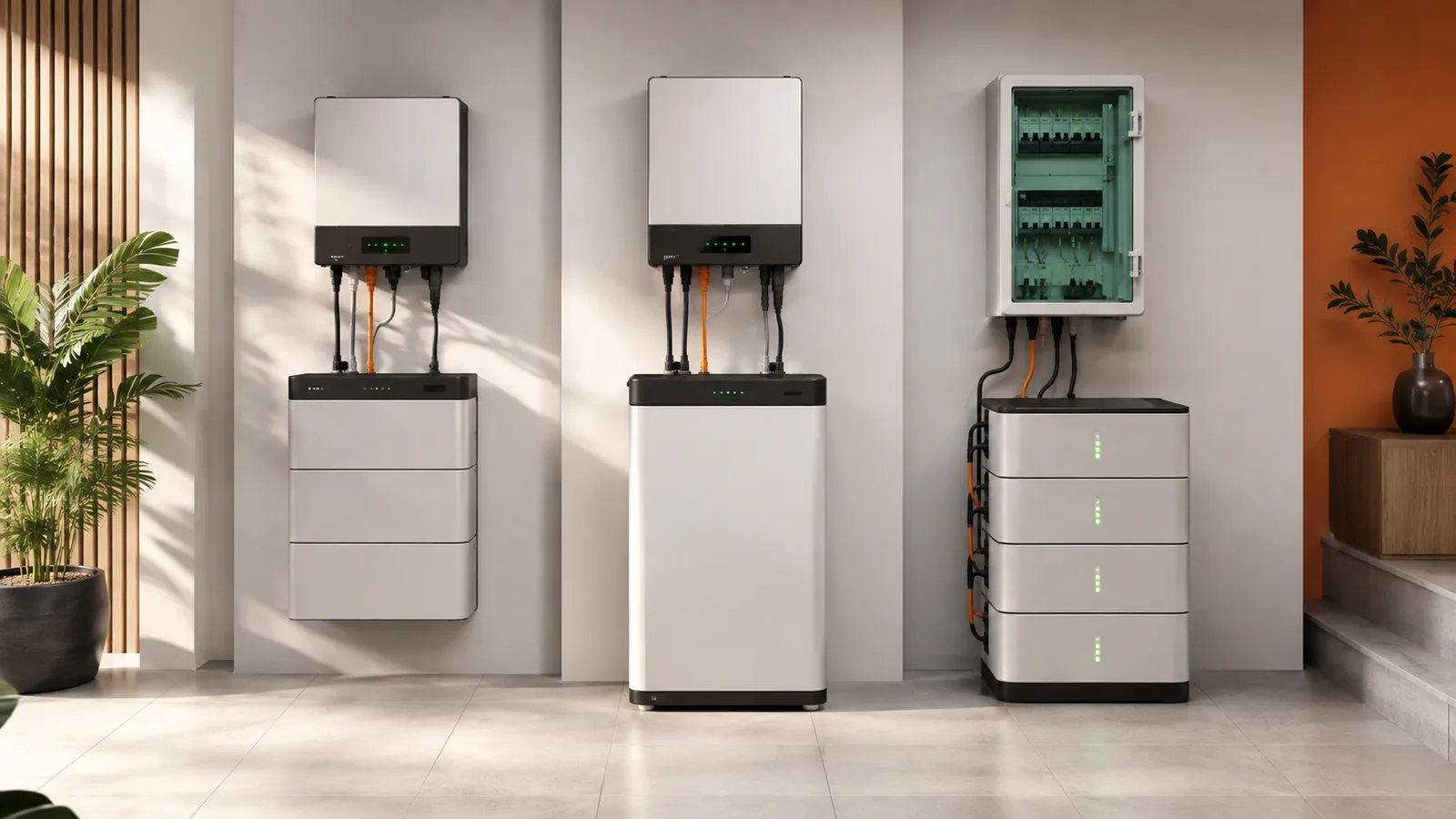
Key points in brief
- The market is mature: BYD, Huawei, Tesla, sonnen, Pylontech, Sungrow and Fox belong to the established names.
- Basic question: modular system (later expandable) or complete system from a single source.
- Almost all good batteries use the LFP cell chemistry in 2026 – safe and durable.
- BYD is inverter-neutral and is often combined with Fronius, Kostal or other hybrid inverters.
- The right size and the match with the inverter decide more than the logo.
Which batteries are relevant in 2026?
The storage market has calmed down and professionalised. We encounter a few names again and again – each with its own character:
| System | Character (rough classification) |
|---|---|
| BYD Battery-Box | modular, combinable with many inverters, large cell manufacturer |
| Huawei LUNA | part of the FusionSolar ecosystem, good price-performance ratio |
| Tesla Powerwall | complete system with integrated inverter and emergency power |
| sonnen | Premium with software and community focus |
| Fenecon Home | DC hybrid system: inverter, LFP battery and emergency power from a single source, open energy management |
| Pylontech / Sungrow / Fox | price-attractive, widespread LFP systems |
Rough classification, As of: July 2026, without a ranking and without claim to completeness. Model series and availability change quickly; the currently offered system is decisive.
Swiss practice confirms this picture: according to the Swissolar battery monitor 2026, BYD and Huawei are used by a large majority of the installation companies surveyed, Fronius has gained a strong presence as a battery provider, and Varta, E3/DC and sonnen remain important players. Almost all of these systems rely on LFP cells (As of: September 2026).
Important to know: some inverter manufacturers like Fronius or Kostal do not build batteries themselves, but combine their hybrid inverters with cell packages from BYD, Pylontech and others. «Battery X on inverter Y» is therefore often the actual system question – how battery and inverter interact is explained in the article DC- or AC-coupled battery storage.
Which batteries does ecoEn install?
We work independent of manufacturer: the system is oriented towards the installation, consumption, inverter and budget – not by brand. Currently the most frequently requested and offered by us (without ranking, As of: September 2026):
| System | Coupling | Typical for |
|---|---|---|
| Huawei LUNA2000 | DC, modular | New systems with Huawei inverter, emergency power optional |
| BYD Battery-Box | DC or AC, modular | Fronius, Kostal, SMA and other inverters |
| Fenecon Home 20/30 | DC-Hybrid | larger single-family homes and apartment buildings with backup power |
| sonnenBatterie | AC complete system | Retrofitting for an existing system |
| Salt battery | AC/DC | Safety and ecology over compactness – for classification |
From our projects: Huawei LUNA2000 with 14 kWh and backup power (Zollikon, 2026) · Fenecon Home 30 with around 20 kWh (Affoltern am Albis, 2026) · Fenecon Home 20 with around 20 kWh (Watt, 2024) · salt battery storage with 18 kWh (Küsnacht, 2023) – all with key data on the Projects page. You can find the starting point for your house on the Battery storage page.
Modular system or complete solution?
This is the first real crucial decision – and it depends on your plans:
Modular systems (such as BYD, Pylontech) start with a base unit and can be expanded in stages. This is suitable if you want to start small and add to it later, or if the combination with a specific inverter is important.
Complete systems (such as Tesla Powerwall) include an inverter, battery and often backup power in one device. This is tidy and quick to install, but binds you more strongly to the one system.
Ecosystem solutions (such as Huawei) show their strength if you want solar, battery and wallbox from a single source.
Which design fits best is decided less by the data sheet than by your expansion planning. The basics for this are provided by the pillar article Home batteries in Switzerland.
What is important regarding cell chemistry and warranty?
In 2026, the question of chemistry is largely decided: almost all good home batteries use LFP (lithium iron phosphate) – a chemistry that is considered particularly safe and durable. The difference to the older NMC chemistry is explained in the article LFP or NMC.
With the warranty, two numbers count: the term (usually around 10 years) and the guaranteed residual capacity at the end (often around 70 percent) or a guaranteed energy throughput. What this means for the real lifespan is covered in the article Lifespan of home batteries. A note from practice: even the best battery is only worthwhile with the right size – the costs and economic viability are covered in the article How much does a battery storage cost?.
With the battery, customers first ask about the brand – we first ask about consumption. Whether BYD, Huawei or Tesla: the most expensive error in judgement is not the wrong brand, but the battery being too large. We regularly see quotes with 15 or 20 kWh for households that realistically manage with half – that costs a lot and brings little. Our sequence is always the same: first the consumption profile, then the size, then the match with the inverter, and only at the end the brand. We often combine modular systems like BYD with a matching hybrid inverter in the Zurich region; anyone who wants everything from a single source is well served with a complete or ecosystem. There is no «best» brand – there is the system that suits your house.
Frequently asked questions
Which battery storage is the best in 2026?
There is no single best one. BYD, Huawei, Tesla, sonnen and others are all established and deliver good LFP systems. Which one suits you depends on your consumption, the desired expandability and the match with the inverter – not on a general ranking.
What is the difference between a modular and a complete system?
Modular systems such as BYD start small and can be expanded later – flexible, but tied to the combination with an inverter. Complete systems such as the Tesla Powerwall include an inverter, battery and often backup power in one device – tidy, but more strongly tied to one system. The choice depends on your expansion planning.
Which cell chemistry should the battery have?
In 2026, almost all good home batteries use LFP (lithium iron phosphate) – it is considered particularly safe and durable. The older NMC chemistry is in decline in the residential sector. For the vast majority of households, LFP is the obvious and recommendable choice.
Is there an alternative to lithium – such as a salt battery?
Yes, as a niche: salt batteries work without lithium and cobalt, are non-flammable and easily recyclable, but require significantly more space and cost more per kilowatt-hour. According to the Swissolar Battery Monitor 2026, they make up around 1.2 percent of the Swiss market, and the circle of providers is small. We have implemented such a system in Küsnacht; the classification is provided by the article Saltwater battery storage.
Does every battery fit every inverter?
No. Battery and inverter must match each other – some systems are open and can be combined with many inverters (such as BYD), others are part of a closed ecosystem. This match is one of the most important questions during selection and should be clarified on a system-specific basis.
Who is the market leader in battery storage?
In Switzerland, BYD and Huawei lead: according to the Swissolar Battery Monitor 2026, both are used by a large majority of the surveyed installation companies, Fronius has caught up strongly as a battery provider. Worldwide, BYD, Tesla and Huawei are among the largest providers of home batteries. However, a market leader is not a quality verdict for your house – the match with the inverter, warranty and on-site service remain decisive (As of: September 2026).
Free initial consultation
The right battery – in the right size.
We size the battery according to your consumption and choose the system that suits your inverter and your expansion plans.
Want to calculate yourself first? Solar calculator with official roof data →
Prefer to talk? +41 78 830 83 35
Your photovoltaic system from a specialist company →
Swissolar-certified specialist company · ESTI installation authorisation (Art. 14 NIV) · in Zurich since 2017 · over 150 systems completed · a personal answer from the specialist company, no call centre
Sources: Swissolar, Battery Monitor Switzerland 2026 (most common brands, technology shares); manufacturer data sheets (BYD, Huawei, Tesla, sonnen, Fenecon, Pylontech, Sungrow, Fox, etc.), Swissolar technical information, market observation by ecoEn GmbH (Zurich region). The battery market is developing quickly – As of: July 2026.
Last updated: 9 July 2026 · Author: ecoEn editorial team