
Installed, a home storage battery in Switzerland currently costs roughly CHF 800 to 1,200 per kilowatt-hour of usable capacity – so a typical 10 kWh storage battery costs around CHF 8,000 to 12,000. Larger systems sit at the lower end per kWh, small ones or those with backup-power capability at the upper end. It becomes significantly cheaper if the storage battery is installed together with the solar system rather than later. (Guideline values, as of: July 2026)
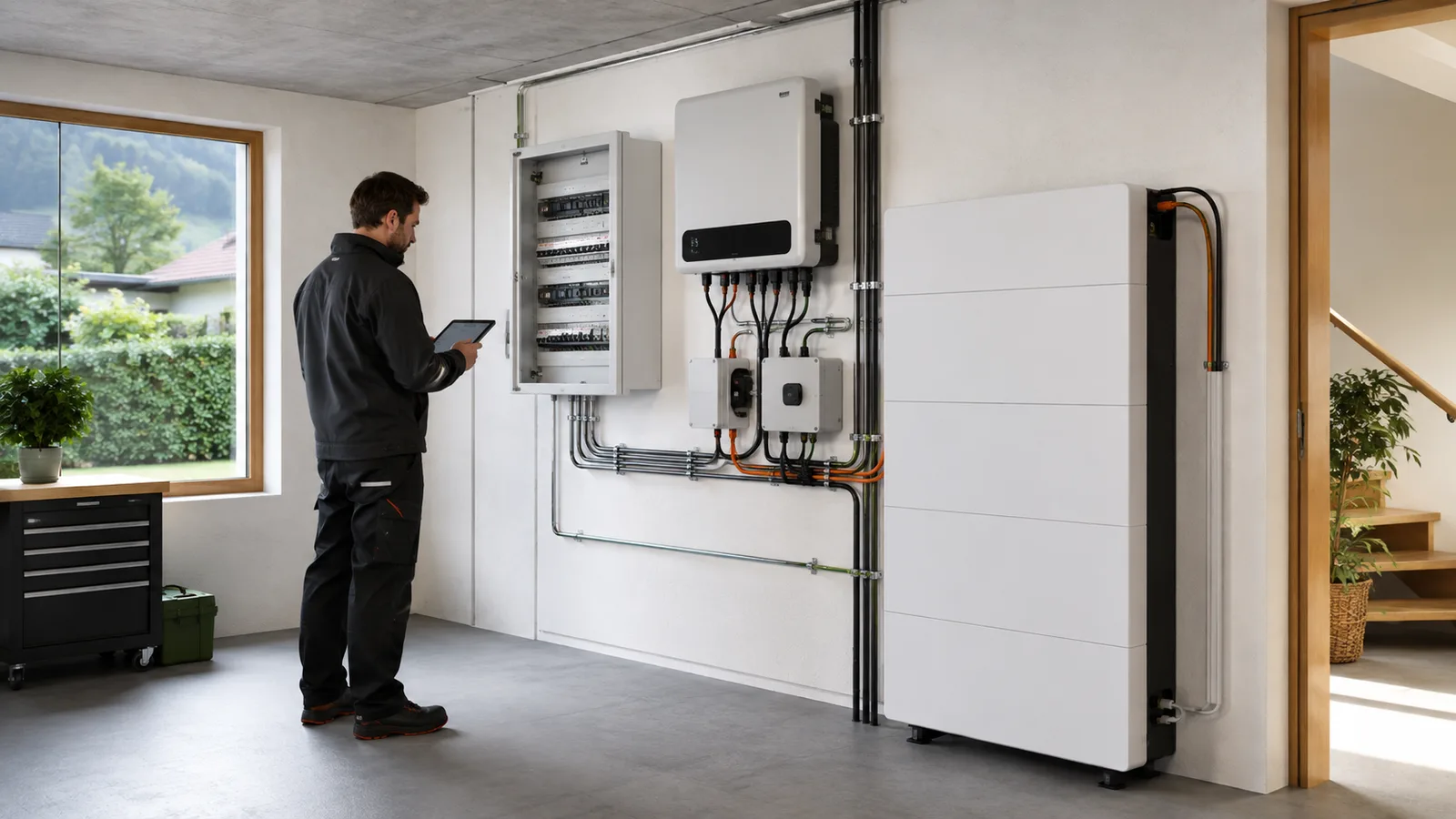
Key points in brief
- The honest figure for comparison is the price per usable kilowatt-hour, installed – not the device price in an online shop, and not the gross capacity.
- Guideline value: CHF 800–1,200 per kWh; the four big price drivers are size, backup-power capability, retrofit vs. co-installation, and the installation situation.
- Timing is a price factor: installed together with the system, the storage battery shares the inverter, installation and electrician.
- Incentives exist depending on location – the City of Zurich has been paying storage contributions since 1 August 2026.
- The storage battery has practically no operating costs – the calculation is decided at purchase.
What does a battery storage system cost per kilowatt-hour?
The most robust anchor in the storage market is the installed price per usable kilowatt-hour of capacity: currently roughly CHF 800 to 1,200. «Installed» here means: device, installation, electrical work, integration into the system and commissioning – everything it takes until the storage battery actually charges. Bare device prices from the internet are lower, but aren't a basis for comparison: no storage battery runs without a professional connection, and the installation side is a fixed part of the calculation.
The word usable is important. Storage batteries are advertised with gross capacity, usable capacity is less because of the protective reserve – and only the usable kilowatt-hour works for you. Anyone comparing quotes per kWh has to put both on the same basis, otherwise the wrong offer wins on paper.
Guideline values by storage size
| Usable capacity | Installed guideline price | Typical case |
|---|---|---|
| ~5 kWh | CHF 4,000–6,000 | small household, low evening consumption |
| ~10 kWh | CHF 8,000–12,000 | common single-family home size |
| ~15 kWh | CHF 12,000–18,000 | large household, high evening/night consumption |
Guideline values, as of: July 2026, before incentives and tax deduction, without obligation – the individual quote is authoritative. Within the ranges: smaller systems and those with backup-power capability tend to be at the upper end, larger ones at the lower end.
The table also shows why correct sizing is real money: between «10 kWh, because it fits» and «15 kWh, because it impresses» lie several thousand francs – for capacity that an average household simply doesn't empty in the evening. The size therefore belongs before the price comparison, not after it.
For the overall budget of system plus storage battery – the most common purchase situation – the complete example calculation is in its own article: 10 kWp with 10 kWh currently sits at CHF 28,000–39,000 as a package before incentives.
Which factors drive the price?
Size – but degressively: per kilowatt-hour, larger systems become cheaper because the housing, power electronics and installation effort don't grow proportionally. That's not an argument for oversizing (see above), but it explains why the 5 kWh storage battery is the most expensive per kWh.
Backup power and emergency power. The house continuing to run during a grid outage is a separate function with its own technology and cabling – and a noticeable extra cost. Anyone who wants it should plan it in from the start; anyone who doesn't need it shouldn't pay for it just because it's in the package.
Co-installation or retrofit. When built together with the system, the storage battery shares the hybrid inverter, the installation team and the electrician's appointment. Retrofitting is its own small construction job – usually AC-coupled with its own battery inverter – and costs correspondingly more for the same result. Anyone planning the storage battery for «later» keeps the costs in check with a storage-ready-built system: a suitable inverter, reserve space, empty conduit.
The installation situation. A long cable run to the meter box, a narrow basement staircase, necessary adjustments to the house distribution board – the edge cases of the site can move the quote by several hundred francs. That's not a warning sign, but normal building physics; it just needs to be transparently priced.
And the brand? There are price differences between manufacturer segments, but they're smaller than the four factors above – and a more expensive storage battery in the right size beats a cheap one in the wrong size every time.
Incentives and taxes: what else brings the price down
Unlike with the solar system itself, there's no nationwide one-off feed-in incentive for storage batteries – incentives are a matter for cantons and municipalities and accordingly a patchwork. Two examples from the region: the City of Zurich has been paying a storage incentive for the first time since 1 August 2026; in Thurgau there are contributions per system with an annual quota – it's worth checking the quota status there before counting on it. For all other locations, the rule is: a quick check of the municipal and cantonal programmes before the quote is signed – not after.
For taxes, the deduction depends on the canton and the installation situation – if the storage battery is installed together with the system as an energy measure, it's in many cases part of the deductible package. The details belong in tax advice, or in the tax chapter of the solar guide.
And: is it worth it?
The price question is only half the calculation – whether the invested francs come back is decided by the consumption profile, tariff area and incentives, not the catalogue price. The short version: the greater the difference between your grid purchase tariff and your feed-in remuneration, and the better the storage battery fits your evening consumption, the faster it earns back its money. For many households it remains a matter of priorities – self-sufficiency and backup power have a value alongside pure return. What it should never be: an impulse purchase at whatever size happens to be on offer.
When prospective clients present us with two storage quotes to compare, our answer almost always starts with the same calculation exercise: convert both offers to francs per usable kilowatt-hour – installed, not off the pallet. Surprisingly often, the picture flips: the «cheaper» offer turns out to be a small gross storage battery with tight usable capacity and without the electrical work that has to happen later anyway. And one more pattern from consultations: the question «what does a storage battery cost?» is usually the wrong first question. The right one is «what size do I need?» – because between a fitting size and an impressive one there are regularly more francs than between two competing providers.
Frequently asked questions
Should I wait until storage batteries get cheaper?
Prices have fallen over the years, but you shouldn't rely on any curve – and waiting costs the returns of the meantime plus any incentive that expires. Anyone calculating tightly today often does better with a storage-ready-built system than with pure waiting: the door stays open without leaving money on the roof.
Does a battery storage system have ongoing costs?
Practically none – there are no maintenance appointments and no wear parts in everyday operation. Only the conversion losses during charging and discharging slightly reduce the yield; they're already included in a reputable profitability calculation.
What does the backup-power function cost extra?
That depends on the system – backup power needs additional technology and cabling and can noticeably increase the quote. More important than the amount: the function has to be planned in from the start; retrofitting is elaborate. Have both variants shown to you separately.
Are used or second-life storage batteries a cheap alternative?
For a home, usually not today – the saving on the device is offset by unclear remaining capacity, short or missing warranties, and full installation costs. The market is developing; as things stand today, a new storage battery in the right size is the cleaner calculation for most households.
How long does a storage battery last – and what does that mean for the cost?
Current systems are designed for several thousand charge cycles, manufacturers usually guarantee ten years or a defined remaining capacity. The storage battery is therefore calculated over its lifetime: the price per kWh is spread over all the cycles it actually runs – one more reason to size it correctly.
Are battery storage systems getting cheaper in 2026?
The direction is right: according to the Swissolar Battery Monitor 2026, a typical 15 kWh home storage battery including installation cost around a quarter less in 2025 than the year before, driven by falling cell prices and larger volumes. The guideline values in this article are therefore deliberately conservative; small storage batteries, backup-power versions and retrofits are higher per kWh. Waiting still rarely pays off, though, because every year without a storage battery costs self-consumption, and incentive contributions like the one in the City of Zurich are time-limited.
How big does a battery storage system need to be for a single-family home?
As big as your evening and night consumption – that's the electricity the storage battery can actually shift. For many single-family homes that's 8 to 12 kWh of usable capacity; more towards the upper end with a heat pump or electric car. Every kilowatt-hour beyond that costs money without bringing more benefit. The derivation: Choosing the right storage size.
How long does a 10 kWh storage battery last?
With a typical single-family home's evening and night consumption, usually until the next morning – that's exactly what it's sized for. If a heat pump runs at night or an electric car is charging, it's empty sooner; then the house draws grid electricity as usual. Different rules apply for the backup-power case (see above).
Free initial consultation
What does your storage battery cost – in the right size?
In the free storage check, we calculate which size fits based on your consumption profile – and quote with a stated usable capacity, a clear installation side, and checked incentives at your location.
Want to calculate yourself first? Solar calculator with official roof data →
Prefer to talk? +41 78 830 83 35
Have a battery storage system installed →
Swissolar-certified specialist company · ESTI installation authorisation (Art. 14 NIV) · in Zurich since 2017 · over 150 systems completed · a personal answer from the specialist company, no call centre
Sources: Market observation and quote practice of ecoEn GmbH, Zurich region (as of July 2026); incentive programmes of the City of Zurich and Canton of Thurgau (respective current regulations).
Last updated: 9 July 2026 · Author: ecoEn editorial team