
For the combination of a 10 kWp solar system and a battery with around 10 kWh of usable capacity, the guideline values in Switzerland currently total CHF 28,000 to 39,000 before incentives. The battery's share of that: typically CHF 8,000 to 12,000 installed. (Guideline values, as of: July 2026)
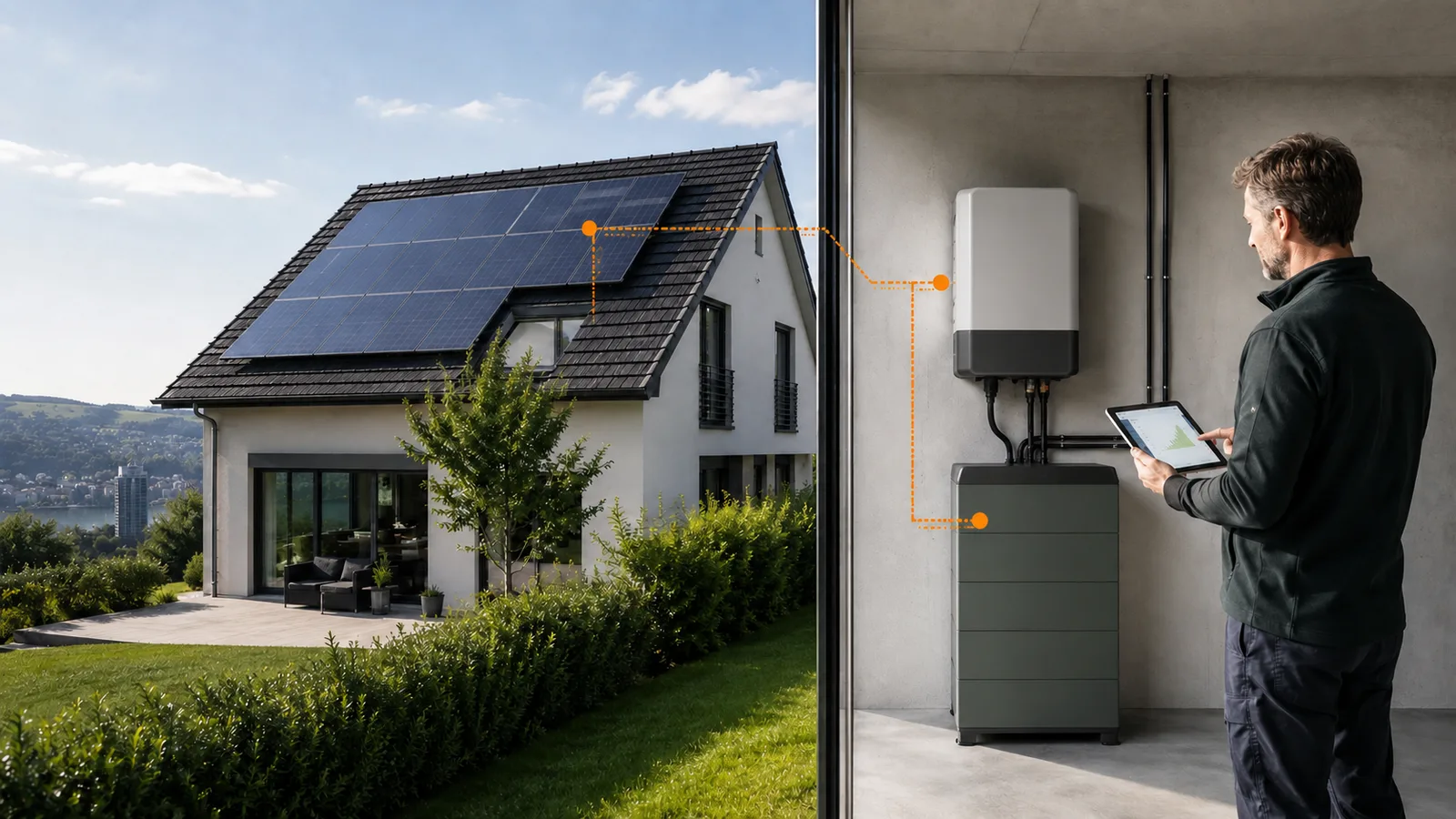
Key points in brief
- Battery costs are best calculated per kWh of usable capacity: currently roughly CHF 800 to 1,200 installed.
- The battery typically increases self-consumption significantly – from roughly 30% to 60% or more, depending on the profile.
- The one-off feed-in incentive applies to the PV part; the federal government currently does not directly subsidise batteries.
- Installing together is cheaper than retrofitting – if you're unsure, at least choose a battery-capable inverter.
The sample calculation: 10 kWp + 10 kWh
| Item | Guideline |
|---|---|
| 10 kWp PV system, turnkey | CHF 20,000–27,000 |
| Battery storage ~10 kWh usable, installed | CHF 8,000–12,000 |
| Total investment | CHF 28,000–39,000 |
| One-off feed-in incentive (PV part only, approx.) | – approx. CHF 3,600 |
| Remaining before tax deduction | approx. CHF 24,400–35,400 |
Guideline values, as of: July 2026, before tax deduction. Pronovo's current rates and the individual quote are decisive.
The price range for batteries depends on manufacturer, capacity, backup-power capability and the installation situation. Larger batteries are cheaper per kWh; backup or emergency power functions cost extra. The market overview: What does a battery storage system cost?
What does the battery change in the calculation?
Without a battery, a typical household directly consumes roughly 25 to 35 percent of its own solar power – the rest flows into the grid. With a properly sized battery, this share often rises to 60 to 80 percent: midday electricity then also covers the evening and night.
Economically this means: every stored kilowatt-hour replaces grid purchases at the full tariff, instead of being sold at the feed-in tariff. So the battery's value is the difference between the electricity price and your utility's feed-in tariff – and that's exactly why the calculation turns out differently depending on the municipality. With a low feed-in tariff and a high electricity price, the battery works for you; where the two are close together, the margin gets thin. The figures for your municipality: Feed-in tariffs compared.
Whether the bottom line comes out positive deserves its own honest look – we cover that in the article Is a battery storage system worth it?
Example, Canton of Zurich: the City of Zurich has subsidised battery storage since 1 August 2026 with a CHF 1,000 base contribution plus CHF 100 per kWh (second-life bonus: another CHF 100 per kWh); ewz remunerates fed-in electricity in 2026 at an average of 12.91 Rp./kWh, while EKZ and many municipal utilities use the reference market price. What this means for 10 kWp plus 10 kWh in Zurich: Solar system with battery in Zurich.
Which battery size fits?
The rule of thumb from planning: choose battery capacity roughly in line with your daily evening/night consumption – for many single-family homes that's 8 to 12 kWh. An oversized battery is never full in winter and never empty in summer; but you've paid for it regardless. The derivation with examples: The right battery size.
Install together or retrofit?
Both work – but not at the same price. Installing together, PV and battery share the electrician, site visits and, in part, the components (hybrid inverter). Retrofitting adds an additional battery inverter, depending on the system architecture, plus renewed installation effort.
The pragmatic middle ground we often recommend: build battery-ready. A hybrid inverter costs moderately more but keeps the door open – the battery can be added later once prices, tariffs or your own consumption make the case. The technical variants are explained in DC or AC coupling.
Two observations from consultations in the region: first, battery size is often chosen by gut feeling – «let's take the big one». A look at the load profile then often shows that the smaller step delivers the same effect for half the money. Second, many underestimate the difference between backup-power marketing and a genuine emergency power function: not every battery keeps supplying the house during a grid outage. Anyone who cares about this must specify it explicitly – beforehand, not afterwards.
Frequently asked questions
What does a battery cost per kWh?
Installed, the current guideline values are around CHF 800 to 1,200 per kWh of usable capacity – larger systems at the lower end, small or backup-capable ones at the upper end (as of: July 2026).
Is there an incentive for the battery?
Currently none directly from the federal government; individual cantons and municipalities run their own programmes. The overview: Battery storage incentives. For tax purposes, the battery counts in many cantons as part of the deductible investment – practice varies.
Does the house keep running on the battery during a power outage?
Only with a demonstrated emergency or backup power function – that's a matter of equipment, not automatic. Details: Backup power function.
How long does a battery storage system last?
Today's lithium systems are designed for several thousand charge cycles; manufacturers usually guarantee ten years or a defined remaining capacity. More on this: Lifespan & cycles.
Can I expand the battery later?
With many systems, yes, module by module – but manufacturer-dependent and not indefinitely, because battery generations change over. Anyone planning to expand should choose the system accordingly.
What does a 10 kWp system with battery cost including installation?
As a guideline, around CHF 28,000 to 39,000 turnkey: roughly CHF 20,000 to 27,000 for the 10 kWp solar system and CHF 8,000 to 12,000 for a battery with around 10 kWh of usable capacity, each including installation and commissioning. The federal one-off feed-in incentive for the PV part is deducted from this, and in most cantons the tax deduction comes on top. Systems with 12 or 15 kWp are correspondingly higher; the range depends on the roof, the battery system and whether backup power is wanted (guideline values, as of: July 2026, non-binding).
What are the disadvantages of an oversized battery?
It ties up capital that earns no return: capacity that's never filled on normal days extends the payback period without bridging winter – the winter gap remains, however large the battery is. Undersized is the less harmful mistake: a tight battery simply works flat out every day. What matters is evening and night consumption; for many single-family homes that's 8 to 12 kWh usable (choosing the right battery size).
Free initial consultation
PV with or without a battery? We calculate both variants.
Transparently side by side, with your municipality's tariffs – then you decide. Free of charge and without obligation.
Want to calculate yourself first? Solar calculator with official roof data →
Prefer to talk? +41 78 830 83 35
Photovoltaics Switzerland – installation by a specialist company →
Swissolar-certified specialist company · ESTI installation authorisation (Art. 14 NIV) · in Zurich since 2017 · over 150 systems completed · a personal answer from the specialist company, no call centre
Sources: Pronovo AG, SFOE, EnergieSchweiz, manufacturer documentation.
Last updated: 9 July 2026 · Author: ecoEn editorial team