
Solar Panels Zurich: Cost and Incentives at a Glance
A turnkey solar system for a classic single-family home costs, as a guideline, CHF 2,100–2,700 per kWp. Zurich adds three location advantages: the federal one-off feed-in incentive (around CHF 360 per kWp for roof-mounted systems), one of the most generous city incentive schemes in Switzerland, and with ewz one of the highest feed-in tariffs in the region (12.91 Rp./kWh). ecoEn plans and installs as a direct specialist company based in Zurich – over 150 systems in the region. (As of July 2026)
This page brings together what concretely matters for your solar system in the City and Canton of Zurich: guideline costs, current incentive amounts, your grid operator's feed-in tariff and real projects from the neighbourhoods. New buildings in the Canton of Zurich are also subject to a self-generation obligation – details in the guide on the solar obligation. The technology and our services at a glance can be found on the Photovoltaics page.
What does a solar system cost?
Cost depends mainly on system size, roof covering and the condition of the household electrics – not on the neighbourhood. As orientation, here are the guideline prices per kilowatt of capacity (kWp):
| System size | Guideline price per kWp | Typical use |
|---|---|---|
| 3–5 kWp | CHF 2,400–3,000 | small roofs, partial coverage |
| 5–10 kWp | CHF 2,100–2,700 | classic single-family home |
| 10–15 kWp | CHF 2,000–2,500 | larger single-family home, with heat pump or EV |
| 15–30 kWp | CHF 1,800–2,300 | large single-family roofs, small apartment buildings |
| from 30 kWp | CHF 1,500–2,000 | apartment buildings, businesses |
Guideline prices as of July 2026, turnkey incl. installation and VAT, before incentives. The binding figure is the individual quote.
The solar calculator uses the official roof data for your building.
Incentives in the City and Canton of Zurich
The City of Zurich is one of the most generous incentive locations in Switzerland: since 1 August 2026 a base contribution of CHF 5,000 plus CHF 450 per kWp up to 30 kWp applies (tiered lower above that), plus a CHF 3,000 flat rate for systems requiring a permit – and for the first time, battery storage is also subsidised (CHF 1,000 base contribution plus CHF 100 per kWh, second-life bonus a further CHF 100 per kWh). All details and how the application works: City of Zurich incentives and City of Zurich storage incentives.
The Canton of Zurich does not pay its own blanket PV incentive – what counts here is the federal one-off feed-in incentive (around CHF 360 per kWp for roof-mounted systems, as of July 2026), additional contributions from individual municipalities and the full tax deduction. Overview: Canton of Zurich incentives.
What does your grid operator pay for solar power?
In the City of Zurich, ewz remunerates exported solar power in 2026 at an average of 12.91 Rp./kWh (energy 8.5 Rp. peak and 4.45 Rp. off-peak, plus 3 Rp. guarantee of origin and 2 Rp. solar incentive) – anyone selling to the neighbourhood via ewz.solarquartier reaches 14 Rp./kWh. That makes the ewz area one of the most attractive feed-in locations in the region: ewz feed-in tariff in detail.
In the EKZ municipalities around the city, the federal quarterly reference market price plus guarantee of origin applies, backed by the minimum remuneration of 6.0 Rp./kWh for systems up to 30 kWp: EKZ tariff. All grid operators compared: feed-in tariffs in the region.
Solar power in Zurich: yield, self-consumption and export
A solar system in Zurich delivers, as a guideline, 950–1,100 kWh per kWp and year – a 10 kWp system therefore around 10,000 kWh, more than an average single-family home uses in a year. For the economics, though, what counts is less the yield than the share you use yourself: self-consumed solar power replaces grid electricity at the full purchase tariff (Swiss median price 2026 around 28 Rp./kWh according to ElCom), while exported power is remunerated by ewz at 12.91 Rp./kWh. Without storage, self-consumption in a single-family home is typically 25–35%, with battery storage 60–80% – a heat pump and EV charger shift additional consumption into the sunshine hours. Which levers work without new technology: optimising self-consumption.
If you don't need the solar power yourself, there are two routes in the City of Zurich: exporting to ewz (12.91 Rp./kWh, up to 14 Rp./kWh via ewz.solarquartier – ewz tariff in detail) or, in an apartment building, a self-consumption community (ZEV), in which tenants draw power from their own roof. How much solar power your roof delivers is shown by the solar calculator with the official roof data for your address.
Photovoltaics in the Canton of Zurich: the numbers
In the Canton of Zurich, 32,829 photovoltaic systems with a combined 923.6 MW of capacity are in operation – an average of 28.1 kWp per system, 11.6% of them roof-integrated. In the City of Zurich alone there are 2,445 systems with 96.25 MW. Per capita, however, the canton ranks only 24th of 26 at 566 watts: the potential on Zurich's roofs is far from exhausted. (Source: Swissolar, Statistik Sonnenenergie 2025; as of August 2026)
All cantons and the largest municipalities compared: Photovoltaics Switzerland in numbers.
Solar for a single-family home in Zurich: cost, incentives, calculation
The most common system in the Canton of Zurich is the 10 kWp system on a single-family home – turnkey, as a guideline, CHF 20,000 to 27,000 before incentives (as of July 2026). What remains depends on where you live:
- City of Zurich (ewz area): since 1 August 2026, CHF 5,000 base contribution plus CHF 450 per kWp – for 10 kWp, CHF 9,500 total incentive including the federal contribution. That leaves around CHF 10,500 to 17,500.
- Rest of the canton (EKZ and municipal utilities): the federal one-off feed-in incentive of around CHF 360 per kWp – for 10 kWp around CHF 3,600 – plus any additional municipal contributions; the canton itself pays no PV incentive.
- For everyone: in the Canton of Zurich, the investment is deductible from taxable income, minus incentives received – worked examples in the tax guide further below.
Example: south-west pitched roof, 4-person household with around 5,000 kWh consumption: a 10 kWp system delivers 9,500 to 11,000 kWh a year; without storage, 25 to 35 percent stays in the house, the rest goes to the grid at the feed-in tariff. Scenarios and system sizes: Solar for a single-family home: cost overview · City of Zurich incentives · Incentives in the Canton of Zurich.
Solar system with storage in Zurich: what storage changes in the calculation
With around 10 kWh of battery storage, self-consumption of a 10 kWp system rises from 25–35 to 60 to 80 percent. Installed storage costs, as a guideline, CHF 8,000 to 12,000; the full package of 10 kWp plus 10 kWh CHF 28,000 to 39,000 before incentives (as of July 2026).
- City of Zurich: since 1 August 2026, storage is subsidised for the first time – CHF 1,000 base contribution plus CHF 100 per kWh, with second-life batteries a further CHF 100 per kWh. For 10 kWh that's CHF 2,000, or CHF 3,000 with second-life.
- When it pays off: the lower your utility's feed-in tariff (ewz 2026 average 12.91 Rp./kWh; EKZ and many municipal utilities at the reference market price with a 6.0 Rp. floor) and the higher the electricity price, the more every self-used kilowatt-hour is worth. With a heat pump or EV, the calculation shifts further in favour of storage.
- When it doesn't: with low consumption or a tight budget, we design the system storage-ready and add storage later – usually without any problem.
Worked example and storage size: Solar system with storage: cost and example calculation · City of Zurich storage incentives.
All services around your solar system in Zurich
In Zurich, a solar system is rarely the end of the planning: storage, EV charger and heat pump are part of the same calculation – and the same incentives. Details on each component:
- Battery storage in Zurichsubsidised by the City of Zurich since August 2026, retrofittable
- EV charger and electric car with solar powersurplus charging, load management, underground car parks
- Heat pump in Zurichcantonal incentive for heating replacement, PV-controlled
- Roof-integrated solar systemfor renovation and townscape, higher one-off incentive
- Photovoltaics for business in Zurichflat roof, self-consumption, GREIV from 100 kWp
- Maintenance and system checkcheck existing systems, secure the yield
References from the City of Zurich
Real systems instead of stock images – three examples from the neighbourhoods:
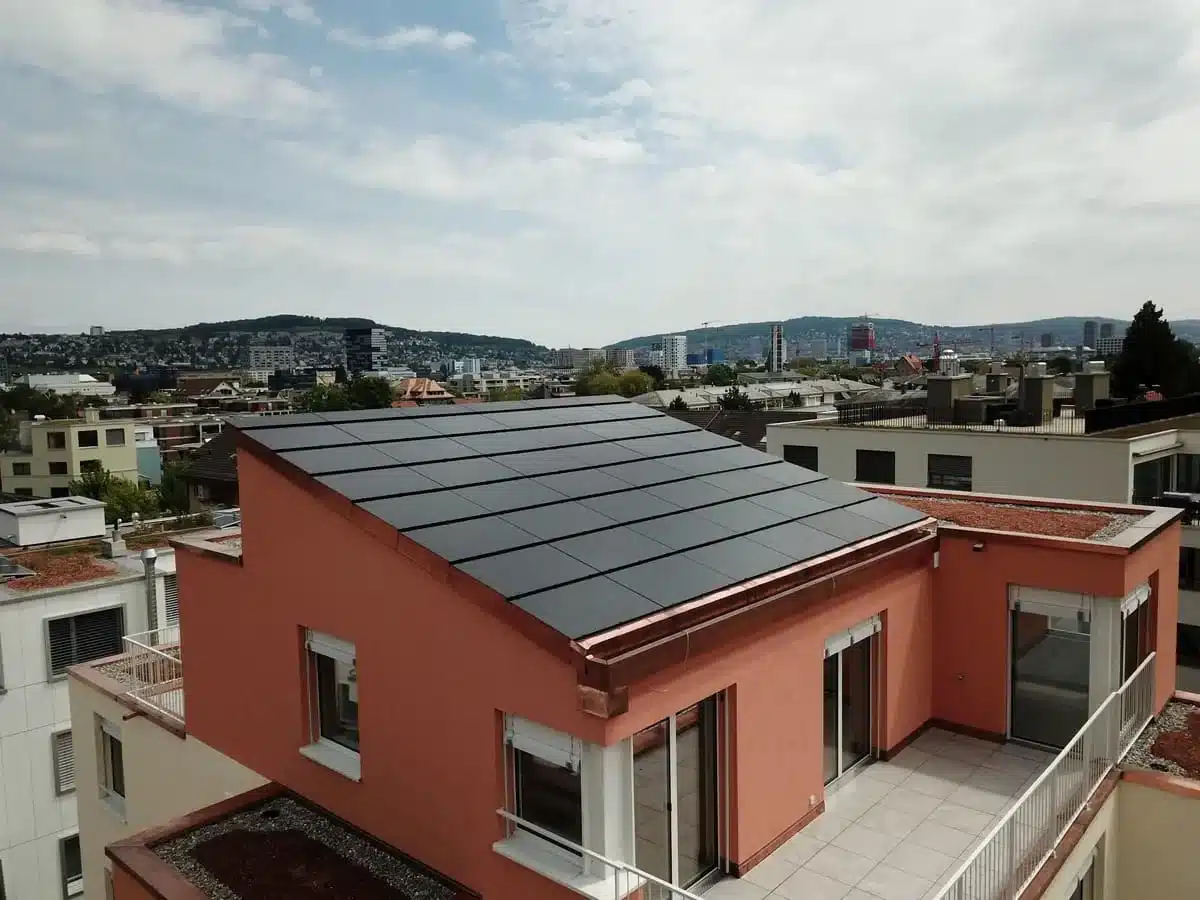
Apartment building, roof-integrated, Zurich (8048)
- Stampfenbrunnenstrasse · apartment building
- Roof-integrated system
- Commissioned 2021
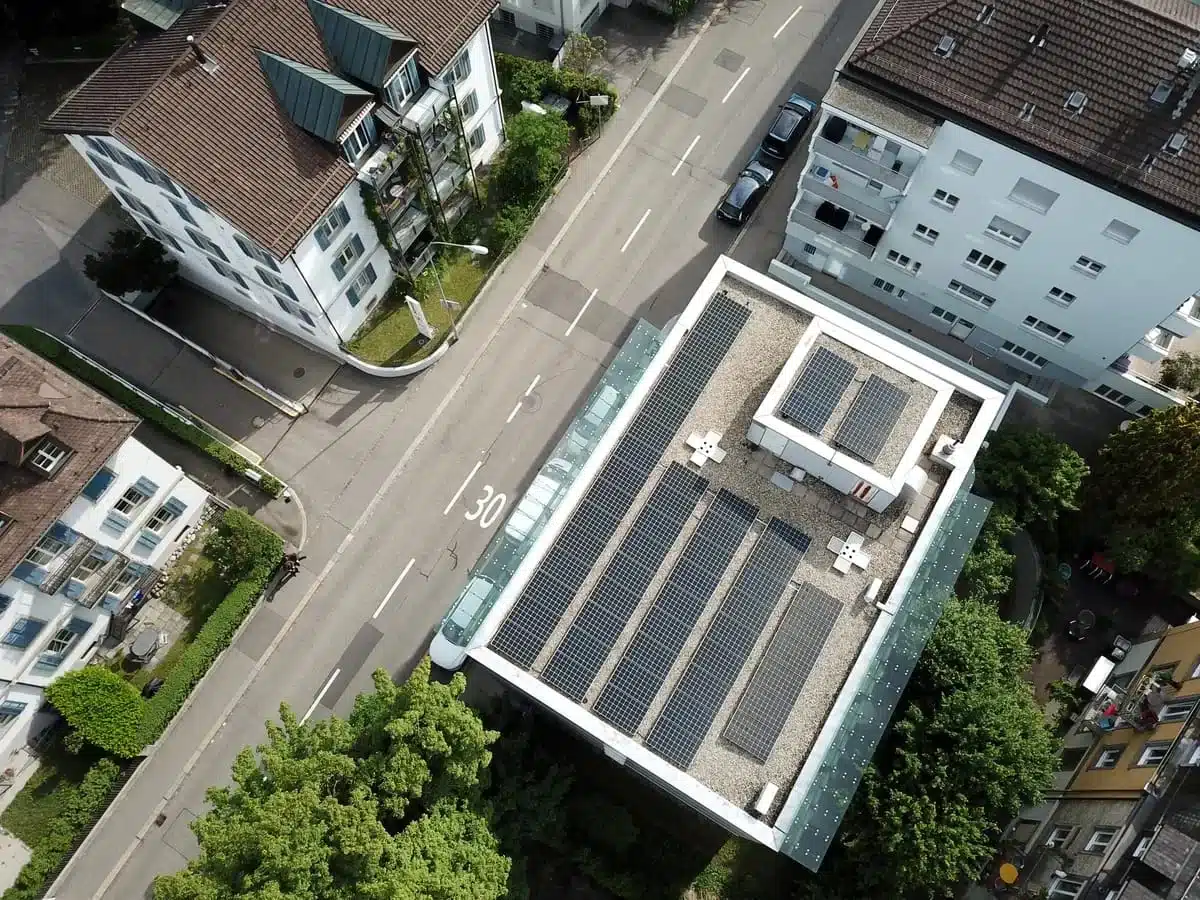
Commercial flat roof, Zurich (8032)
- Hofackerstrasse · commercial building
- Flat-roof system
- Commissioned 2020
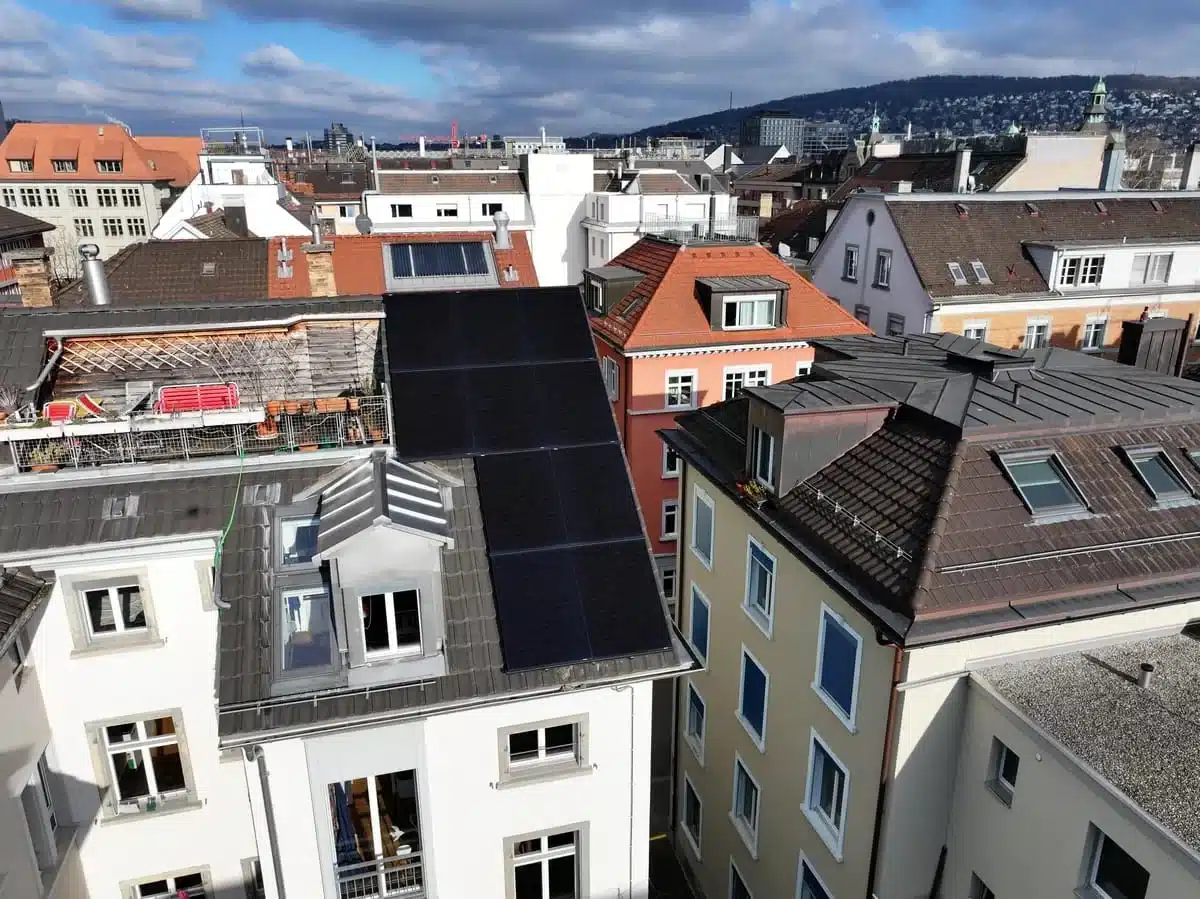
Housing cooperative roof, Zurich (8004)
- Anwandstrasse · housing cooperative
- ewz Solarsplit billing model
- Commissioned 2024
All completed systems with key data: Projects & references.
How your project works
- Initial consultation. Free and without obligation – on site or by phone.
- Site visit & planning. Roof, meter box and consumption: we design the system to suit your building.
- Quote. Transparently itemised – every item traceable.
- Permit & registration. We handle the notification procedure, grid operator and Pronovo for you.
- Installation. By our own team – no passing the job on to subcontractors.
- Commissioning & service. Acceptance, instruction and monitoring – we remain your point of contact.
What our quote includes – and what it doesn't
The most common worry before signing isn't the price but the question of what gets added at the end. That's why we show both.
Included: planning and design, materials (modules, inverter, mounting system, cabling), scaffolding, installation, the electrical connection by our own specialist company, commissioning and measurement, registration with the grid operator and the incentive application to Pronovo – we submit it for you.
Shown separately: anything added in individual cases appears as its own item in the quote, not in a lump sum. The most common case: if the existing meter distribution board – the fuse box – is not suitable for the system and needs to be adapted, we invoice this separately. Depending on the property, official fees and work provided by the client may also apply.
Payment in stages, linked to project progress. Under our terms and conditions (AGB), that's 30% on placing the order, 50% on delivery of the main components and 20% after commissioning and acceptance. We agree different terms on a project basis; the arrangement in your quote always applies.
Who is liable for what
After the company bankruptcies in the Swiss solar industry, this is the question that counts in the end – and it has three different answers:
- Product and performance warranties lie with the manufacturer of the modules, inverter and storage. A manufacturer's warranty is only ever as reliable as the manufacturer behind it – that's why, when choosing products, we also consider who will still be reachable if something goes wrong.
- The installation warranty lies with us: installation, electrical work, commissioning. That's the part we honour directly.
- Business liability insurance: as an installation company, we carry liability insurance.
In the event of a fault, you have one point of contact – us – regardless of whose component is affected.
Frequently asked questions
What does a solar system cost in Zurich?
What incentives are available in the City of Zurich?
How much does ewz pay for exported solar power?
Do I need planning permission in Zurich?
Does ecoEn also install storage and heat pumps?
Does a solar system pay off in the City of Zurich?
Do I need to declare my solar system on my tax return?
What does a solar system for a single-family home cost in Zurich?
Is battery storage subsidised in Zurich?
Guides for Zurich homeowners
- What does a solar system cost? The complete cost guide
- City of Zurich incentives in detail
- Incentives in the Canton of Zurich
- ewz feed-in tariff 2026
- Planning permission or notification procedure?
- Does a solar system pay off?
- Solar systems on apartment buildings
- Solar obligation: what applies to new buildings?
- Finding a solar company and installer in Zurich
- Solar systems for businesses and SMEs: cost and self-consumption
- Solar systems in agriculture: cost, HEIV and rules
- Photovoltaics for business and industry in Zurich
Free quote for your address
Site visit, incentive check and a transparently itemised quote – without obligation and without sales pressure.