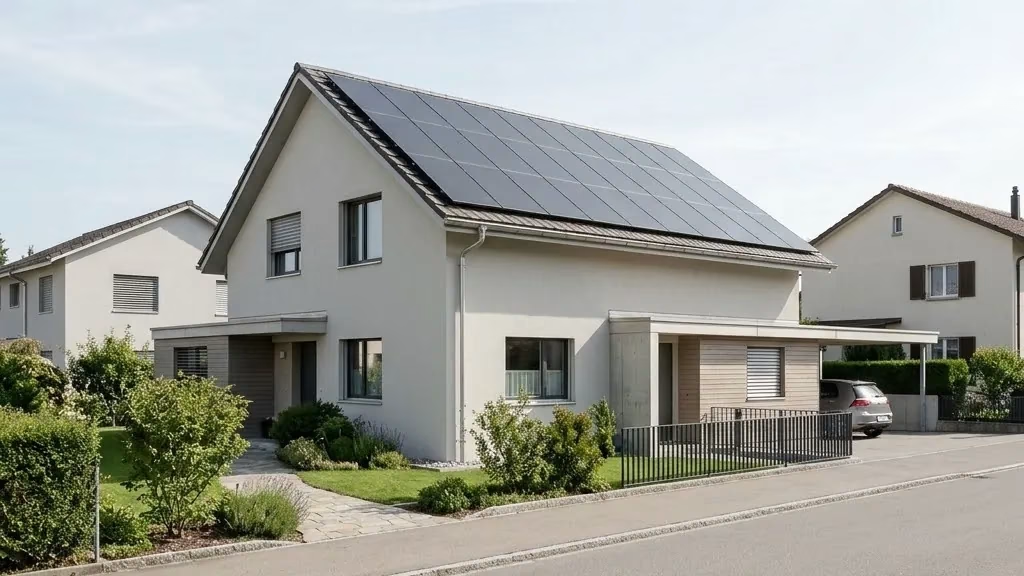
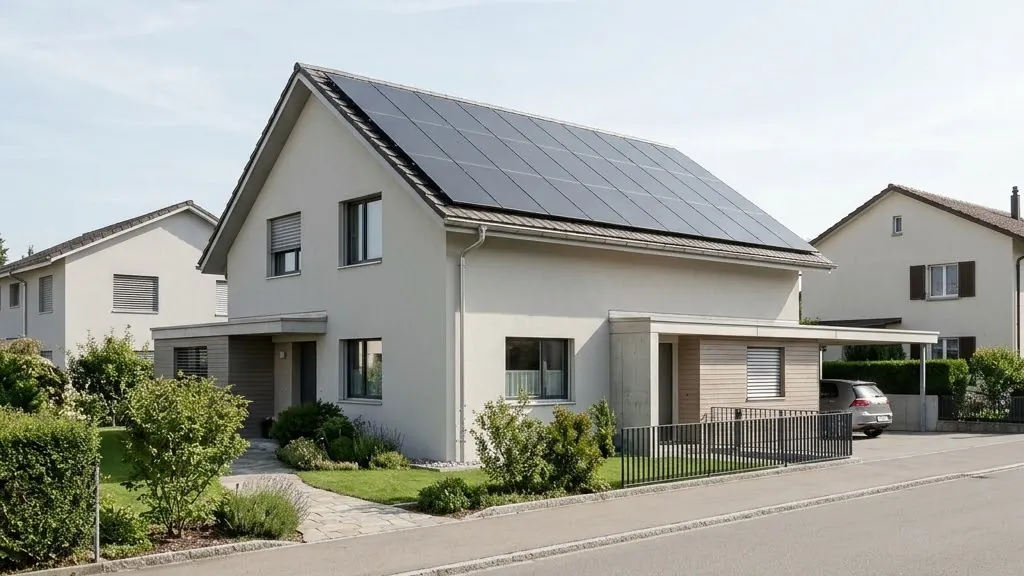
For a single-family home in Switzerland, a turnkey solar system typically costs between CHF 12,000 and 37,000 before incentives, depending on size. The most common constellation – around 10 kWp – costs CHF 20,000 to 27,000; the one-off feed-in incentive and the tax deduction recover a notable part of that. Which scenario fits your house is decided above all by the roof. (Guideline values, as of: July 2026)
Key points in brief
- Three typical single-family home scenarios: partial coverage (~5 kWp), standard (~10 kWp), full coverage of large roofs (~15 kWp).
- Besides the system, the budget also has to include electrical adaptations and – depending on the plan – a storage battery or wallbox.
- The one-off feed-in incentive (currently around CHF 360 per kWp) and the tax deduction reduce the net cost significantly.
- The condition of the roof plays a role too: if a renovation is due in the next few years, it belongs in the planning.
- Budget for the next 25 years, not for today's electricity consumption.
Which system size fits which single-family home?
The cost question starts with the roof, not the catalogue. Three constellations cover the bulk of single-family homes:
| Scenario | Typical situation | Turnkey (guideline value) | After the one-off feed-in incentive (approx.) |
|---|---|---|---|
| Partial coverage, ~5 kWp | small or irregularly shaped roof, terraced single-family home | CHF 12,000–15,000 | CHF 10,200–13,200 |
| Standard, ~10 kWp | classic single-family home roof, with an eye on a heat pump or electric car | CHF 20,000–27,000 | CHF 16,400–23,400 |
| Full coverage, ~15 kWp | generous roof or east-west on both sides | CHF 28,000–37,000 | CHF 22,600–31,600 |
Guideline values, as of: July 2026, incl. installation and VAT, before the tax deduction. KLEIV rate currently around CHF 360 per kWp; Pronovo's current rates and the individual quote are authoritative.
The detailed calculations for the individual sizes: 5 kWp, 10 kWp and 15 kWp. Anyone who wants to understand the pricing logic behind it – why small systems are more expensive per kilowatt – will find it in the article Cost per kWp.
An observation from many consultations: most owners start with too small a figure in mind, because they base it on today's consumption. But the system sits on the roof for 25 years and more – and during that time, many households add a heat pump or electric car.
What else belongs in the budget for a single-family home?
The system price is the biggest item, but not necessarily the only one. For a single-family home, it's worth looking at four more points:
The house electrics. In houses with older wiring, an adaptation of the meter box or the supply line may become necessary. This shows up during the site visit – reputable quotes show it as a line item instead of adding it later to the final invoice.
The roof condition. A covering that will need renovating in five years is the wrong base for a new system: dismantling and rebuilding costs double. If the renovation is due anyway, an in-roof solution can become interesting – more on this in the article In-roof photovoltaics.
Storage – now or later. A battery storage system noticeably raises the investment and isn't a must for a single-family home. Anyone who wants to keep the option open chooses the inverter accordingly. Figures and assessment: Solar system with storage and Is a battery storage system worthwhile?
Wallbox. If an electric car is foreseeable, the preparation (empty conduit, reserve at the meter box) costs little within the ongoing project – retrofitting it as a separate job costs significantly more.
How much do incentives and the tax deduction bring down the cost?
For the single-family home, three effects typically come together:
1. One-off feed-in incentive (EIV): currently around CHF 360 per kWp, paid out via Pronovo after commissioning – so around CHF 3,600 for 10 kWp (as of: July 2026). 2. Tax deduction: in most cantons – including Zurich – the investment on existing buildings is deductible from taxable income. Depending on income, that amounts to another four-figure sum; the details: Tax deduction for solar systems. 3. Municipal contributions: individual municipalities and cities pay additionally – the overview by region: Incentives Switzerland.
The current regulations of Pronovo or the canton and municipality are authoritative – programmes change, sometimes at short notice.
Example: Canton of Zurich. In the City of Zurich, ewz has been paying a CHF 5,000 base contribution plus CHF 450 per kWp since 1 August 2026 – for 10 kWp, CHF 9,500 total incentive including the federal contribution; in the rest of the canton it remains at the one-off feed-in incentive plus any municipal contributions. The calculation for city and canton with an example: Solar system Zurich: cost and incentives.
What does operation cost afterward?
Little, but not nothing – and that belongs in an honest overview. Ongoing items for a single-family home: the grid operator's meter rental or metering costs, possibly an extension of the building insurance, and reserves for the inverter, which is typically replaced once during the system's lifetime. Cleaning isn't a subscription matter on most pitched roofs – why is explained in the article Cleaning a solar system.
The budget conversation for a single-family home rarely revolves around the module price – almost always around the items surrounding it. We regularly see two patterns in the region: houses built in the 60s, 70s or 80s, where the meter box is the real surprise, and families who want the storage battery «later» but have been quoted an inverter with no retrofit option. Both are solvable if they're on the table before signing – afterward it gets more expensive.
Frequently asked questions
What does a solar system for a typical single-family home cost in total?
With the most common size around 10 kWp: CHF 20,000 to 27,000 turnkey, before incentives (as of: July 2026). After the one-off feed-in incentive and the tax deduction, the effective burden is usually significantly lower – the exact figure depends on the roof, electrics and tax situation.
Is the system also worthwhile for a small terraced single-family home?
Often yes, with adjusted expectations: partial coverage around 5 kWp covers a good part of the household's electricity and benefits from the same incentives. It's more expensive per kWp than larger systems – whether it pays off is shown by the individual calculation.
Should I wait for falling prices before investing?
The components have become cheaper, but the craft share tied to Swiss wages hardly falls. Anyone who waits loses years of production in the meantime and keeps paying the full grid electricity price. We don't see a «right» moment in the sense of a price crash.
Can I finance the costs via the mortgage?
Many banks finance energy investments via a mortgage increase, sometimes at preferential terms. That's a conversation with your bank – we provide the quote and the technical documents for it.
How quickly does the system pay off for a single-family home?
A reputable answer needs your figures: consumption, roof, the utility's tariffs. Over the years, the payback period typically sits in a range of roughly ten to fifteen years – the assessment with all the factors: Is a solar system worth it?
Free initial consultation
Your single-family home, your figures
Roof, electrics, consumption, your municipality's incentives: we calculate the variants for your house – free of charge, without obligation, and transparent item by item.
Want to calculate yourself first? Solar calculator with official roof data →
Prefer to talk? +41 78 830 83 35
Photovoltaics Switzerland – installation by a specialist company →
Swissolar member and Solarprofi · ESTI installation authorisation (Art. 14 NIV) · in Zurich since 2017 · over 150 systems completed · a personal answer from the specialist company, no call centre
Further guides
 Kosten-Übersicht Schweiz
 Was kostet eine 10-kWp-Anlage?
 Solaranlage mit Speicher
 Förderung im Überblick
 Offerten richtig vergleichen
Sources: Pronovo AG (current EIV rates), Swiss Federal Office of Energy SFOE, SwissEnergy, Swissolar.
Last updated: 9 July 2026 · Author: ecoEn editorial team