
Photovoltaics for business and industry in Zurich: hall roofs that pay off
The Canton of Zurich has the second-highest installed solar capacity in Switzerland – and yet ranks only 24th of 26 per capita. The gap is the hall roofs: the Limmat valley, the Glatt valley, Winterthur and the commercial zones along the A1 have more empty roof area than any residential estate. ecoEn plans and builds photovoltaic systems for commercial and industrial businesses in the Zurich area – from 30 kWp on a workshop to a large-scale system on a logistics roof, designed around your business's load profile rather than the roof area. A direct specialist company from Zurich-Oerlikon with its own electrical installation and ESTI installation authorisation (Art. 14 NIV), not a broker. For apartment buildings and condominium ownership: Solar systems for apartment buildings, STWEG and ZEV.
Built in the Zurich area – with key data
Three completed systems on commercial and large roofs, no stock images:
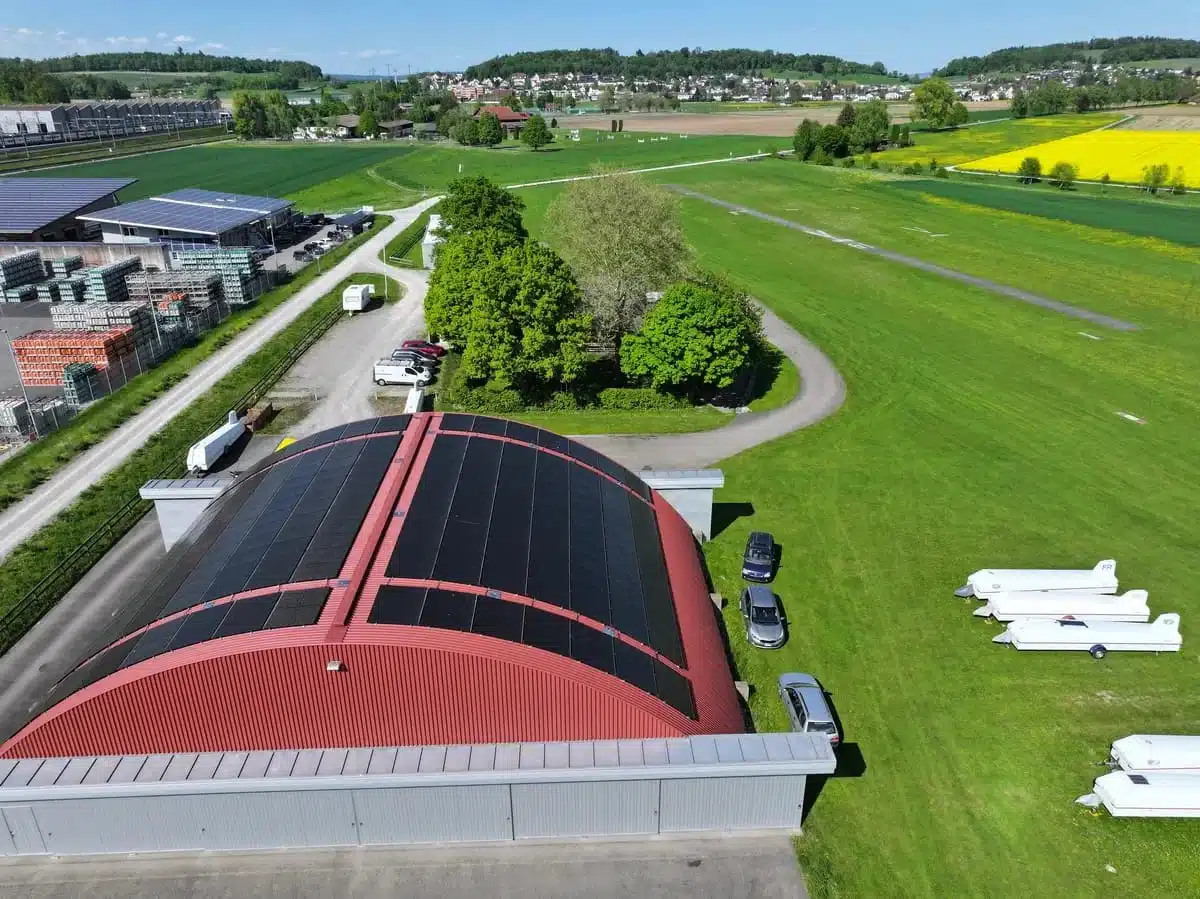
Industrial roof, gliding airfield, Winterthur
- 89.6 kWp · 224 modules · 110 kVA
- East-west layout on trapezoidal sheet metal
- Commissioned 2022 · EKZ
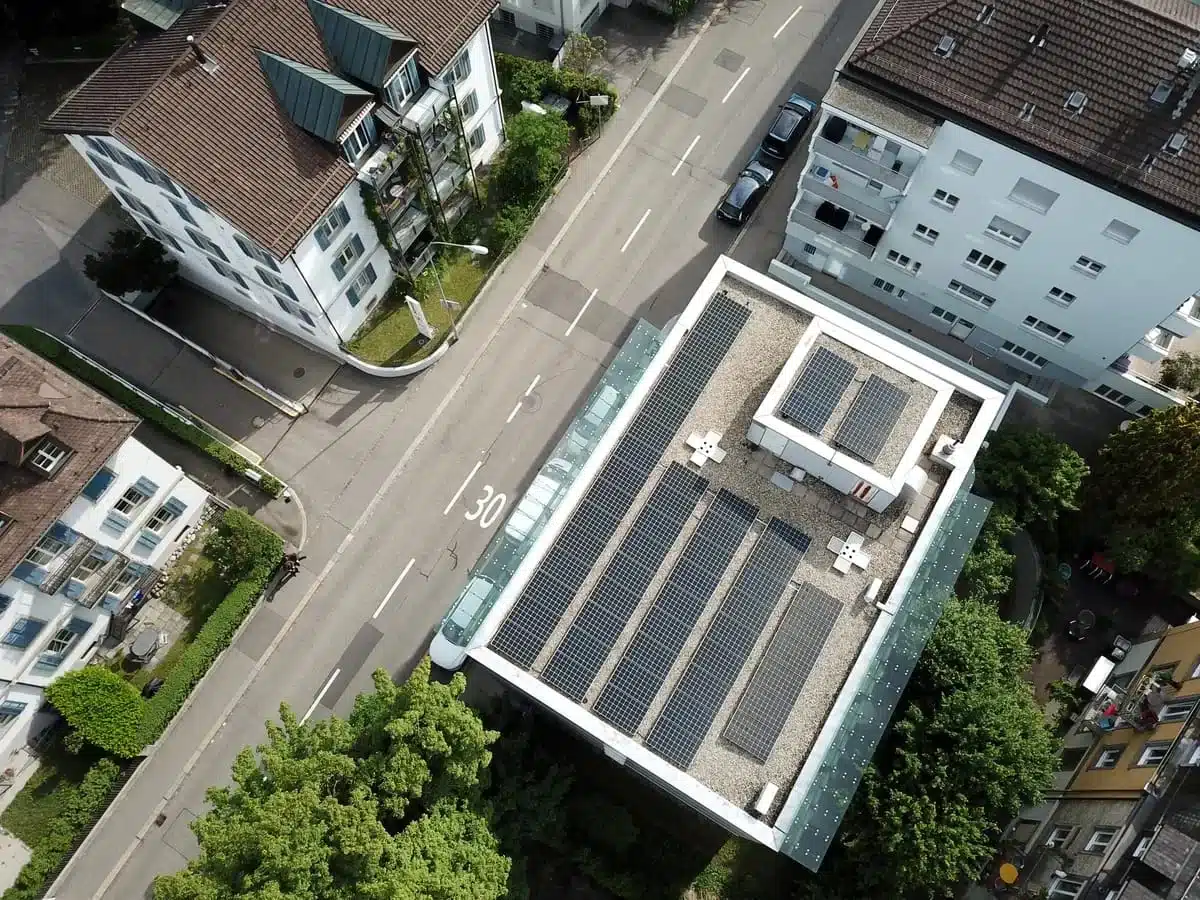
Commercial flat roof, Zurich 8032
- 19.25 kWp · 55 modules
- Flat-roof mounting · ewz Solarsplit
- Commissioned 2020
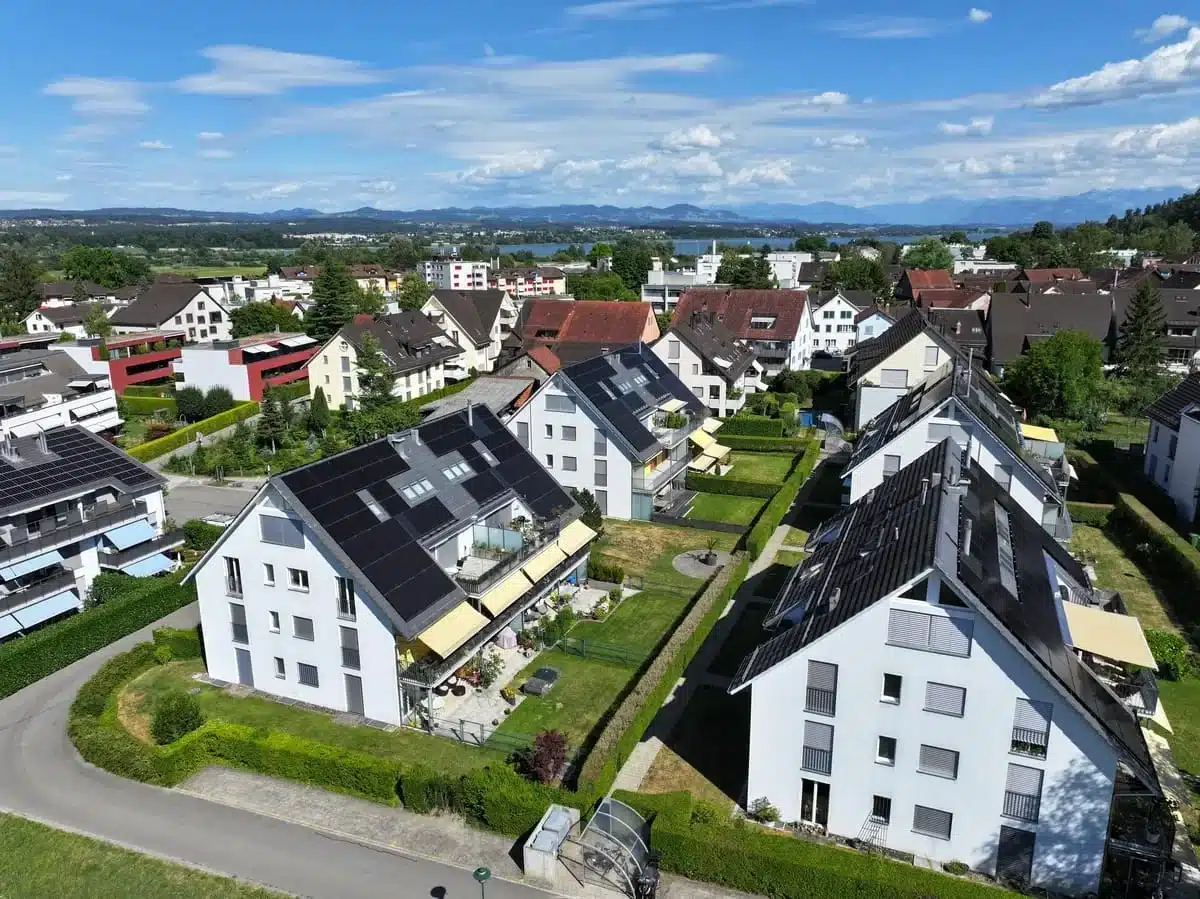
Large-scale system over 100 kWp, Fällanden
- over 100 kWp · 274 modules · 2 buildings
- Self-consumption optimisation · EV load management
- Commissioned 2023/2024
All completed systems with key data: Projects & references.
How a commercial project with ecoEn works
- Guideline quote from your electricity bill and roof plan. The annual bill – from 100,000 kWh, the quarter-hour values – and roof dimensions are enough for an initial framework: system size, self-consumption, incentive route.
- Site visit and structural analysis. Roof skin, fastening (trapezoidal sheet metal or ballast), main distribution board, transformer station, cable routes – the structural verification comes before sizing.
- Concept. Layout, inverters, metering concept for multiple tenants, incentive route (EIV, GREIV, supplements or auction), storage and charging infrastructure on request – readable for management.
- Permit, connection, incentives. Notification procedure or building application with the municipality, connection application to ewz or EKZ, GREIV application before construction – we keep to the right sequence.
- Installation and electrical work. Roof installation outside peak operating times, electrical installation and grid registration by our team with ESTI installation authorisation, acceptance.
- Operation. Monitoring set up, yield and self-consumption visible monthly, responsibilities agreed in writing.
Where the large roofs are in the Zurich area
The federal public plant register shows where commercial systems have long been everyday. The average system size per municipality is the more meaningful figure than total capacity – where it is above 50 kWp, these are halls, not homes:
| Location | Systems | Ø system (kWp) | Building type |
|---|---|---|---|
| Regensdorf | 118 | 131,1 | Almost all capacity on industrial and logistics roofs |
| Schlieren | 142 | 90,4 | Limmat valley commercial axis, industrial and life sciences sites |
| Volketswil | 302 | 52,8 | Glatt valley logistics and retail |
| Canton of Zurich total | 32’829 | 28,1 | Per capita rank 24 of 26 – many hall roofs are still empty |
Our own analysis of the SFOE register «Electricity production plants», data as of August 2026. All cantons and 35 municipalities: Photovoltaics Switzerland in numbers.
Two takeaways: in the Limmat valley (Schlieren, Dietikon, Regensdorf), the Glatt valley (Volketswil, Kloten, Wallisellen, Dübendorf) and in Winterthur, grid operators and building authorities know the process for large-scale systems – the route there is short. And because the canton lags so far behind per capita, every large roof counts double: the existing halls are the potential.
Why self-consumption carries the calculation for businesses
Since 2026, a new regime applies to export: for systems under 150 kW, the statutory minimum remuneration falls with size; from 150 kW, the grid operator only pays the quarterly reference market price – around 3.90 Rp./kWh in the second quarter of 2026. A business, by contrast, typically buys its electricity for around 20 Rp./kWh. Every kilowatt-hour from your own roof that stays in the workshop, the cooling system or the charging stations is therefore worth around five times as much as an exported one.
| Type of farm | Self-consumption without storage (empirical value) |
|---|---|
| Workshop, production (Mon–Fri daytime) | 60–80 % |
| Cold store, food, beverages | 60–80 % |
| Office, services, practice | 40–60 % |
| Retail, hospitality | 50–70 % |
| Warehouse without cooling, shed | 20–40 % |
Empirical values as of September 2026; what's decisive is the analysis of the load profile (quarter-hour values), which businesses with an annual consumption of around 100,000 kWh or more can obtain from their grid operator. Worked examples by business type: Solar systems for businesses and SMEs.
This leads to the most important planning rule: the system is designed around the load profile, not the roof area. Storage rarely pays off for self-consumption in businesses, but often for peak shaving – see commercial storage.
Solar obligation: federal since 2025 – and the Zurich proposal for roofs over 300 m²
Since 2025, federal law has required a solar system on new buildings with more than 300 m² of chargeable floor area – this affects practically every new hall. On 6 January 2026, the Zurich cantonal government also submitted an amendment to the Energy Act to the cantonal parliament, under which suitable roofs over 300 m² would have to be fully covered with solar systems – on new buildings from construction, on existing buildings when the roof is renovated, with exceptions for lack of economic viability, lack of grid capacity or protection interests. The cantonal parliament will decide whether and when the obligation comes; no entry into force has been scheduled. For hall owners, this means today: if you're renovating the roof anyway, it's better to plan the system voluntarily now – scaffolding and roofer will already be there. Background: Solar obligation Switzerland and Photovoltaics on industrial roofs.
What does a commercial system in the Zurich area cost?
With large roofs, the price per kilowatt drops significantly – scaffolding, planning, connection and registration are one-off costs, whether 30 or 100 kWp go on the roof:
| System size | Typical market guideline (fully installed, without storage) |
|---|---|
| ~30 kWp (workshop, practice, small warehouse) | CHF 1,400–1,700 per kWp |
| ~50 kWp (production business, car garage) | CHF 1,500 per kWp and below |
| ~100 kWp (commercial hall, logistics, cold store) | CHF 1,100–1,400 per kWp |
| from 200 kWp (industrial roof) | project-specific – transformer, connection and structure determine the price |
Guideline values based on published Swiss market data, as of July 2026, fully installed, without storage, before incentives and taxes; the individual quote based on the load profile and site visit is binding. Not included: structural verification, scaffolding, changes to the main distribution board or transformer station, metering for multiple tenants.
Detailed worked examples are in our guides: Solar systems for businesses and SMEs (30–100 kWp), Photovoltaics on industrial roofs (from 100 kWp), Cold stores and Financing a solar system as a business – purchase, leasing, contracting and roof rental compared, with input VAT and depreciation.
Incentives and feed-in in the Zurich area
Federal. The one-off feed-in incentive is around CHF 360 per kWp for the part of the system up to 30 kWp and around CHF 300 per kWp above that, plus a base contribution (EnFV Annex 2.1, as of August 2026) – for 100 kWp, in the order of CHF 30,000. From 100 kW, the application runs as GREIV and can be submitted before construction; for car park canopies from 100 kW there's an additional car park bonus of CHF 250 per kW, for systems with a tilt of 75° or more the tilt angle bonus. From 150 kW, the auction is an alternative.
City of Zurich. Since 1 August 2026, a base contribution of CHF 5,000 plus CHF 450 per kWp up to 30 kWp applies (tiered lower above that), plus a CHF 3,000 flat rate for systems requiring a permit: City of Zurich incentives. The Canton of Zurich does not pay its own blanket PV incentive; individual municipalities have additional programmes: Canton of Zurich incentives.
Feed-in. In the ewz area, ewz remunerates solar power in 2026 by peak and off-peak tariff plus guarantee of origin and solar incentive – an average of around 12.91 Rp./kWh for the typical roof system (ewz tariff in detail); in the EKZ municipalities, the quarterly reference market price plus guarantee of origin applies, backed by the minimum remuneration for small systems (EKZ tariff). From 150 kW system capacity, the minimum remuneration no longer applies anywhere – one more reason to design for self-consumption. All utilities: feed-in tariffs in the region.
A second roof area: the company car park
The car park in front of the hall is both the obvious second consumer and the second surface: employees charge during the day when the system is producing, and canopies from 100 kW receive the federal car park bonus. We plan charging infrastructure with load management on the same service connection right from the start.
- Photovoltaics over the company car park: car park bonus & costs
- Electrifying company car parks: the practical guide
- Load management: controlling multiple charging points
- Billing charging power: employees, fleet, customers
What our quote includes – and what it doesn't
The most common worry before signing isn't the price but the question of what gets added at the end. That's why we show both.
Included: planning and design, materials (modules, inverter, mounting system, cabling), scaffolding, installation, the electrical connection by our own specialist company, commissioning and measurement, registration with the grid operator and the incentive application – we submit it for you.
Shown separately: anything added in individual cases appears as its own item in the quote, not in a lump sum. The most common case: if the existing meter distribution board – the fuse box – is not suitable for the system and needs to be adapted, we invoice this separately. Depending on the property, official fees and work provided by the client may also apply.
Payment in stages, linked to project progress. Under our terms and conditions (AGB), that's 30% on placing the order, 50% on delivery of the main components and 20% after commissioning and acceptance. We agree different terms on a project basis; the arrangement in your quote always applies.
Who is liable for what
After the company bankruptcies in the Swiss solar industry, this is the question that counts in the end – and it has three different answers:
- Product and performance warranties lie with the manufacturer of the modules, inverter and storage. A manufacturer's warranty is only ever as reliable as the manufacturer behind it – that's why, when choosing products, we also consider who will still be reachable if something goes wrong.
- The installation warranty lies with us: installation, electrical work, commissioning. That's the part we honour directly.
- Business liability insurance: as an installation company, we carry liability insurance.
In the event of a fault, you have one point of contact – us – regardless of whose component is affected.
Frequently asked questions
Does ecoEn also build systems over 100 kWp?
What does a 100 kWp system on a hall in the Zurich area cost?
What incentives does a commercial business receive in the Canton of Zurich?
Will I soon have to cover my hall roof in the Canton of Zurich with solar?
Can a trapezoidal sheet or flat roof carry the system?
How long does a commercial project take – and does operation stop?
Does ecoEn also work in Winterthur, the Limmat valley and the Glatt valley?
Guides for business and industry
- Solar systems for businesses and SMEs: cost, self-consumption, process
- Photovoltaics on industrial roofs: large-scale systems from 100 kWp
- Solar systems for cold stores
- Photovoltaics over the company car park
- Financing a solar system as a business
- Commercial storage: peak shaving
- PV auctions for large-scale systems
- Charging infrastructure for companies
Your load profile and roof plan are enough for an initial framework.
Send us your annual bill or quarter-hour values and the roof plan – we'll calculate system size, self-consumption and incentive route as a guideline quote. A direct specialist company from Zurich, not a broker.