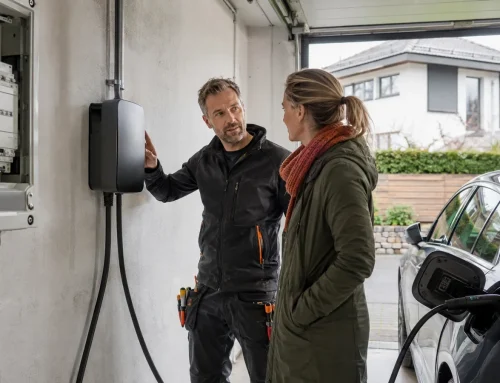
As soon as several parties charge over the same infrastructure, charging electricity needs clean billing – and that starts with metering: each charge point records its own consumption. Billing then runs, depending on the situation, via service charges, a billing system from the wallbox provider, or – for an employer – via defined rules for business and private charging. The basic rule: settle the billing model first, then choose the hardware. (As of: July 2026)
Key points in brief
- Without metering per charge point there's no fair billing – that's the basic technical prerequisite.
- In apartment buildings, three routes have become established: service charges, a billing service provider, or direct contracts.
- With an employer, the core question is separation: who pays for charging at work, and how is private charging recorded?
- Flat rates are tempting but prone to conflict – they penalise light chargers and subsidise heavy ones.
- The billing model belongs at the start of planning, because it determines the choice of wallboxes.
Why is billing the real planning question?
Because it decides the hardware – not the other way round. For a single single-family home, the question doesn't arise: the wallbox hangs off your own meter, the charging electricity appears on your own bill, done. But as soon as several parties are involved – a rental building, condominium ownership, a company car park – everyone charges over shared infrastructure, and someone has to know who drew how much.
This is exactly where solutions bought together after the fact fail: three different wallboxes with no metering function hang off the underground car park's supply line, and at year end the guessing game begins. The order has to run the other way – first the billing model, then charging-infrastructure planning including load management, then the choice of devices. Wallboxes with integrated, calibrated metering and user identification (for example via badge or app) are the basis of almost all multi-party solutions.
The metering question itself is actually the simplest part: modern charge points record their consumption per charging session and per user. What already measures what in the building anyway – the article Metering, meters & monitoring gives the overview.
How is billing done in an apartment building?
Three models have become established – with different effort and different fairness:
Via service charges. The metered charging draws flow into the annual service-charge statement, similar to water or the laundry room. That works well if the administration gets clean figures – and does require metering per charge point. For smaller buildings with few charge points, often the most pragmatic route.
Via a billing service provider. Many wallbox systems offer a billing platform: users identify themselves at the charge point, the platform records the charges, issues invoices and transfers the proceeds to the owners – for a fee. From a certain number of charge points and with changing users, that's usually worth the money; the logic matches the service-provider model that's also proven itself with ZEV billing.
Directly per party. Where each flat has its own parking space with a charge point, the charge point can sometimes be connected directly to the flat's meter – then the charging electricity simply appears on your own bill. Not always structurally possible, but the simplest solution where it works.
| Model | Suits | Strength | Weakness |
|---|---|---|---|
| Service charges | small apartment buildings | simple, familiar vehicle | annual cycle |
| Service provider | larger properties, changing users | automated, professional | ongoing fee |
| Own meter | fixed parking space per flat | maximally simple | not always structurally possible |
Orientation, as of: July 2026. The building situation and the property's organisation are decisive.
What's to be advised against: the flat rate. "Everyone with an EV pays X per month" sounds uncomplicated, but systematically creates dissatisfaction – the light driver subsidises the heavy driver, and the imbalance grows with every new EV in the building. With metered values, fair billing costs barely more effort.
What applies to charging at the workplace?
Here a second dimension comes in: the relationship between employer and employees. The technology is the same – metering per charge point and user identification – but the model has to answer two questions:
Who pays for charging at the workplace? Some companies offer charging as a benefit, free or discounted, others charge the electricity at cost. Both are legitimate – what matters is a clear, communicated rule and clean recording per employee. Tax aspects of a free benefit are best clarified by the company with its accountant.
How is company-car charging at home recorded? The mirror case: the company car charges at the employee's private wallbox. For the employer to be able to reimburse the electricity cost, a wallbox is needed that records and reports the company car's charging session separately. That's also a question of device choice – and belongs in the requirements profile before the boxes are ordered.
For company car parks on a larger scale – base infrastructure, load management, user groups – the article on charging infrastructure for companies goes into depth; billing there is one of several planning axes.
The most common pattern we correct in multi-party projects: the technology is bought before the billing model is settled – and then it turns out the cheap boxes can neither meter nor tell users apart. The retrofit then costs more than the right choice would have cost at the start. Our standard question in every first conversation for underground car parks and company car parks is therefore not "which wallbox?" but "who should end up billing whom for what?". Once that's answered, the device list follows almost by itself – and the annual statement becomes a formality instead of a point of conflict.
Frequently asked questions
Can I simply run charging electricity through the existing service-charge statement?
Yes, if every charge point meters its consumption and the administration has the figures. The service-charge statement is a proven vehicle for that. Without metering per charge point, though, it becomes unfair – flat distributions by floor area or per head don't fit charging electricity.
What does a billing service provider cost?
Providers usually charge a fee per charge point or a share of the billed electricity; the terms differ considerably. Whether it's worthwhile depends on the number of charge points and the administrative effort saved. The quotes belong in the planning's comparison of options.
How is solar power from your own roof factored into the charging price?
The owners set that in the pricing model – for example a charging tariff that reflects the cheaper solar share. In ZEV properties, charging electricity runs through the ZEV billing like the rest of consumption. What matters is transparency: the charging tariff and how it was derived should be communicated.
Does the metering in the wallbox have to be calibrated?
For billing on to third parties, measurement-accurate, approved metering is the standard – reputable systems with a billing function provide for it. Which requirements apply in a specific case is clarified by the specialist company when choosing the device; that's exactly why the billing model comes first.
What applies if visitors or tradespeople want to charge?
There are guest charging modes for that: the charging session is unlocked via app or QR code and paid for directly, without the guest needing to be recorded in the system. Whether that's needed depends on the property; for companies with customer traffic, the question belongs in the planning.
Free initial consultation
Electrifying an underground car park or company car park?
We plan charging infrastructure starting from the billing model: metering, load management and solar-power integration from a single source – so the annual statement stays a formality.
Prefer to talk? +41 78 830 83 35
Wallbox & charging solution for your home →
Swissolar-certified specialist company · ESTI installation authorisation (Art. 14 NIV) · in Zurich since 2017 · over 150 systems completed · a personal answer from the specialist company, no call centre
Sources: General technical basics on charging billing systems and metering requirements, practical experience from ecoEn GmbH's apartment-building and commercial projects, Zurich region.
Last updated: 9 July 2026 · Author: ecoEn editorial team