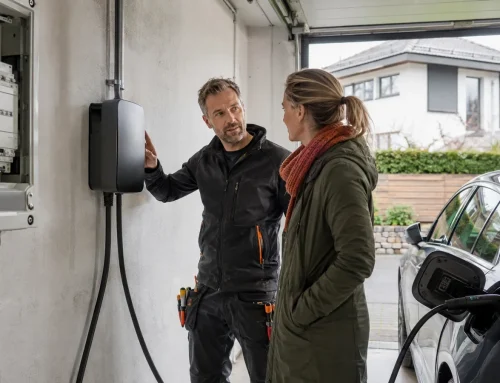
Smart charging can be controlled on three levels: via the car's app, the wallbox's app, or an overarching energy manager that coordinates the solar system, battery and charge point. For working together with your own solar system, the third level is the strongest – it's the only one that sees the whole house. The most important rule: one level should lead, otherwise the systems work against each other. (As of: July 2026)
Key points in brief
- Three control levels compete: the car app, the wallbox app and the house's energy management.
- The car app knows the car, the wallbox app knows the charge point – only the energy manager knows the whole house.
- For surplus charging with solar power, the route runs via wallbox control or an energy manager.
- Double control is the most common disruptive factor: two systems with their own charging schedules block each other.
- Less is more: one leading control, the other apps just for monitoring.
What three control levels are there?
Anyone charging an EV at home quickly ends up with three apps on their phone – and all three want to control the charging. They differ in what they see and what they can influence:
The car app. It comes from the vehicle manufacturer and knows the car best: charge level, range, pre-conditioning, charge limits. Many car apps offer charging schedules ("80 per cent by 7am"). What it doesn't see: the solar system, the house consumption, the battery. It plans the car, not the house.
The wallbox app. It controls the charge point: charging power, authorisations, charging history, and on PV-capable boxes also surplus charging. It sees more of the house than the car app – with the right connection, the solar production – but it stays focused on the charge point.
The energy manager (EMS). The top level: an energy management system coordinates the solar system, battery, heat pump and wallbox by priority. It's the only entity that sees the whole house – and therefore the strongest control when several large consumers compete for the solar power. How an EMS leads, say, the heat pump is shown in the article on SG-Ready and energy management.
The rule of thumb for responsibility: the more smart charging is meant to interact with the solar system, the higher up the control should sit.
What does solar-led charging actually need?
Less than the app variety suggests – but the right building blocks. Solar-led charging means: the charging power follows the system's surplus. For that you need three things – a measurement of the surplus at the grid connection, a controllable wallbox, and a logic that links the two. That logic can sit in the wallbox itself (for PV-capable models) or in the overarching energy manager.
What the car app contributes to that is more modest, but useful: charge limits ("only up to 80 per cent") and the target-time preference. The art lies in the interplay – and there a rule applies that matters more in practice than any feature: one level leads. If the car app wants to charge at 3am while the wallbox is waiting for sun, nobody wins – the car is half-empty in the morning, and the troubleshooting begins. That's why, during setup, it's decided who makes the charging schedule; the other apps remain display instruments.
| Level | Sees | Best at controlling | Limit |
|---|---|---|---|
| Car app | the car (charge level, range) | limits, comfort | blind to the house |
| Wallbox app | charge point, sometimes PV | Surplus charging | only one consumer |
| Energy manager | whole house | priorities of all consumers | needs setup |
Simplified overview, as of: July 2026. The specific system combination is decisive.
What should I watch for when choosing – without brand roulette?
On compatibility and responsibility rather than feature lists. Four check questions lead to the right solution:
1. Does the wallbox talk to my solar system? PV capability is the central criterion of choosing a wallbox – without it, every app is just cosmetic. 2. Who should lead? Just car + wallbox: wallbox control is enough. Car + wallbox + battery + heat pump: an energy manager pays off, because it manages the priorities. 3. Does it also work without the cloud? Some controls run locally, others via the manufacturer's servers. Local core functions are more robust – if the provider's server has issues, the car should still charge. 4. Can the system be expanded? Anyone who only makes the wallbox smart today may want to integrate a battery or heat pump tomorrow – an open system saves you starting over.
And the display side? For monitoring, the same applies as for system monitoring and the battery app: an occasional, informed look beats daily staring. A good charging overview shows how much of a charge came from the sun – that's the number that measures the success of smart charging.
The most common support call about smart charging has a surprising cause: two charging schedules. The car app has "charge until 6am" set, the wallbox has surplus charging set – and depending on the day, one system or the other wins. Since we've started consistently defining one leading level at handover and setting the other apps to "monitor only", these calls have practically disappeared. Our second standard piece of advice in the Zurich region: first set up the interplay with the solar system cleanly, then talk about comfort features. A car that reliably fills up with sun needs surprisingly little app.
Frequently asked questions
Do I absolutely need an energy manager for smart charging?
No – for a car plus a solar system, a PV-capable wallbox with its own control is often enough. The energy manager becomes valuable when several large consumers need coordinating: battery, heat pump, several charge points. Then it manages the priorities instead of the devices competing.
Why isn't my car charging even though the sun is shining?
The most common cause: two controls with conflicting schedules – for example a charge limit or a schedule in the car app, while the wallbox is waiting for surplus. Check which level is leading, and disable competing charging schedules. After that, it's worth checking the actual surplus: is it enough for charging right now?
Can I save money with the apps?
The app itself saves nothing – the control behind it does: surplus charging replaces expensive grid electricity with your own solar power, and with dynamic tariffs, time-shifted charging can help further. The app makes these effects visible; the right configuration is what creates them.
Does smart charging work with every EV?
Solar-led control runs via the wallbox and generally works regardless of brand. Comfort functions such as charge limits or pre-conditioning, by contrast, depend on the manufacturer's car app. For the core goal – charging with your own solar power – the vehicle model is rarely the obstacle.
What happens if the internet or a server goes down?
That depends on the system: local controls keep charging according to the stored rules, cloud-dependent ones sometimes fall back to a default mode. When choosing, it's worth asking which core functions run locally – charging itself should never depend on an internet connection.
Free initial consultation
Smart charging that just works
We set up the wallbox, solar system and – where it makes sense – the energy manager so that one level leads and your car reliably charges with solar power.
Prefer to talk? +41 78 830 83 35
Wallbox & charging solution for your home →
Swissolar-certified specialist company · ESTI installation authorisation (Art. 14 NIV) · in Zurich since 2017 · over 150 systems completed · a personal answer from the specialist company, no call centre
Sources: General technical basics on charge control, energy management systems and PV surplus charging; empirical data from ecoEn GmbH's setup and support practice, Zurich region.
Last updated: 9 July 2026 · Author: ecoEn editorial team