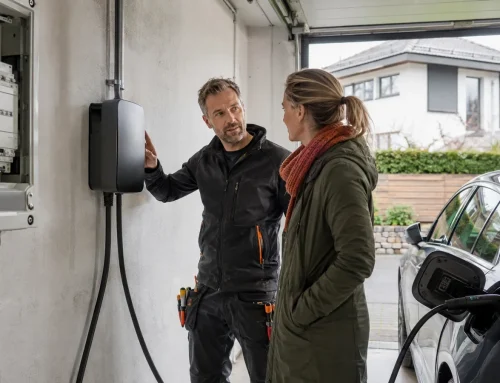
The right wallbox results from a few criteria: should it be able to charge with your own solar power (surplus charging), which charging power makes sense, fixed cable or socket, and is load management needed for several vehicles? For most single-family homes, a solid, PV-compatible wallbox with 11 kW is sufficient. The brand is secondary – it is crucial that the functions fit your everyday life. (As of: July 2026)
Key points in brief
- The most important question first: should the wallbox be able to use your own solar power?
- 11 kW is almost always enough in a single-family home – 22 kW rarely brings an advantage in everyday life.
- A fixed cable is convenient, a socket more flexible – a question of habit.
- Load management becomes relevant when several charging points or a tight house connection come into play.
- The brand is secondary; the matching functions and a clean installation are crucial.
What do I base my choice of a wallbox on anyway?
Not by brand, but by four practical questions. Whoever answers these for themselves has almost already found the right wallbox – the rest is equipment and taste. The basic terms concerning plugs, cables and charging power are explained in the article Wallbox basics; this article here helps with the selection.
The four questions are:
1. Should the wallbox be able to charge with its own solar power? 2. Which charging power makes sense? 3. Fixed cable or socket? 4. Is load management needed?
Going through them one by one, a clear requirement profile emerges – and that is a better basis for a decision than any best-of list.
Should the wallbox use my solar power?
This is the most important question if you have or are planning a solar system – and the one that decides the most about the choice. Because not every wallbox can specifically charge with its own solar power.
The so-called surplus charging means that the wallbox only or preferably charges when the solar system produces more than the house is currently consuming. This way, the car fills up on cheap own electricity instead of expensive grid electricity. How this works technically and what is needed for it is described in the article on surplus charging. For the choice of wallbox, what counts is: whoever wants this function needs a wallbox that masters it and can be connected to the solar system – this is not a matter of course with simple devices.
This capability fits the fundamental idea described by the pillar Charging an e-car with solar power: the biggest lever is the downtime profile. Whoever can charge the car at home during the day or over longer periods gets the most out of it with surplus charging. For this profile, the PV compatibility of the wallbox is the decisive point.
Which charging power, fixed cable or socket?
Two equipment questions that count for more in everyday life than the technical maximum values.
Charging power: 11 kW is almost always sufficient. In a single-family home, the car is usually at the wallbox overnight or for hours – and in this time, an 11 kW wallbox easily fully charges the vast majority of cars. The jump to 22 kW sounds like more, but rarely brings an advantage in everyday life, as the article 11 kW or 22 kW shows in detail. Furthermore: for surplus charging from a typical home system, 22 kW is rarely available anyway. In most cases, 11 kW is the right choice.
Fixed cable or socket. A wallbox with a permanently mounted cable is convenient – arrive, plug in, done, without taking out your own cable every time. A wallbox with a socket is more flexible, because different cables and vehicles fit and the cable stays in the car. This is mainly a question of habit and the situation. Whoever always charges the same car often appreciates the fixed cable; whoever wants to stay flexible, the socket.
| Criterion | Recommendation for most single-family homes |
|---|---|
| PV compatibility | yes, if a solar system is installed/planned |
| Charging power | 11 kW |
| Cable | fixed cables convenient, socket more flexible |
| Load management | only with multiple charging points / tight connection |
Orientation, as of: July 2026. The assessment of your specific situation is decisive.
When do I need load management – and what about the brand?
Load management becomes an issue when several charging points are running at the same time or the house connection is tight. It ensures that the available power is distributed intelligently instead of overloading the connection. For a single car at a single-family home, this is usually not needed; it becomes relevant with two vehicles, in apartment buildings or where a lot of power is needed anyway. How this works is described in the article on load management.
And the brand? It is deliberately at the end. A wallbox is a solid piece of technology, and many devices fulfil the mentioned requirements reliably. More important than the name on the housing are the appropriate functions, the compatibility with your solar system and a professional installation including registration with the utility. Whoever answers the four questions clearly chooses well – regardless of which brand ultimately fulfils the criteria.
«Which wallbox is the best?» is the most frequent question – and the one to which we deliberately do not name a brand. Because the best wallbox is the one that fits your everyday life. We go through the four questions with people, and usually it quickly becomes clear: a solid 11 kW box that can perform surplus charging with the solar system, fixed cable or socket depending on preference. In the Zurich region, we see time and again that the big debate about 22 kW and brand logos completely misses the actual needs. What really counts is that the box can use its own solar power and is cleanly installed.
Frequently asked questions
Do I absolutely need a wallbox that can perform surplus charging?
If you have or are planning a solar system, it is highly recommended – only then does the car specifically fill up with your cheap solar power. Without this function, the wallbox simply charges with grid electricity, which leaves the biggest advantage of your own system unused. Without a solar system, on the other hand, the function is secondary.
Is a more expensive wallbox automatically better?
No. The price says little about its suitability for your case. A well-equipped mid-range wallbox with PV compatibility and 11 kW fulfils most requirements in a single-family home. Additional functions that you never use do not justify a surcharge. The appropriate functions are crucial, not the highest price.
Can every wallbox charge with every e-car?
Common wallboxes and e-cars charge together without problems via the standard connection in Europe. The actual charging power depends on what the car and wallbox can do together. Details on plugs and cables can be found in the wallbox basics. Compatibility is rarely the problem when choosing.
Does the wallbox have to be registered?
Yes, a wallbox must be reported to the responsible utility, and the installation belongs in expert hands. This is part of any serious planning and is often overlooked. The specialist company takes care of the registration and installation – this is part of choosing a wallbox, even if it does not concern the box itself.
Free initial consultation
Which wallbox suits your house?
We go through the crucial questions with you and recommend a wallbox that suits your car, your solar system and your everyday life – without the brand hype.
Prefer to talk? +41 78 830 83 35
Charging station from a specialist company in Zurich →
Swissolar-certified specialist company · ESTI installation authorisation (Art. 14 NIV) · in Zurich since 2017 · over 150 systems completed · a personal answer from the specialist company, no call centre
Sources: General technical basics on wallbox selection, charging power and surplus charging; practical experience from the installation operations of ecoEn GmbH, Zurich region.
Last updated: 9 July 2026 · Author: ecoEn editorial team