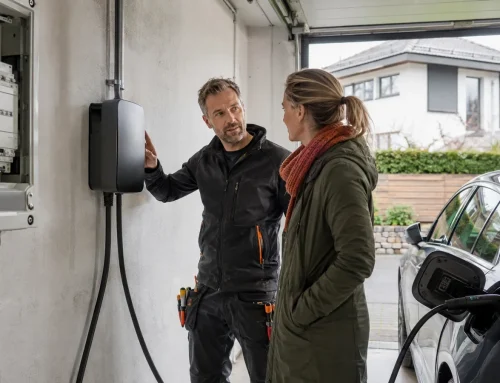
At home, charging is done with alternating current (AC) via the Type 2 plug – this is standard in Switzerland and Europe, adapter worries are unfounded. The charging capacity is determined by the weakest link in the chain: wallbox, supply line or the charger in the car. And the most important equipment is invisible: the controllability that turns the box into a solar charging system. (As of: July 2026)
Key points in brief
- One plug for everything: Type 2 is the AC standard in Europe – every electric car sold here charges with it.
- AC at home, DC on the road: The wallbox supplies alternating current, which the car converts itself; fast charging with direct current is the technology of the highway pillars.
- The chain determines the pace: box, supply line and the car's on-board charger – the weakest link sets the actual charging capacity.
- A fixed cable on the box is more comfortable in everyday life than the socket variant – a small difference with daily effect.
- Protection technology is built into modern wallboxen; installation and reporting to the grid operator is still done by the specialist.
The plug: Type 2 – and the matter is settled
Let's start with the question that is answered the fastest: In Switzerland and all of Europe, the Type 2 plug is the standard for charging with alternating current. Every electric car sold here has the matching port, every wallbox the matching counterpart. The variety of adapters of earlier years is history; anyone buying a wallbox today buys Type 2 and does not need to think about it further.
The second plug type you will encounter does not belong to the wallbox: CCS is the connection for fast charging on the road – the same vehicle connection, expanded by two direct current contacts. Which brings us to the most important fundamental difference.
AC and DC: Why charging at home is different than on the road
The battery in the car stores direct current (DC), the grid supplies alternating current (AC) – so conversion has to take place somewhere, and the location of this conversion separates the two charging worlds:
At home (AC): The wallbox passes the alternating current on to the car; the conversion is handled by the vehicle's own charger, the on-board charger. The wallbox is thus – somewhat disenchanting – above all an intelligent, safe power transfer point: it communicates with the car, secures and regulates the capacity. Conversion takes place in the vehicle.
On the road (DC): The fast-charging station converts itself and feeds directly into the battery – bypassing the on-board charger, hence the high outputs in highway advertising. This technology has nothing to do with the home wallbox; the brochure values («to 80 percent in 20 minutes») are not a benchmark for charging at home – and do not have to be, because at home the car has time.
The chain determines the pace: box, line, car
The actual charging capacity is not a property of the wallbox alone – it is the minimum of a chain:
1. The wallbox specifies its maximum – 11 kW is usual. 2. The supply line and fuse protection must carry this maximum – matter of the electrical installation, planned by the specialist company, coordinated with the house connection. 3. The car's on-board charger sets the final limit – and is the weakest link in the chain for many models.
Added to this is the concept of phases: The home grid supplies electricity via three conductors, and anyone using all three («three-phase») charges at three times the single-phase capacity. Modern wallboxen and most cars charge three-phase; individual vehicles only single- or two-phase – that is also in the data sheet and belongs to the chain. For you this means practically: First read the car data sheet, then choose the box – not the other way around. And for solar charging the opposite direction counts anyway: how finely the box can regulate downwards, not how high it goes up.
Fixed cable or socket: the underestimated everyday difference
Wallboxen come in two designs: with a permanently mounted charging cable that waits rolled up on the box – or with a Type 2 socket into which you plug your own cable. The technical performance is identical; the difference is everyday life: With the fixed cable you reach once, plug in, done. With the socket variant you get the cable out of the trunk, plug in twice, and stow it away again after charging – with every charging process, in every weather.
For the private garage with one car, the fixed cable is therefore almost always the more comfortable choice; pay attention to the matching cable length to the car's charging port (the position of the port varies depending on the model). The socket variant has its justification where different users charge with their own cables – more of a topic for multi-party and corporate solutions than for the single-family home.
Protection technology, installation, registration: the mandatory programme
The comforting news: Modern wallboxen bring their essential protection technology integrated – including residual current monitoring, which makes charging vehicle batteries safe. Exactly for this reason, the wallbox is superior to the socket permanent solution: It is built for hours of full load, the household socket is not.
What the integrated technology does not replace: professional installation. Supply line, fuse protection and alignment with the house connection are the business of the authorised electrical specialist company, and the installation is reported to the grid operator – routine that the company takes care of and that should be in the quote. Anyone who thinks of later in the course of installation – reserve at the meter box, empty conduit, controllability for solar charging – makes the expensive course settings while they are cheap.
The small wallbox glossary
| Term | Significance |
|---|---|
| Type 2 | European standard plug for AC charging |
| CCS | Type 2 plus DC contacts – the fast-charging connection on the road |
| AC / DC | Alternating current (at home) / Direct current (fast charging, battery) |
| On-board charger | Charger in the car; converts AC to DC and limits the AC charging capacity |
| single-/three-phase | Use of one or all three outer conductors – three-phase charges three times as fast |
| Load management | distributes available capacity to multiple charging points or protects the house connection |
| PV/surplus charging | the box charges preferentially with solar power surplus – requires controllability |
As of: July 2026.
The fundamental questions about the wallbox rarely come to us individually – they come as a package, mostly introduced with «I no longer see through the terms». After a few hundred consultations we can say: It is almost always the same three confusions. The DC values from car advertising are applied to the home box (while those play in a different league and a different place). The kilowatt number of the box is taken for the charging speed (while the chain decides that, often the car itself). And controllability – the single feature that later decides on solar charging – does not even appear in the conceptual confusion. Our short formula for the purchase decision has proven itself: Plug is set (Type 2), capacity is chain (read car data sheet), comfort is cable (permanently mounted), future is controllability. Anyone who takes these four sentences with them understands every quote.
Frequently asked questions
Does every wallbox fit every electric car?
With the plug yes – Type 2 is the European standard used by all vehicles sold here. There are differences in capacity (car's on-board charger) and functions (controllability, billing); therefore, the vehicle data sheet belongs in every wallbox consultation.
Can I fast charge at home like at the highway?
No – fast charging is DC technology of public pillars, with its own performance class and price. Charging at home is AC, and that is no disadvantage: Over night or an afternoon, even the 11 kW box fills large batteries comfortably.
What is better: fixed cable or socket on the box?
For the private garage almost always the fixed cable – reach once instead of plugging twice, during every charging process. The socket variant is worthwhile where changing users charge with their own cables, e.g. in multi-party garages.
Why is my car charging slower than the wallbox could?
Because the chain decides: The on-board charger of many vehicles accepts less than the box could deliver, or the car only charges single- or two-phase. Intentional throttling is also possible – during surplus charging, the box deliberately regulates down to what the roof is currently delivering.
Do I need a separate residual current protection for the wallbox?
The DC residual current monitoring required for this is integrated into modern wallboxen; what the house installation additionally needs is assessed and built by the electrical specialist company. For you what counts: Installation and registration run via the specialist – then the protection chain is also correct.
Free initial consultation
From conceptual confusion to the matching box.
We translate data sheets into plain text, plan supply line and solar control along with it – and install the wallbox right along with your system.
Prefer to talk? +41 78 830 83 35
Have a wallbox installed – charge with solar power →
Swissolar-certified specialist company · ESTI installation authorisation (Art. 14 NIV) · in Zurich since 2017 · over 150 systems completed · a personal answer from the specialist company, no call centre
Sources: Vehicle and wallbox manufacturer documentation (standards and charging capacities, general); empirical values from the installation and consulting practice of ecoEn GmbH, Zurich region.
Last updated: 9 July 2026 · Author: ecoEn editorial team