
As a guideline, purchase and installation of a wallbox for a single-family home comes to CHF 2,500 to 5,000. The device itself is available from a few hundred francs depending on features, with smart or more powerful models costing more; the bigger and more variable item is installation by a certified electrician – reckon with CHF 1,500 to 3,000, plus surcharges for long cable runs or wall breakthroughs. You're not allowed to install it yourself in Switzerland: that's a job for a licensed company. (As of September 2026)
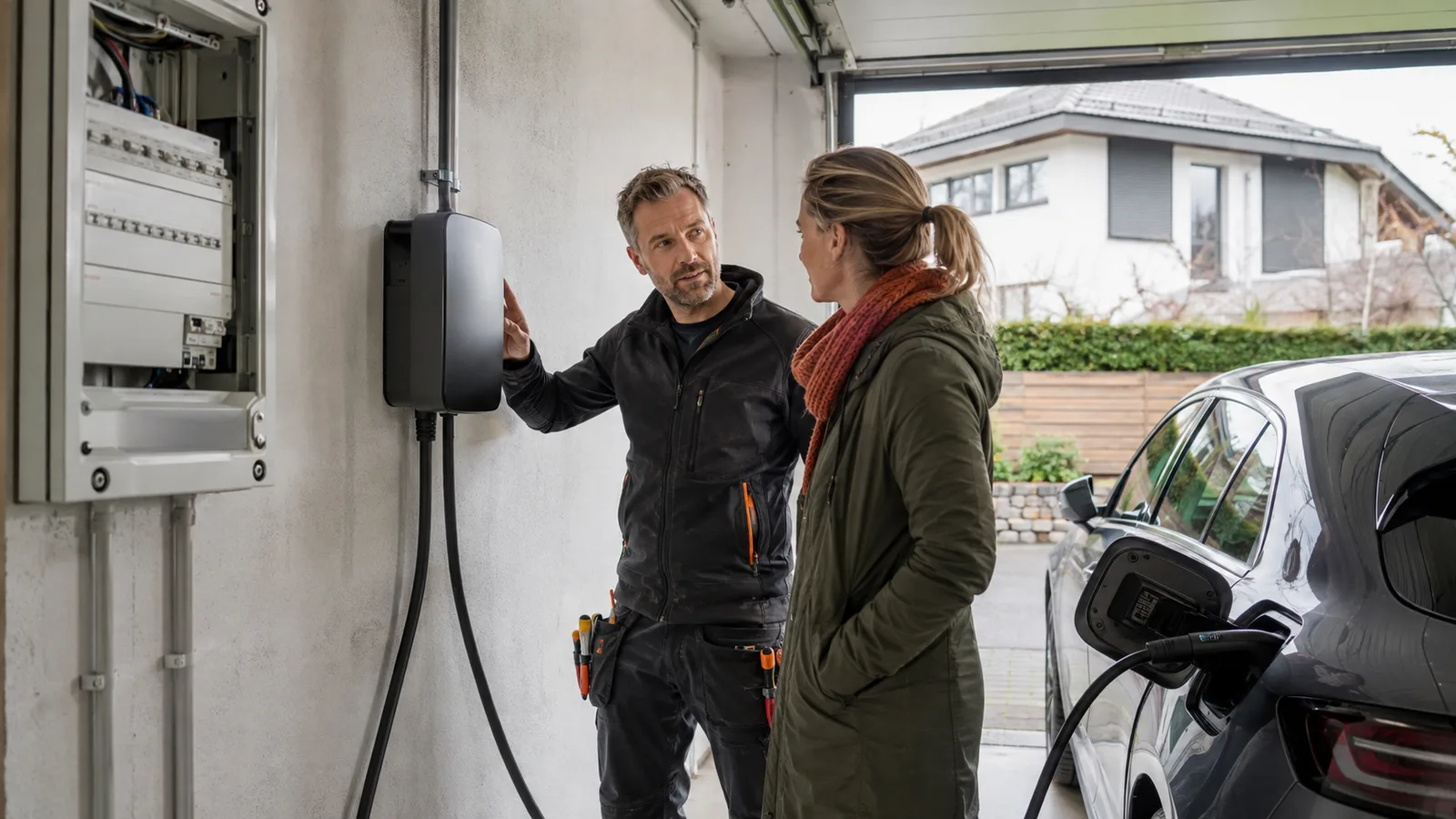
Key points in brief
- Guideline total cost for a single-family home: CHF 2,500–5,000.
- The device is the smaller item, the installation the bigger and more variable one.
- The cable route, wall breakthroughs and the condition of the meter box drive the price.
- Installation is mandatorily a job for a certified electrical installer – not a DIY project.
- Incentive: in the Canton of Zurich, CHF 500 per parking space – also for single-family homes, and can be applied for up to six months after installation; many other cantons pay nothing for private wallboxes.
- Charging at home then costs roughly 25 to 35 Rp. per kWh from the grid, with your own solar surplus only a fraction of that.
What does a wallbox cost in total?
As a guideline, a wallbox for a single-family home including installation comes to CHF 2,500 to 5,000 – a wide range, because it bundles two very different items: the device and the installation. The technical fundamentals, Type 2, AC charging and what a wallbox actually is are explained in the article Wallbox fundamentals; here it's about the money.
The mistake would be to look only at the device price. A cheap box with an elaborate installation can end up more expensive than a mid-range box with a short route. That's why it's worth looking at the two items separately.
For context: in the simplest case – a parking space directly next to a modern meter box with spare capacity – the total can also stay under CHF 2,000. In practice, though, such setups are the exception; as soon as the cable route, breakthroughs or the meter box come into play, you land in the range mentioned.
How do the device and installation costs break down?
The device. A simple 11 kW wallbox is available from just a few hundred francs. Smart models with app control, load management or surplus charging, and more powerful 22 kW variants, cost considerably more – into four figures. Whether 11 or 22 kW makes sense is covered in the article Wallbox 11 kW or 22 kW; for most single-family homes, we recommend 11 kW, because 22 kW rarely adds value in everyday use.
The installation. This is the bigger and more variable item: reckon with CHF 1,500 to 3,000 for professional installation by the electrician. On top come surcharges if the route from the meter box to the wallbox is long, if wall breakthroughs are needed, or if the meter box itself has to be adapted.
| Item | Guideline | What drives it |
|---|---|---|
| Wallbox device | from a few hundred to over CHF 1,000 | Power, smart functions, load management |
| Installation | CHF 1,500–3,000 | Cable route, meter box, circuit breaker |
| Additional work | approx. CHF 500–1,000 | Wall breakthrough, long routes |
| Total (single-family home) | around CHF 2,500–5,000 | Overall situation |
Guideline figures, as of September 2026. Actual costs depend heavily on the building's specific situation – the individual quote is decisive.
The biggest cost driver is almost always the distance between the meter box and the parking space. A charging point right next to the distribution board is cheap; one at the far end of the property can multiply the installation cost. That's why, for new builds or renovations, an empty conduit is worth laying – the cheapest franc is the one laid ahead of time.
What additional items appear in the quote?
Most price surprises aren't in the box, but in the installation route and a few additional items that only become visible at the site visit. Here's what the market guideline figures look like:
| Additional item | Market guideline price | When it applies |
|---|---|---|
| Installation, parking space close to the distribution board | from around CHF 700 | short route, no breakthroughs |
| Installation with a wall or ceiling breakthrough | around CHF 1,100 | garage or carport next to the house |
| Installation in an underground car park, around 15 m of cable | around CHF 1,800 | parking hall, parking space far away |
| Wall breakthroughs, excavation work | CHF 300–800 | outdoor parking space, cable through the ground |
| Reinforcement of the service connection or distribution board | CHF 500–2,000 | old meter box, too little spare capacity |
| Load management | CHF 300–1,500 | from two charging points, or when a heat pump and wallbox share the connection |
| Registration and approval | CHF 100–300 | for every wallbox |
Market guideline figures according to the ofri.ch quote portal, cross-checked with Helion (installation usually CHF 1,000–3,000); as of September 2026. Not binding – the quote after the site visit is decisive.
Two items deserve a second look. Registration with the grid operator is mandatory and belongs in every serious quote (Registering a wallbox); if it's missing, it comes later as an add-on. And load management in an apartment building isn't optional but a requirement: in the Canton of Zurich, the incentive requires it from two connected parking spaces onwards (Load management for wallboxes).
What does the wallbox cost after the incentive?
In the Canton of Zurich, the cantonal charging infrastructure incentive programme pays CHF 500 per equipped parking space – also for single-family homes. That turns the guideline figure of CHF 2,500 to 5,000 into a net figure of around CHF 2,000 to 4,500. For up to four parking spaces, the application can be submitted up to six months after completion, so retrospectively too. The catch: of the CHF 50 million, 96 percent had already been claimed by 22 September 2026, and the programme ends at the latest by the end of 2026.
In an apartment building, the incentive changes the calculation far more: ten connected parking spaces come to CHF 5,000. Because only one application is allowed per parking facility, it's worth connecting all the spaces at once – details in Wallboxes in apartment buildings.
Outside Zurich, things are thinner on the ground: Aargau gives no cantonal support for private wallboxes, Schaffhausen supports apartment buildings with 25 percent of the connection costs. The overview by canton is in Incentives for the wallbox.
What does charging cost afterwards?
The purchase is a one-off, but the electricity runs every year. Grid electricity at home costs roughly 25 to 35 Rp. per kilowatt-hour. If the car instead charges from your own solar system's midday surplus, only the forgone feed-in remuneration counts as the price – roughly 6 to 14 Rp. depending on the utility.
For a car with around 15,000 kilometres a year (roughly 2,500 kWh), that means: around CHF 625 to 875 a year from the grid, around CHF 150 to 350 from your own roof – provided the car is at home during the day. Over the wallbox's service life, this difference is bigger than any one-off incentive. The full calculation with parking times and tariffs is in What does charging with your own solar power cost?.
What drives the price up or down – and am I allowed to install it myself?
Taking the last question first, because it's often answered wrongly: no. Installing a wallbox counts as high-current electrical work and, in Switzerland, is permitted only to a certified electrical installation company. Screwing up the cheap box yourself isn't an option – for good reason, because safety is at stake here.
What lowers the price: a short route, a modern meter box with spare capacity, no structural obstacles. What drives it up: long cable runs, an old meter box, several charging points with load management. And what raises the value of the box without the device price giving it away: the ability to do surplus charging with solar power – so the car fills up on the midday surplus instead of expensive grid electricity.
With the wallbox price, we regularly see the same surprise – not with the device, but with the route. Someone finds a cheap box online and reckons on «a few hundred francs»; then the parking space turns out to be at the other end of the parking hall, and suddenly we're talking about the cable route, the breakthrough and the meter box. That's not a surcharge someone made up – it's simply the reality of the installation. What we advise everyone building new or renovating: lay an empty conduit to the future parking space, even if the EV is still a distant prospect. This small upfront step is the difference between a cheap and an expensive wallbox – years later.
Frequently asked questions
What does a wallbox with installation cost in Switzerland?
As a guideline, CHF 2,500 to 5,000 for a single-family home. The device is available from a few hundred francs, installation by the electrician costs around CHF 1,500 to 3,000, plus surcharges for long routes or wall breakthroughs. Actual costs depend heavily on the building's specific situation.
Why is the installation often more expensive than the wallbox itself?
Because it depends on the building's specific situation – above all on the route between the meter box and the parking space. Long cable runs, wall breakthroughs and an old meter box drive up the price. A charging point right next to the distribution board is cheap; one at the far end of the property is considerably more expensive.
Am I allowed to install my wallbox myself?
No. In Switzerland, installation counts as high-current electrical work and is permitted only to a certified electrical installation company. That's not red tape – it's a matter of safety, since high currents flow through a charging station over long periods.
Is there an incentive for a wallbox?
It depends on the canton. The Canton of Zurich pays CHF 500 per equipped parking space, also for single-family homes; but 96 percent of its pot had already been claimed by 22 September 2026, and the programme ends at the latest by the end of 2026. Aargau gives no cantonal support for private wallboxes. Where to check for your address is shown in the article on wallbox incentives.
What does a wallbox cost in the Canton of Zurich after the incentive?
From the guideline figure of CHF 2,500 to 5,000 for a single-family home, CHF 500 of incentive is deducted – so net around CHF 2,000 to 4,500. For up to four parking spaces, the application can still be submitted up to six months after installation, as long as there are funds left in the cantonal pot.
What does load management for the wallbox cost?
As a market guideline, CHF 300 to 1,500, depending on the number of charging points and whether a heat pump or solar system is integrated. From two charging points onwards, it's practically always needed, and in the Canton of Zurich it's also a condition for the incentive.
How much does it cost to charge the EV at home?
From the grid, roughly 25 to 35 Rp. per kWh – around CHF 625 to 875 a year for about 15,000 kilometres. With surplus charging from your own roof, only the forgone feed-in remuneration of roughly 6 to 14 Rp. counts, so around CHF 150 to 350 a year, if the car is at home during the day.
Can any electrician install a wallbox?
Any electrical installation company with an ESTI installation authorisation may connect a wallbox – that's mandatory in Switzerland, because the box is permanently wired into the house installation. This includes checking the service connection, a dedicated circuit with residual-current protection, notifying the grid operator, and the safety certificate. For charging with solar power, it's worth choosing a company that plans the wallbox, inverter and energy manager together; ecoEn installs wallboxes with its own ESTI authorisation.
Free initial consultation
What your wallbox actually costs.
We look at the route from the meter box to the parking space and tell you honestly what the device and installation will cost for you – and whether surplus charging is worthwhile.
Prefer to talk? +41 78 830 83 35
Wallbox & charging solution for your home →
Swissolar-certified specialist company · ESTI installation authorisation (Art. 14 NIV) · in Zurich since 2017 · over 150 systems completed · a personal answer from the specialist company, no call centre
Sources: market-standard guideline figures from Swiss providers and electrical installers (Helion: total cost usually CHF 1,500–5,000, installation CHF 1,000–3,000; ofri.ch: installation CHF 695–2,000 depending on effort, additional items for grid reinforcement, load management, breakthroughs, registration; as of September 2026), Canton of Zurich «Förderprogramm Ladeinfrastruktur» (regulations and incentive brochure, programme page accessed on 22 September 2026), Canton of Schaffhausen energy incentive programme 2026, electrical installation requirements (NIV), experience from ecoEn GmbH's wallbox projects, Zurich region.
Last updated: 9 July 2026 · Author: ecoEn editorial team