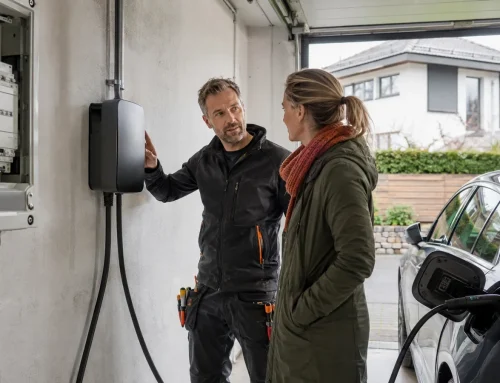
Load management distributes the available power across several wallboxes so that the house connection is not overloaded. With static load management, a fixed upper limit is divided among the charging points; with dynamic, the system continuously measures how much the rest of the house is currently consuming and gives the wallboxes the rest. For a single car at a single-family home, this is mostly not needed – it becomes relevant with multiple charging points. (As of: July 2026)
Key points in brief
- Load management ensures that several wallboxes together do not overload the house connection.
- The house connection is the limit: it can only deliver a certain power, and all consumers share it.
- Static load management distributes a fixed upper limit across the charging points.
- Dynamic load management measures the remaining house consumption and continuously adjusts the charging power.
- Mostly unnecessary for one car at a single-family home; important with several vehicles, in an apartment building or with a tight connection.
What do I need load management for?
So that several charging points do not overload each other – and the rest of the house. The starting point is a simple physical limit: the house connection can only deliver a certain power. Everything that runs simultaneously in the house shares this power.
As long as a single car is charging, this is not a problem – a single 11 kW wallbox fits into almost every connection. It becomes critical when several wallboxes want to draw full power at the same time, possibly even while the cooker, heat pump and boiler are running. Then the sum can exceed the connection. Load management prevents this by controlling the charging power so that the limit is maintained.
You can think of it like a traffic light in front of a bottleneck: instead of everyone pushing through at the same time and causing a jam, the system regulates the flow. No charging point comes to a complete standstill, but nobody takes more than the shared system can handle. How much power a single wallbox actually sensibly draws is classified by the article 11 kW or 22 kW.
Static or dynamic – what is the difference?
Both keep the connection clear, but cleverly in different ways. The difference lies in whether the system takes the remaining house consumption into account or not.
Static load management. Here, a fixed upper limit is defined and distributed across the charging points. If two wallboxes are charging at the same time, each gets a fixed share. This is simple and reliable, but not optimal: the reserve for the remaining house consumption is deducted as a flat rate, even if the house currently hardly needs anything. Power remains unused that would actually be available for charging.
Dynamic load management. Here, the system continuously measures how much the rest of the house is currently consuming, and gives the wallboxes exactly the power that is left over. If little is running in the house, the cars are allowed to charge faster; if the heat pump starts up, the charging power is automatically reduced. This way, the connection is optimally utilised without ever overloading it.
| Static | Dynamic | |
|---|---|---|
| Principle | divide fixed upper limit | measures house consumption, gives the rest |
| Utilisation | conservative, flat-rate reserve | optimal, adapts |
| Effort | simpler | measurement necessary |
| Typical application | simple multiple charging | tight connection, many charging points |
Simplified comparison, as of: July 2026. The specific connection and charging point situation is decisive.
The dynamic principle is similar to that of surplus charging from the solar system – there too, a system continuously measures and adjusts the charging power. The difference: with load management, it is about the limit of the house connection, with surplus charging it is about the available solar power. In practice, both are often combined in the same energy management.
When do I really need it – and when not?
For most single-family homes with one car: not at all. A single 11 kW wallbox generally fits into the house connection without any problems, and there is nothing to distribute. Load management here would be a solution to a problem that does not exist.
It becomes relevant in clearly defined cases:
- Multiple charging points. Two cars in the household that are supposed to charge at the same time – or a planned second wallbox.
- Tight house connection. If the connection is at its limit anyway, for example with a heat pump and other large consumers, dynamic load management helps to charge the car anyway, without strengthening the connection.
- Apartment building and business. As soon as several parties are charging, load management is practically mandatory. For larger systems with many charging points, this is a separate planning topic, which the article on charging infrastructure for companies covers.
The second point in particular is often the most favourable solution: instead of expensively strengthening the house connection, dynamic load management ensures that the car charges with the existing power – simply a little slower if a lot is running in the house. For the wallbox choice, this means the question about load management belongs on the list, as the article on wallbox selection shows.
«Is my house connection sufficient for a wallbox?» is a question we ask with every installation – and for a single car, the answer is almost always yes. It becomes interesting when a second car arrives or the connection is already well utilised by the heat pump. Then we advise dynamic load management before someone has the connection expensively strengthened. The car then simply charges a little slower when a lot is running in the house, and briskly when not – and nobody notices a disadvantage in everyday life. The house connection is the limit, and with a bit of intelligence you can almost always get by with what is already there.
Frequently asked questions
Do I need load management for a single wallbox?
In most single-family homes, no. A single 11 kW wallbox generally fits into the house connection without anything having to be distributed. Load management only becomes an issue with a second charging point or with a tight connection. The specialist company checks this during planning.
What happens without load management with two wallboxes?
If both draw full power at the same time and the connection cannot provide this, an overload threatens, which in the best case triggers the fuse. Load management prevents exactly this by distributing the power. With multiple charging points, it is therefore not an optional extra, but a prerequisite for safe operation.
Does the car charge slower with dynamic load management?
Only temporarily – namely when the rest of the house needs a lot of electricity. If little is running in the house, the car charges briskly. Over the night or longer downtimes, this balances out, and the car is full in time. The advantage: you save the expensive strengthening of the house connection.
Can load management be combined with surplus charging?
Yes, and this is often sensible. Both functions are based on a continuous measurement and can be brought together in an energy management system: the system keeps the connection clear and at the same time preferentially charges with solar power. In this way, the existing power is optimally utilised – for the connection limit as well as for your own solar power.
When is load management sensible for multiple e-cars or wallboxes?
As soon as two or more charging points are attached to the same house connection – two cars in a single-family home, multiple parties in an apartment building, a company fleet. Then the load management divides up the available power and prevents the connection from being overloaded or having to be strengthened. Even with a single car, it is worthwhile if the heat pump and other large consumers are already well utilising the connection. For a single car on a normally dimensioned connection, it is not needed.
Free initial consultation
Multiple charging points or tight connection?
We check your house connection and plan a load management system that safely operates multiple wallboxes – often cheaper than strengthening the connection.
Prefer to talk? +41 78 830 83 35
Have a wallbox installed – charge with solar power →
Swissolar-certified specialist company · ESTI installation authorisation (Art. 14 NIV) · in Zurich since 2017 · over 150 systems completed · a personal answer from the specialist company, no call centre
Sources: General technical basics on load management (static/dynamic) and house connection power; empirical values from the installation practice of ecoEn GmbH, Zurich region.
Last updated: 9 July 2026 · Author: ecoEn editorial team