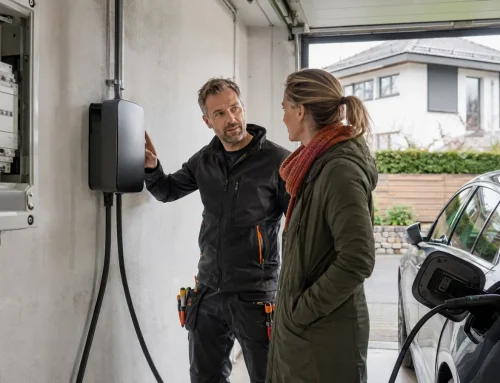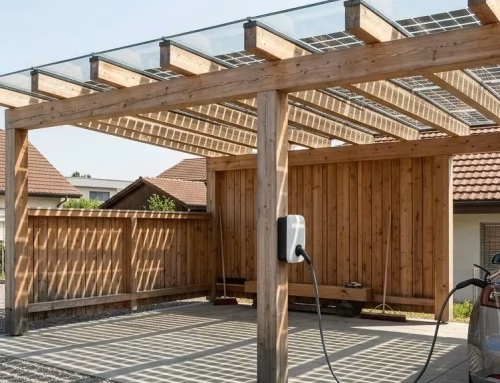
For the single-family home almost always 11 kW. A car standing overnight or an afternoon does not need double the capacity – many vehicles cannot absorb more than 11 kW on alternating current anyway, and for solar charging less capacity is even an advantage. 22 kW are worthwhile in narrowly defined special cases, not as a standard. (As of: July 2026)
Key points in brief
- The decisive calculation variable is not the capacity, but the stationary time: Energy = Capacity × Time, and cars have plenty of time at home.
- Many electric cars charge on alternating current (AC) with a maximum of 11 kW – on a 22 kW box they still charge with only 11.
- For surplus charging with the solar system, the smaller box is the better one: The roof rarely delivers more than 11 kW can absorb.
- 22 kW mean higher demands on supply line and connection – effort for an advantage that is hardly ever used in everyday life.
- Sensible 22 kW cases exist: very high daily driving distances, multiple vehicles consecutively, pool vehicles in operation.
The actual question: How long does your car stand?
The charging capacity debate almost always starts with the wrong size. It intuitively feels: twice the capacity, twice as good. In reality, a different calculation counts at home: Energy is capacity times time – and time is precisely what a car has in abundance at its own house. Anyone who plugs in at seven in the evening and leaves at seven in the morning has a twelve-hour charging window; anyone charging in the home office over midday has several hours. In both cases, an 11 kW box easily fills large batteries in the available window – for actual daily needs (commuting, shopping, children) a fraction of it is often enough.
The 22 kW box halves a waiting time that doesn't even exist in everyday life. It is the answer to a problem of public charging – where every minute counts – that simply does not exist at your own parking space. It is the same logic as with company parking lots: With hours of stationary times, moderate capacity delivers the necessary energy more cheaply.
The often overlooked point: What can your car do at all?
Before deciding on the wallbox, a look into the vehicle data sheet is worthwhile – at the on-board charger. It limits what the car can absorb at maximum on alternating current (AC), and for many models this limit is 11 kW; only a portion of vehicles take 22 kW, partly for a surcharge. The consequence is inconvenient for any sales argument: An 11 kW car charges at an 22 kW wallbox with exactly 11 kW. The double capacity of the box never arrives in the vehicle – it is paid for anyway.
The high charging capacities from advertising («to 80 percent in 20 minutes») concern DC fast charging on the road – a different technology that has nothing to do with the home wallbox. Charging at home is AC, and there 11 kW is the established standard.
For solar charging, less is even more
Anyone who wants to charge their car with their own solar power turns the capacity question around for good. Surplus charging means: The wallbox charges with what the roof is currently delivering beyond household consumption – and this surplus is clearly below 11 kW most of the time in typical single-family home systems. A 22 kW box could simply never play out its capacity during solar charging; it waits for a surplus that does not exist.
More important than the maximum capacity for solar charging is the opposite: how finely down the box can regulate and how well it talks to the inverter or energy management. A controllable 11 kW box that breathes gently with the cloud beats any rigid 22 kW box in precisely the discipline for which the roof was built – controllability is the feature that should not be skimped on, not the kilowatt number.

What 22 kW cost additionally – not just for the device
Double the capacity also wants to be delivered: 22 kW place higher demands on supply line, fuse protection and, if applicable, the house connection – especially in older houses, where heat pump and wallbox already gnaw at the connection's reserve. The larger box is also the more demanding topic with the grid operator; depending on the utility, stricter specifications up to controllability requirements apply to higher charging capacities.
All this is solvable – but it is effort for an advantage that everyday life hardly ever calls upon. Anyone who has the budget invests it more sensibly in controllability, load management or simply one or two more modules on the roof.
When 22 kW actually make sense
The honest counterpart so that the recommendation does not become a dogma – there are cases:
- Very high, irregular driving performance with short home windows – e.g. on-call services where the car stands for two hours at midday and then has to be full again.
- Multiple vehicles at one box that have to charge consecutively without sharing the night.
- Operational use – pool vehicles with high turnover frequency belong in company charging planning with load management anyway.
- Future-proofing the cabling: Anyone building new or pulling lines anyway can dimension the supply line for 22 kW and still operate the box with 11 – the reserve then lies in the copper, not in the device. That is the cheapest compromise of the whole debate.
Anyone who does not find themselves in any of these cases finds one thing above all in 22 kW: a surcharge.
The comparison at a glance
| 11 kW | 22 kW | |
|---|---|---|
| Typical full charge overnight | problem-free | problem-free – just finished faster than necessary |
| Vehicle compatibility (AC) | practically all | only a part uses full capacity |
| Surplus charging with PV | ideal – roof surplus fits | Capacity remains unused |
| Installation / supply line | Standard | higher demands, depending on the house |
| Sensible deployment | Single-family home, everyday life | Special cases, businesses, short stationary times |
Qualitative classification, as of: July 2026 – vehicle data, house installation and the specifications of your grid operator are decisive.
The 22 kW question comes up regularly in consultations – and almost always from the same thought: «If you're going to do it, do it right.» Our counter-question is always the same: When is the car at home, and how many kilometers are pending the next morning? The answers usually settle the debate by themselves – twelve hours of stationary time for a hundred kilometers of daily demand can be managed easily with any capacity. What happens afterwards is interesting: The freed-up budget goes into the controllability of the box for most, and exactly that is what the same customers rejoice over in the first summer – when the car practically only charges from the roof for weeks. Of the few 22 kW boxes we have built, almost every one had a concrete, good reason. «If you're going to do it, do it right» was never one of them.
Frequently asked questions
Does my car charge twice as fast at a 22 kW wallbox?
Only if its on-board charger can absorb 22 kW of alternating current – many models are at the limit at 11 kW and charge at exactly the same speed at the larger box. A look into the vehicle data sheet therefore belongs before the wallbox decision.
Is 11 kW enough even for a car with a large battery?
Yes — over a typical night, an 11-kW box will largely fully charge even large batteries, and the actual daily requirement is usually a fraction of that. The battery size determines the range, not the required charging capacity at home.
Is a 22-kW box at least more future-proof?
Scarcely — the trend in vehicles is not towards higher AC charging, and 11 kW remains the appropriate size for solar charging. Anyone wanting future-proofing should dimension the supply cable generously and choose a controllable box; the copper in the wall is a better reserve than the type plate.
Can I operate a 22-kW box throttled to 11 kW?
As a rule, yes — most things are configurable. You just end up paying for the large box in order to run it in a small way. The combination is primarily useful the other way around: prepare the supply cable for 22 kW, buy an 11-kW box, and swap it later if there is a genuine need.
What applies to two electric cars in the household?
Usually two 11-kW points with load management rather than one large box — the vehicles share the available capacity over their parked time, and nobody has to move their car at night. The connection situation is checked by the electrician; the principle is the same as on a small scale for company car parks.
Free initial consultation
The right box is the one that suits your everyday life.
We plan the wallbox, supply cable, and solar control system together with the system — and calculate honestly what your parked times genuinely require.
Prefer to talk? +41 78 830 83 35
Have a wallbox installed – charge with solar power →
Swissolar member and Solarprofi · ESTI installation authorisation (Art. 14 NIV) · in Zurich since 2017 · over 150 systems completed · a personal answer from the specialist company, no call centre
Further guides
 E-Auto mit Solarstrom laden
 Firmenparkplätze elektrifizieren
 Eigenverbrauch optimieren
 Combining a heat pump and photovoltaics
 Das Beratungsgespräch: Diese Fragen sollten Sie stellen
Sources: Vehicle and wallbox manufacturer documentations (AC charging capacities, general); empirical values from the installation and consulting practice of ecoEn GmbH, Zurich region.
Last updated: 9 July 2026 · Author: ecoEn editorial team