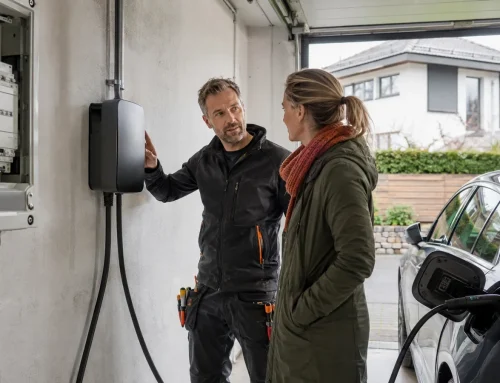
The most expensive wallbox mistakes happen before installation: the household socket as a permanent solution, forgetting controllability for solar charging, saving on the empty conduit during system construction, not thinking of the house connection together with the heat pump and co. Each of these seven mistakes can be avoided with little money in the planning phase – and retrospectively constitute their own small construction site. (As of: July 2026)
Key points in brief
- Mistake one is no planning: The household socket as a permanent charging solution is neither built for this nor efficient – and of all things for the largest consumer in the household.
- The strategic mistake: buying a mute box – without controllability there is no surplus charging later, no matter how large the solar system is.
- The most expensive saving mistake: no empty conduit during system or environment construction – retrofitting as separate excavation work costs a multiple.
- The reflex mistake: 22 kW «might as well do it right» – paid-for power that the car and everyday life almost never call upon.
- The system mistake: planning wallbox, heat pump and battery individually instead of thinking of the house connection and control together.
Mistake 1: The socket as a permanent solution
It almost always starts harmlessly: The new electric car is here, the wallbox is not yet, the supplied emergency charging cable hangs on the garage socket – and stays there. Only the household socket is not built for hours of full load: contacts and lines work at the limit, charging losses are higher, and nothing can be controlled. Fine as a bridge for weeks – as a permanent solution, the wrong answer to the household's largest new consumer.
Avoidance: The wallbox belongs in the electric car purchase like insurance – planned before delivery, installed by the specialist company, registered with the grid operator.
Mistake 2: Forgetting controllability
The strategically most expensive mistake because it only shows itself years later: A wallbox without communication capability cannot do surplus charging – it stubbornly charges at full power, no matter what the roof delivers. Anyone who buys without a solar system today and builds one tomorrow then stands there with a mute box; «retrofitting» in practice usually means a new purchase.
Avoidance: Treat controllability (communication with inverter or energy management) as a mandatory criterion – even if the solar system is only a thought. The surcharge is small, the effect is half the solar charging concept.
Mistake 3: No empty conduit, no reserve – the saved fiver
The classic from solar system planning, in the opposite direction: When building the system, the garage or the surroundings, the empty conduit to the parking space would have been a minor item – years later the supply line is its own construction site with excavation work, wall breakthroughs and a separate electrician appointment. The same applies to the reserve at the meter box.
Avoidance: Think ahead to the future of the wallbox with every floor that is open anyway and every meter box adjustment – lay an empty conduit, reserve space. Even those who «surely never» want an electric car: The conduit costs almost nothing and waits patiently.
Mistake 4: The 22 kW reflex
«If a box, then the fast one» – the most understandable mistake on the list, and the most thoroughly refuted: Many cars only charge AC with 11 kW anyway, the stationary times at home make double the power superfluous, for surplus charging it is even a hindrance – and supply line as well as connection are unnecessarily made more expensive.
Avoidance: First the vehicle data sheet, then the power question – the detailed consideration almost always ends at 11 kW with good adjustability for single-family homes. Anyone who wants a reserve puts it in the supply line, not on the type plate.
Mistake 5: Not thinking of the house connection as a whole
The wallbox rarely comes alone: heat pump, battery, maybe a second car – and all hang on the same house connection. Anyone who plans each consumer individually discovers the limit of the connection at the stupidest moment; older houses reach the limit faster than you think.
Avoidance: Have it planned comprehensively once – the electrician checks the connection reserve, and a load management prevents wallbox and heat pump from drawing the maximum at the same time. With two charging points it is set anyway; the logic is the same as in the company parking lot, just smaller.
Mistake 6: The location according to socket logic
The box ends up where there happened to be a line – and then the car stands with the charging port on the wrong side, the cable stretches straight across the footpath, or the box hangs on the weather side, where driving rain and summer sun make it age. Everything works – just a little bit annoying every day.
Avoidance: Plan from the car: Where does it really stand, where is its charging port, how does the cable fall? Short paths, no tripping hazards, protected installation – with the fixed cable also pay attention to the matching length. Five minutes with a tape measure save years of daily reparking.
Mistake 7: Giving away registration and incentives
Two administrative stumbling blocks at the end: The wallbox installation belongs reported to the grid operator – the specialist company takes care of that, but it must be included in the scope of services, otherwise no one takes care of it. And individual municipalities and utilities maintain incentive contributions for charging infrastructure – not nationwide, but worth a quick look before buying; as always: Applications before installation, no one pays retroactively.
Avoidance: Tick off both points in the quote – notification included? Incentive checked at the location? Two questions, two minutes.
The seven mistakes at a glance
| Mistake | Costs | Avoidance |
|---|---|---|
| 1. Socket as permanent solution | Safety, losses, controllability | Plan wallbox with the car |
| 2. Mute box without controllability | the whole solar charging | Communication capability as a mandatory criterion |
| 3. No empty conduit, no reserve | separate construction site later | think ahead with every open floor |
| 4. 22 kW reflex | Surcharge without benefit | Read data sheet, 11 kW + adjustability |
| 5. Consumers planned individually | Connection at the limit | Comprehensive planning + load management |
| 6. Location according to line layout | Daily minor annoyance | Plan from the car and its port |
| 7. Forgot notification/incentive | Formal error, given-away contributions | Tick off both points in the quote |
As of: July 2026.
Wallbox retrofits are a small genre of their own with us – and they almost always tell of the same saved fiver. The most frequent case: Solar system built two, three years ago, back then «no electric car is coming into the house», today one is standing in the driveway – and the supply line to the garage becomes excavation work straight across the forecourt, for which the empty conduit would have been a minor item back then. Since we have experienced this often enough, we lay the conduit with every system construction, even against friendly protest. The second most frequent case is quieter: the functioning, but mute box, bought in a DIY store reflex, which cannot play along during later system construction – then of all days on the day of the solar system the almost new wallbox is replaced. Both cases have the same moral, and it costs nothing: The wallbox is not an accessory, it is part of the house energy system – and wants to be thought of in context once.
Frequently asked questions
What is the most expensive mistake in wallbox planning?
In the long run, the mute box without controllability – it blocks surplus charging and is replaced during solar expansion even though it works. In the short term, the missing empty conduit: A minor item turns into a separate construction site with excavation work.
Can I charge my electric car temporarily at the socket?
As a bridge for a few weeks yes, with the supplied emergency charging cable and an intact, preferably exclusively used socket. As a permanent solution no – neither the socket is built for this nor the charging process is efficient or controllable.
Do I need load management for a single wallbox?
For the single 11 kW box at a healthy house connection, mostly not. As soon as a heat pump, battery or a second charging point are added, joint control makes sense to become necessary – the reserve of the connection is assessed by the electrician during planning.
Are there incentives for private wallboxen?
Occasionally – some municipalities and utilities pay contributions towards charging infrastructure, but this is not nationwide. A quick check at your own location is worthwhile before buying; applications must practically always be submitted before installation.
Where is the best place to install the wallbox?
Where the car really stands – with a view of the position of its charging port, short cable routes without tripping hazards and a weather-protected place. The boxes are suitable for outdoors; protected they age slower anyway.
Free initial consultation
Planned correctly once instead of retrofitted three times.
We think wallbox, solar system and house connection together: controllability, empty conduit, load reserve and notification – all in one quote.
Prefer to talk? +41 78 830 83 35
Wallbox & charging solution for your home →
Swissolar-certified specialist company · ESTI installation authorisation (Art. 14 NIV) · in Zurich since 2017 · over 150 systems completed · a personal answer from the specialist company, no call centre
Sources: Empirical values from the installation and retrofit practice of ecoEn GmbH, Zurich region; grid operator specifications (registration of charging infrastructure, general).
Last updated: 9 July 2026 · Author: ecoEn editorial team