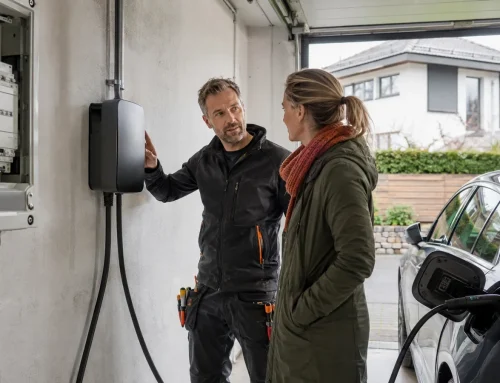
With surplus charging, the wallbox only charges the EV with the solar power the house isn't using itself at that moment. Instead of feeding the surplus into the grid at a low tariff, it goes into the car. For that, a system continuously measures how much electricity is spare and adjusts the charging power. Pure surplus charging is the cheapest but weather-dependent – for predictable charging there are mixed modes. (As of: July 2026)
Key points in brief
- Surplus charging only uses the solar power that would otherwise flow unused into the grid.
- This is the cheapest way to charge, because the electricity from your own roof costs the least.
- The prerequisite is a wallbox that can do this, plus a measurement that detects the surplus.
- The charging power fluctuates with the sun – when it is cloudy, the car charges slower or pauses.
- For plannable charging, there are mixed modes with a minimum power or a target time.
What does surplus charging mean?
It means charging the car only with the electricity that is left over anyway. On sunny days, a solar system often produces more than the house is consuming at that moment. Without an EV, this surplus would flow into the grid and would only be remunerated at the low feed-in tariff. With surplus charging, the wallbox intercepts exactly this surplus and sends it into the car.
The economic core behind it is simple: The self-produced solar power is the cheapest energy available in the house. Charging it into the car instead of selling it cheaply and buying expensive grid electricity for charging later is the biggest saving effect when charging at home. Why this is so and how the costs are classified is described in the article What does charging with your own solar power cost.
Surplus charging is therefore the most consistent implementation of the idea from the pillar Charge EV with solar power: to use your own electricity where it is most valuable. At the same time, it joins the levers described in the article on Optimise self-consumption – the car is one of the largest and most rewarding consumers for this.
How does it work technically?
Via a continuous measurement and a wallbox that reacts to it. The system must know two things: how much the solar system is currently producing and how much the house is consuming at the same moment. The difference is the surplus available for charging.
A measuring point at the grid connection records whether electricity is currently flowing into the grid or being drawn from it. If surplus flows into the grid, the wallbox control gives the signal: there is electricity left now, charge with it. If house consumption rises – for example because the oven is turned on – or clouds gather, the wallbox throttles accordingly or pauses. This happens continuously and automatically without you having to intervene.
For this to work, a wallbox that masters this control and the appropriate measurement are needed. This is one of the criteria when selecting a wallbox: A simple charging box without this capability cannot charge with surplus. In practice, a small control or energy management system often coordinates between the system, the house and the wallbox.
Pure surplus or mixed operation – what is realistic?
Both have their justification, and the honest point is: Pure surplus charging is the cheapest, but not always practical. Because the sun does not follow your schedule.
Pure surplus charging. The wallbox charges exclusively with surplus. This is the cheapest, because no grid electricity is added. The catch: On dull days or when the car is to be charged in the evening, little or nothing comes together. For vehicles that are parked at home for a long time during the day, it is ideal – for the commuter who arrives in the evening and needs a full car in the morning, often too little on its own.
Mixed modes. That is why many systems offer compromises. One variant preferably charges with surplus, but supplements with a minimum power from the grid so that charging does not stop completely. Another works with a target time: «By seven o'clock tomorrow morning the car should be full» – the system uses as much solar power as possible until then and fills up the rest with grid electricity. This is how you combine cheap solar power with the necessary plannability.
| Mode | Advantage | Limit |
|---|---|---|
| Pure surplus | cheapest electricity | dependent on weather and time of day |
| Surplus + minimum power | always charges something | partly grid electricity needed |
| Target time | plannable, uses solar maximally | fills rest with grid electricity |
Simplified overview, as of: July 2026. The capabilities of your wallbox and control are decisive.
Which mode fits depends on the parking time profile. If you can charge the car flexibly, pure surplus is the cheapest. If you rely on a full car at a fixed time, choose the target time and accept some grid electricity.
Tesla, VW ID, BMW and co.: Which EV can be charged with PV surplus?
The short answer: every one. Surplus charging is not a capability of the car, but of the wallbox or the control behind it – it measures the surplus and tells the wallbox how much power to charge with. The vehicle takes what the wallbox releases via the Type 2 connection. Whether Tesla, VW ID, BMW, Hyundai, Kia, Škoda or Renault: With a PV-capable wallbox or an energy management system, they all charge with solar power.
There are differences in the limits. The charging standard dictates a minimum charging current of 6 amperes – single-phase that is around 1.4 kW, three-phase around 4.1 kW. A wallbox with phase switching therefore starts single-phase at around 1.4 kW surplus and switches to three phases when there is a lot of sun; without switching, charging only starts from around 4.1 kW surplus, which leaves a lot of solar power unused on mixed days. Some vehicles are sensitive to the phase change during charging; good controls therefore take a short charging break. How many kilowatt hours end up in the car per year depends mainly on the parking times – not on the brand.
| Vehicle | Surplus charging via | Note |
|---|---|---|
| Tesla (Model 3, Y, S, X) | Tesla app «Surplus charging» – only together with a Tesla Powerwall; otherwise PV-capable wallbox or energy manager | Tesla solution needs at least 1.2 kW stable surplus; the Wall Connector alone cannot do it |
| VW ID.3/ID.4/ID.7, Škoda Enyaq, Cupra Born | PV-capable wallbox or energy manager | Departure time and charging limit in the vehicle app, surplus logic in the wallbox |
| BMW i4, iX, i5, Mini Electric | PV-capable wallbox or energy manager | three-phase 11 kW, phase switching makes sense |
| Hyundai Ioniq 5/6, Kia EV6/EV9 | PV-capable wallbox or energy manager | 800-volt technology changes nothing for AC charging |
| Renault, Polestar/Volvo, MG, Mercedes | PV-capable wallbox or energy manager | observe minimum charging current, charge single-phase with small surplus |
Rough classification, as of: September 2026. The wallbox, control and charging electronics of the vehicle are decisive. Which wallboxes can be easily controlled: Which wallbox fits?; feeding back from the car is a separate topic: bidirectional charging.
Sources: Tesla Support, «Surplus charging» in the Tesla app (prerequisite Powerwall, minimum surplus 1.2 kW); trade press on the introduction of the function (February 2024); charging standard IEC 61851 (minimum charging current 6 A); ecoEn installation practice.
Surplus charging is the function that brings the most to most people – and is most often wrongly expected. Many imagine the car charges constantly fast only with the sun. In reality, the charging power breathes with the weather: quickly in blazing sun, slowly in the clouds, not at all in the evening. If you know this, you are satisfied; if you expect an evenly fast charge, you are initially irritated. For almost every system in the Zurich region, we therefore set up a mixed mode with a target time: as much sun as possible, but a full car in the morning. This is the compromise people live with best.
Frequently asked questions
Does my car charge slower with surplus charging?
Temporarily yes – the charging power adapts to the available surplus. When there is a lot of sun, it charges quickly, with clouds slower, and without surplus it pauses. This is intentional, because this is the only way to exclusively use your own cheap electricity. If you want to charge plannably, combine surplus charging with a target time.
Do I need a home battery for surplus charging?
No. Surplus charging works directly from the solar system, without a battery – the car is in a sense itself a large battery for the solar power. A home battery and the car sometimes even compete for the same surplus. How both interact is a separate topic for households with a battery.
Can every wallbox charge with surplus?
No, this is a special capability. A wallbox that can be controlled is required, plus a measurement of the surplus and often a small control unit. Simple charging boxes without this function only charge with fixed power. Therefore, PV suitability is a central criterion when choosing a wallbox.
Is surplus charging also worthwhile with a small solar system?
Even then, it uses the surplus that would otherwise go into the grid – every kilowatt hour charged yourself is cheaper than grid electricity. With a small system, there is simply less surplus available, so the car charges less often and slower with pure sun. A mixed mode compensates for this.
Can I charge my electric car with PV surplus?
Yes, every EV with a Type 2 connection – the brand does not matter. The decisive factor is the wallbox: it must be controllable and needs a measurement of the surplus at the house connection, often via an energy management system. With phase switching, the car charges from around 1.4 kW surplus, without it only from around 4.1 kW.
Can I charge a Tesla with PV surplus?
Yes, in two ways. Tesla's own «Surplus charging» function in the Tesla app only works together with a Tesla Powerwall, which measures the surplus; it requires at least 1.2 kW stable surplus, the Wall Connector alone cannot do it. Without a Powerwall, you charge the Tesla like any other EV via a PV-capable wallbox or an energy manager that regulates the charging current according to the surplus.
Free initial consultation
Charge your car with your own solar power
We set up the wallbox and control so that your car takes in as much solar power as possible – with the compromise of cost-effectiveness and plannability that fits your everyday life.
Prefer to talk? +41 78 830 83 35
Have a wallbox installed – charge with solar power →
Swissolar-certified specialist company · ESTI installation authorisation (Art. 14 NIV) · in Zurich since 2017 · over 150 systems completed · a personal answer from the specialist company, no call centre
Sources: General technical basics on surplus charging, PV surplus measurement and charge control (charging standard IEC 61851, minimum charging current 6 A); Tesla Support, «Surplus charging» in the Tesla app, and trade press on the introduction (February 2024); empirical values from the installation practice of ecoEn GmbH, Zurich region. As of September 2026.
Last updated: 9 July 2026 · Author: ecoEn editorial team