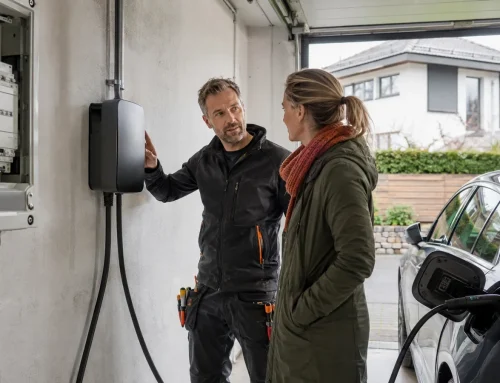
Wallbox and home battery compete for the same solar surplus – therefore the prioritisation is crucial. As a rule, the car charges the solar power directly, not via the detour of the battery, because every intermediate step costs energy. The battery rather supplies the household in the evening. An energy management system regulates who has priority and when. Important to know: A battery is rarely there to charge the car – the car is simply too big for that. (As of: July 2026)
Key points in brief
- Wallbox and battery access the same solar surplus – without clear rules they hinder each other.
- The car mostly uses the solar power directly; the detour via the battery costs unnecessary energy.
- A home battery is too small to significantly charge an e-car – the car itself is the much larger battery.
- An energy management system sets the priorities: what gets electricity first.
- In practice, this means: battery for the house, solar surplus directly into the car.
Do wallbox and battery compete for the same electricity?
Yes – and exactly that is the core of the topic. Both want the solar power that the house does not immediately consume during the day. Without clear rules, the battery would store the surplus that the wallbox would need for the car, or vice versa. That is why the interaction is less about technology than about prioritisation: Who gets the surplus first?
The surplus solar power is a limited amount that fluctuates depending on the weather and time of day. Distributing it sensibly is the task. And here a look at the magnitudes helps: An e-car has a much larger battery than a typical home battery. The car can therefore take up much more solar power than the battery would ever hold – an important point for the question of who should get the surplus.
How the car is fundamentally charged with solar power is described in the pillar Charging the e-car with solar power; how targeted charging with surplus works, the article on Surplus charging. This article here clarifies how this is compatible with an existing home battery.
Why does the car usually charge directly and not via the battery?
Because every detour costs energy. If the solar power were first loaded into the home battery and from there into the car, it would undergo two conversions – in and out again – and a small part is lost with each. Charging the car directly with the solar surplus is the lower-loss and therefore more sensible way.
This corresponds exactly to the logic that already applies to the battery size: The article on Battery size notes that the car takes the electricity directly and is not routed via the home battery. The home battery has a different task – it supplies the household in the evening and at night, when the sun is no longer shining: light, fridge, electronics, the base load of the house.
This results in a natural division of labour: During the day, when the sun shines, the car charges directly with the surplus. What the car does not need goes into the household and into the battery. In the evening, the battery covers the house consumption. The car is the large consumer for the midday surplus, the battery the buffer for the evening – two different roles, no competition, if the priorities are right.
How are the priorities regulated?
Via an energy management system that decides who gets the solar power and when. It is the conductor that coordinates the system, household, battery and wallbox – without it, the consumers would struggle uncoordinated for the surplus.
A proven prioritisation often looks like this:
1. Direct house consumption first. What the house currently needs is covered directly from the sun – that is always the cheapest. 2. Charge car with the surplus. If the car is at the wallbox, it gets the remaining solar surplus directly. 3. Fill battery. What is then still left charges the home battery for the evening. 4. Remainder into the grid. If electricity remains beyond that, it is fed in.
This sequence is not a dogma – it can be adapted to one's own needs. For example, anyone who consciously wants to fill the battery first for the evening can set the priorities differently. The important thing is that someone determines the sequence at all. That is the actual planning task when wallbox and battery work in the same house. If the car is rarely at home during the day, the calculation shifts anyway: Then the battery takes over more, and the car charges when it is there.
| Time | Who gets the solar power | Role |
|---|---|---|
| Midday, car at home | House, then car (directly) | Car = large consumer |
| Midday, car away | House, then battery | Battery = evening buffer |
| Evening / Night | Battery supplies household | Car charges, if necessary, partly from grid |
Simplified overview, As of: July 2026. Your idle time profile and the configuration of the energy management system are decisive.
An honest conclusion: Anyone who believes a home battery is there to charge the e-car will be disappointed. It is too small for that. The battery pays off for the household, the car charges best directly from the sun. Whether and how large a battery makes sense at all is determined by the house consumption – not the car.
The idea «battery charges my car at night» is one we often encounter – and we mostly have to correct it. A typical home battery holds a fraction of what a car battery takes up; it would be empty after a short time and would have nothing left for the household. That is why we plan it the other way around: The car is the large consumer for the solar surplus during the day, the battery takes care of the evening in the house. In the Zurich region, we set up the energy management system so that this sequence runs automatically. Anyone who can charge the car during the day often does not need a larger battery for the car at all – the sun handles that directly.
Frequently asked questions
Can I charge my e-car from the home battery at night?
Only to a very limited extent. A home battery is small compared to the car battery – it would be empty after short charging and would no longer be available to the household. It makes more sense to charge the car directly with solar surplus during the day and use the battery for house consumption in the evening. For night-time charging, grid electricity is usually the realistic supplement.
Should I buy a larger battery for the car?
As a rule, no. The battery size is based on the house consumption, not on the car – the car takes the solar power best directly anyway. An oversized battery for the car is hardly worthwhile because it is expensive and the detour via the battery costs energy. The appropriate battery size is a topic of its own.
Do I lose energy if I charge the car via the battery?
Yes, a little. Every charging and discharging of the battery is associated with small losses. If the electricity is first stored and then loaded into the car, these losses add up. Direct charging from the solar system is therefore the lower-loss way – another reason why the car gets the surplus directly.
How do I set the priorities between car and battery?
Via the energy management system, which coordinates the system, household, battery and wallbox. It determines who gets the solar surplus in which order. The setting can be adapted to your needs – for example, depending on whether the car is usually at home during the day or not. The specialist company sets this up during installation.
Free initial consultation
Wallbox, battery and solar system in harmony
We plan the interaction in such a way that your car tanks the solar power directly and the battery supplies the household – with a prioritisation that fits your everyday life.
Prefer to talk? +41 78 830 83 35
Have a wallbox installed – charge with solar power →
Swissolar-certified specialist company · ESTI installation authorisation (Art. 14 NIV) · in Zurich since 2017 · over 150 systems completed · a personal answer from the specialist company, no call centre
Sources: General technical basics on the interaction of wallbox, home battery and energy management; empirical values from the planning practice of ecoEn GmbH, Zurich region.
Last updated: 9 July 2026 · Author: ecoEn editorial team