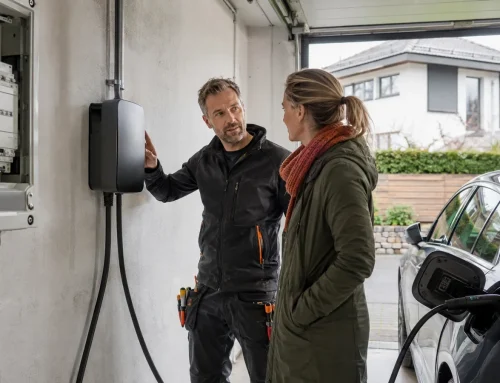
Bidirectional charging means: the EV also gives electricity back – to the house (V2H) or to the grid (V2G). Technically it works and is being trialled in pilot projects; it's not yet a broad standard, because the vehicle, wallbox and billing have to match, and the rules for feeding back need clarifying case by case. Anyone planning today keeps the option open, but doesn't build on it. (As of: July 2026)
Key points in brief
- Three acronyms, three directions: V2L supplies devices, V2H the house, V2G the grid – the effort increases in that order.
- It's stuck on compatibility: only certain vehicle-wallbox combinations can feed back today, and those packages have their price.
- Behind your own meter, feeding back is mainly a technology question – towards the grid it additionally becomes a metering, registration and remuneration question.
- Switzerland is moving: pilot projects and first system packages exist – feasible for early adopters, not yet a planning foundation for the standard household.
- The sensible stance today: calculate the EV as a consumer, keep the option open with future-proof technology.
What is bidirectional charging – and what distinguishes V2L, V2H and V2G?
The basic idea: the electricity no longer just flows into the car battery, but on demand flows back out too. Depending on where to, everyone means something different:
| Acronym | The electricity flows… | What it needs | Everyday readiness today |
|---|---|---|---|
| V2L (Vehicle-to-Load) | to individual devices at a socket on the car | just a vehicle with a V2L function | available on quite a few models |
| V2H (Vehicle-to-Home) | into the house network, behind your meter | vehicle + feed-back-capable wallbox + integration into the house | individual system packages, early-adopter territory |
| V2G (Vehicle-to-Grid) | into the public grid | everything from V2H + metering, registration and remuneration clarification with the grid operator | pilot projects and fleet trials |
Classification, as of: July 2026 – the market is moving fast; the specific product and vehicle information is decisive.
Important for expectations: V2L is a practical socket on the car, not a home battery. The jump to genuine V2H is big – that's about permanent integration into the house network, cleanly coordinated with the meter, protection and, where relevant, the solar system. What of this already works in everyday life today is shown in its own article.
Why isn't it a broad standard yet?
Because three things have to fit at once – and the market is still building on all three. The vehicle: the model has to explicitly support feeding back; the manufacturer landscape is inconsistent, and the battery warranty terms also treat the topic differently. The wallbox: an ordinary wallbox only charges in one direction. Feed-back-capable systems today mostly work with their own power electronics, are correspondingly more expensive, and typically only work with certain vehicles – the package decides, not the individual part. The integration: at the latest once the car's electricity flows through the house, clarified metering and clean integration with the meter and any PV are needed – and towards the grid, the grid operator has to be at the table too.
On top of that there's the standards level: the communication standards between car and charging station keep evolving, and first-generation systems don't automatically speak the next generation's language. That very confusion is why we advise, as with the battery question: calculate with what reliably works today.
What's the regulatory situation in Switzerland?
The short version, on two levels. Behind your own meter – the car feeds into the house network, the electricity is consumed directly again – the topic is primarily technical and regulatory: proper installation, the system reported by the electrical specialist company, compliant protection technology. Towards the grid it gets more demanding: anyone feeding in needs metering and registration with the grid operator, and the remuneration question arises – fed-back electricity from the car battery isn't automatically the same as solar power from the roof, neither for remuneration nor for the guarantee of origin. Separate rules apply to intermediate-stored grid electricity.
Specific processes and terms differ by grid operator and keep evolving with the topic – your utility's information and planning by the specialist company are binding. As a homeowner, you don't need to master the details today; you should just know that V2G is more than a wallbox with reverse gear.
Where does Switzerland concretely stand today?
Honestly assessed: in the transitional phase from pilot project to niche product. There are fleet trials and research projects genuinely running V2G, and there are first commercial system packages with which tech-savvy homeowners implement genuine V2H – with a matching vehicle, matching hardware and consulting effort. What doesn't exist: the one standard solution sitting on the electrician's shelf that works with every car.
The field is moving noticeably, though, and the direction is clear – more vehicles with feed-back capability, more mature standards, falling package prices. That's why it's worth keeping the door open with every new vehicle purchase, without paying a premium today for a function you can't use yet.
What does that mean for your planning today?
Three practical things. First: don't make purchase decisions dependent on V2H. Whether a classic home battery pays off is a question that can be calculated today – the bidirectional car is the option on top, not the basis. Second: build infrastructure that's expandable – generous empty conduit, space in the meter cabinet, a charging solution that can be replaced without rebuilding the supply line. Third: at vehicle purchase, count feed-back capability as a plus point and read the warranty terms on it – the point doesn't need more weight than that today.
And until then, there's a solution already open to everyone today that anticipates part of the V2H benefit: surplus charging – deliberately shifting solar power into the car instead of feeding it in cheaply. No feed-back needed, full benefit when driving.
Bidirectional charging is the topic where, in consultations, expectations are furthest from the market reality – understandable, because the idea is instantly appealing. Our line has been the same for years: we don't plan a project whose numbers only work with V2H, and we don't install anything that would block a later retrofit. The customers who bought into this line a few years ago are doing well with it – they haven't missed anything, and everything stays open.
Frequently asked questions
My car has V2L – is that already bidirectional charging?
In the broader sense yes, in practice it's a socket on the vehicle: good for devices, camping or an emergency. V2L isn't connected to the house network – genuine V2H is an installation project, not a vehicle function alone.
Can I earn money with V2G?
In the longer term, that's the idea – the car battery helps the grid and is compensated for it. Today that runs in pilot and fleet projects; for individual private households it's not yet a realistic business model.
Does feeding back damage the car battery?
Extra charging cycles mean extra use – modern batteries are designed for it, but the manufacturer's warranty terms are decisive: some include intensive V2G operation, others don't address it. Read before use.
Do I need a special wallbox for V2H?
Yes – a feed-back-capable one, today usually with its own power electronics and matched to certain vehicles. A normal wallbox only charges in one direction; retrofitting usually means replacing it.
Should I wait with the home battery until V2H is standard?
No. The battery question can be calculated today, the V2H future can't be planned – anyone who waits makes today's decision dependent on an uncertain bet. The classification: an EV as a home battery.
Free initial consultation
Plan for the future, without betting on it.
We size the charging infrastructure and solar system so V2H can dock on later – and calculate your project with what reliably works today.
Prefer to talk? +41 78 830 83 35
Wallbox & charging solution for your home →
Swissolar-certified specialist company · ESTI installation authorisation (Art. 14 NIV) · in Zurich since 2017 · over 150 systems completed · a personal answer from the specialist company, no call centre
Sources: EnergieSchweiz (bidirectional charging), VSE/industry publications, manufacturer documentation.
Last updated: 9 July 2026 · Author: ecoEn editorial team