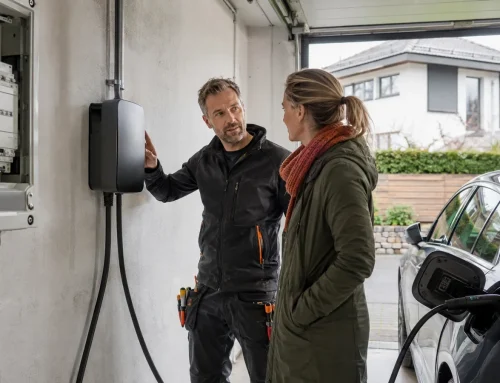
It does not work without the landlord's consent – a wallbox is a structural change to the rented property. Swiss tenancy law does not know a legal entitlement to this as things stand today. The path therefore leads via a good application: concrete solution, clarified costs, clean regulation for moving out. In practice, requests rarely fail because of a no – but because of the vague request. (As of: July 2026)
Key points in brief
- The wallbox touches the electrical installation and often communal areas – this is a matter for the ownership, not everyday tenancy agreement business.
- An enforceable legal entitlement to a charging station does not exist as things stand today – all the more reason why the quality of the application counts.
- The strongest arguments for the landlord side are economic: charging infrastructure enhances the value of the property and is increasingly becoming a question of rentability.
- Clarify in advance: who pays for installation and electricity, what happens when moving out, what applies to other parties?
- This guide contextualises the practice and does not replace legal advice.
What are tenants allowed to do – and what not?
The starting point is sobering: the parking space is rented, the electrical installation belongs to the property, and structural changes to the rented property require the written consent of the landlord. This applies to the wallbox just as much as to any other installation – regardless of who pays for it. An arbitrarily mounted box risks dismantling at your own expense and trouble that goes far beyond the charging issue.
Swiss tenancy law does not know a legal entitlement, as some other countries have introduced, as things stand today. That sounds more discouraging than it is: it just means that the path leads via persuasion instead of entitlement – and persuading works significantly more often than the reputation of the topic might suggest.
Why is a good application worthwhile instead of a vague request?
Because the landlord can hardly react to «Might I perhaps have a wallbox?» in any other way than hesitantly – the request transfers all the clarification work to them. An application that has already done the work turns the situation around:
| Building block of the application | What it answers |
|---|---|
| Quote from an electrical specialist company | What exactly is installed, by whom, at what price? |
| Clarification of feasibility | Is the connection sufficient? What does the specialist company say about the supply line? |
| Assumption of costs | Who pays for installation, box and operation? (usually: the tenant side) |
| Electricity billing | Own measurement – the charging current does not run via general electricity |
| Moving out regulation | Dismantling or takeover by landlord/subsequent tenant – in writing in advance |
| Notification & standards | Registration with the grid operator by the specialist company |
Classification aid, as of: July 2026. The specific agreement should be recorded in writing – if in doubt, with professional or legal support.
With such a dossier, the request becomes a project with completed homework. And it also answers the unspoken core question of every ownership at the same time: «What am I letting myself in for?» – Answer: little.
An argument with an expiry date: In the Canton of Zurich, the cantonal incentive programme currently pays CHF 500 per equipped parking space – however, only the ownership can apply for this (or someone on their behalf), not the tenant. For your application, this means: the incentive is an argument that you provide to the landlord, not money that you collect yourself. And it is urgent – on 22 September 2026, 96 per cent of the framework credit had been claimed, the programme will expire by the end of 2026 at the latest. Anyone who is already thinking about a charging solution has a better leverage now than in a year's time. The amounts and conditions: Wallbox incentives in the Canton of Zurich.
Which arguments convince the landlord?
The economic ones. Charging infrastructure is on the way from being an extra to basic equipment: anyone who is looking for an apartment with a parking space today and drives electrically asks about the charging option just like about the cellar compartment. A property that can offer this is easier to rent out – and the installation that a renting party initiates and pays for enhances the value of the object without burdening the ownership.
The second argument is the expansion idea: instead of an individual solution for one parking space, the ownership can take the request as an opportunity to examine the basic installation for all spaces – once planned, the system grows with every additional electric car. Some landlords then invest themselves and pass the costs on to the users; for the requesting renting party, this is often the best result: charging without their own investment.
Which variants have proven themselves?
Three models cover most cases. Tenant investment model: You pay for installation and box, the agreement regulates moving out and any compensation for the residual value. Advantage: fast; disadvantage: you are investing in someone else's property – the moving out regulation is therefore the most important sentence of the agreement. Landlord investment model: The ownership builds (often the basic installation straight away) and bills via rent or ancillary costs. Contracting model: A service provider builds and operates the charging infrastructure, billing is per charge – widespread in larger properties where operation is to run professionally (for large objects the usual pattern).
For charging itself, the same applies as everywhere: 11 kW is sufficient in everyday life, because the car is stationary for hours anyway – this also keeps the connection discussion with the ownership small.
What if the answer is still no?
First understand, then react. A no usually has a concrete reason – concern about the electrics, unclear precedent for other parties, bad experiences – and many of these reasons can be eliminated with an improved application: attach a load management concept, assure dismantling, involve the administration. Patience with a deadline is also helpful: the request to treat the topic as an agenda item at the next owners' meeting.
If it remains a no, the alternatives carry further than many think: charging at the employer, public charging points in the neighbourhood and fast charging for the exception. It is not as comfortable as your own box – but it bridges the gap until the property follows suit. And according to our observation, they do follow suit: the question is usually not whether, but when.
The successful tenant requests that we accompany have a common pattern: they come with a quote, billing solution and moving out regulation – the landlord only has to say yes. More than once, an individual request became a project of the ownership: if a specialist company is looking at the supply line anyway, the basic installation for all spaces suddenly seems obvious. Vague requests without documents, on the other hand, peter out – often not because of a lack of will, but because of the open work that nobody wants to take on.
Frequently asked questions
May I temporarily charge at the normal socket in the garage?
Only with consent and clean billing – and as a permanent solution, the household socket is unsuitable for the car anyway: it is not built for hours of full load, and the electricity often runs via the general meter.
Who pays for the wallbox – tenant or landlord?
A matter of negotiation. It is usual that the requesting tenant bears the cost of the installation and box; if the ownership invests, it charges this via rent or ancillary costs. It is crucial that this is regulated in writing in advance – including moving out.
What happens to my wallbox when moving out?
What the agreement says: dismantling at your expense, takeover by the ownership against compensation or passing on to the subsequent tenants. Without regulation, dismantling applies in case of doubt – which is why this point belongs in every agreement.
Can the administration simply ignore my request?
There is no obligation to approve, but you may expect an answer. Proven: submit the request in writing and ask for it to be dealt with at the next condominium owners' meeting – this way it ends up on an agenda instead of in a mailbox.
Does the wallbox increase my rent?
Only if the ownership invests and passes this on – the modalities are based on tenancy law and the agreement. If you pay yourself, nothing changes in the rent; moving out must then be regulated.
Free initial consultation
We make your request ready for a decision.
Feasibility check, quote and the documents with which your landlord only has to say yes – from a single source, requested free of charge and without obligation.
Prefer to talk? +41 78 830 83 35
Charging station from a specialist company in Zurich →
Swissolar-certified specialist company · ESTI installation authorisation (Art. 14 NIV) · in Zurich since 2017 · over 150 systems completed · a personal answer from the specialist company, no call centre
Sources: EnergieSchweiz, Swiss eMobility, tenancy law basics: relevant advisory centres (MV/HEV).
Last updated: 9 July 2026 · Author: ecoEn editorial team