
Yes, photovoltaics on the industrial roof is worthwhile in 2026 – but for a different reason than three years ago. Whoever feeds in receives only the reference market price for systems from 150 kW (around 3.90 Rp./kWh in the second quarter of 2026); whoever consumes it themselves replaces purchased power for around 20 Rp./kWh. The large-scale system is therefore dimensioned for the load profile of the business, not for the roof area. As a guideline value, a completely installed system from 100 kWp costs CHF 1,100–1,400 per kWp; the one-off feed-in incentive (GREIV, application before construction possible) covers an order of magnitude of CHF 30,000 at 100 kWp, plus surcharges for facades and car park roofings. New in the Canton of Zurich: The Government Council wants to oblige roofs over 300 m² – including existing ones, during roof renovation – to have a full-surface solar system; the proposal is with the Cantonal Council. (As of: September 2026)
Key points in brief
- From 150 kW system capacity there is no longer a minimum remuneration: Fed-in power brings the quarterly reference market price, around 3.90 Rp./kWh in the second quarter of 2026. Self-consumption is thus the business model, full feed-in the exception.
- Guideline values, completely installed and before subsidies: from 100 kWp CHF 1,100–1,400 per kWp; from 200 kWp project-specific, because transformer, connection and statics characterise the price – not the modules.
- Subsidies: One-off feed-in incentive as GREIV from 100 kW (application before construction), surcharges for car park roofings (CHF 250 per kW from 100 kW) and steep systems from 75° inclination; from 150 kW alternatively the auction.
- The three technical decisions are statics (trapezoidal sheet metal or flat roof ballast), grid connection (connection application, transformer, reactive power) and measurement concept with multiple tenants.
- Solar obligation: The federal government requires it since 2025 for new buildings over 300 m²; in the Canton of Zurich a proposal for all roofs over 300 m² has been with the Cantonal Council since January 2026 – including retrofitting during roof renovation.
Why industrial roofs calculate differently in 2026 than in 2022
For three years the calculation on large roofs was simple: cover as much as possible, feed in as much as possible, the feed-in tariff carries the rest. This calculation is over since the Electricity Act. For systems under 150 kW a minimum remuneration indeed applies – but it decreases with the system size and is only around 1.2 Rp./kWh at 149 kW. From 150 kW it falls away completely: Then the grid operator pays the quarterly reference market price, in the second quarter of 2026 around 3.90 Rp./kWh, plus depending on the utility a small surcharge for the guarantee of origin. Which utilities in the Zurich area pay what is shown in the overview of feed-in tariffs.
On the other side stands the purchase price. A business with more than 100,000 kWh annual consumption buys its power on the free market, typically for around 20 Rp./kWh, in the years 2022 and 2023 at times for a multiple. Every kilowatt-hour from the own roof that remains in the business is thus worth around five times as much as a fed-in one. From this follows the most important planning rule for industrial roofs: The system is dimensioned for the load profile, not for the roof area. An 8,000 m² hall roof that could carry 800 kWp might get 300 kWp – as much as the business consumes itself during the day, plus the charging infrastructure in the car park.
How high the self-consumption turns out depends on the type of business: Production and cooling reach 60 to 80 percent without storage from experience, logistics without cooling significantly less. The bandwidths by business type are in the article on the solar system for business and SME; authoritative is the evaluation of the quarter-hourly values, which businesses from 100,000 kWh can obtain from the grid operator.
What does a large-scale system on the industrial roof cost?
From 100 kWp the roof belongs in the price class in which modules and inverters only make up half of the bill. The rest are positions that turn out differently for every roof – and therefore every number below should be read as a guideline value.
| System size | Guideline price per kWp (fully installed, without battery) | Order of magnitude of investment | Typical object |
|---|---|---|---|
| ~100 kWp | CHF 1,100–1,400 | CHF 110,000–140,000 | Commercial hall, logistics, cold store |
| from 200 kWp | project-specific, further economies of scale | – | Production hall, large distributor, logistics centre |
| from 500 kWp | project-specific; transformer station and medium-voltage connection characterise the price | – | Industrial site, pharma and logistics locations |
Guideline values according to published Swiss market data, As of: July 2026, completely installed, before subsidies and before taxes. From 200 kWp the degression flattens out, because connection, statics and site management no longer scale with the number of modules. The individual quote after load profile and inspection is binding.
Not included in the guideline values and therefore to be quoted individually: static proof and possible reinforcement, fall protection and scaffolding, adaptations to the main distribution board or an own transformer station, the measurement technology for multiple tenants, lightning protection and – for older halls – the roof renovation before the system. How a roof is broken down into cost positions is shown in the article on costs per kWp; the tax and financing side is covered by financing a solar system as a company.
Storage. For self-consumption, the large-scale system rarely needs a storage because the load profile of the business matches the course of the sun anyway. It becomes interesting for capping peak loads, because large consumers pay a capacity tariff – when that works out is calculated in the commercial storage guide.
Subsidies: GREIV, surcharges and the auction from 150 kW
The one-off feed-in incentive of the federal government also applies to industrial roofs: around CHF 360 per kWp for the system part up to 30 kWp and around CHF 300 per kWp for the part above that, each plus the basic contribution (EnFV Annex 2.1, As of August 2026) – at 100 kWp an order of magnitude of CHF 30,000. From 100 kW the application runs as GREIV and can be submitted before construction. For investments of several hundred thousand francs this is the decisive planning advantage: The subsidy decision is available before ordering.
Three surcharges are relevant for industrial buildings (Pronovo, As of September 2026):
| Surcharge | Condition | Rate |
|---|---|---|
| Car park bonus | System from 100 kW on a permanent, previously unroofed car park area | CHF 250 per kW |
| Inclination angle bonus | Inclination from 75° – facade or steep elevation | CHF 400 per kW (integrated), CHF 200 per kW (attached) |
| Winter power bonus | System from 100 kW with winter yield over 500 kWh per kW | The conditions of Pronovo are authoritative – in the Swiss Plateau practically only achievable alpine |
Guideline values; the current provisions of Pronovo are authoritative. The winter power bonus replaces the former altitude bonus since 2026 and plays no role for flat roofs in the Swiss Plateau.
From 150 kW the route via the PV auctions of the federal government is also open: a high one-off feed-in incentive or a sliding market premium over 20 years, both awarded in competition – intended for systems without self-consumption. For a business that uses its power itself, the normal GREIV with self-consumption is almost always the better route; the auction becomes interesting when a roof is rented out or a full feed-in is planned.
Trapezoidal sheet metal, flat roof ballast, statics: What the roof must carry
Industrial roofs are almost always one of two construction types, and both have their own logic.
The trapezoidal sheet metal roof – the rule for halls from steel construction – is attached with clamping systems directly to the high beads, without ballast. The system is light, the assembly fast, and the inclination of the roof dictates the module inclination; for east-west saddle halls this naturally results in the even daily course that a business needs. The limits are set by the sheet metal thickness and the condition of the screw connections – for halls from the eighties this should be checked before the quote.
The flat roof – concrete or lightweight construction with bitumen or foil waterproofing – carries the modules on elevated east-west systems with 10 to 15 degrees inclination, held by ballast. Ballast plus snow load is the limiting factor: Lightweight halls are often tightly dimensioned, and then a partial coverage or a lighter system is the solution, not the full area. Second point is the roof skin: A waterproofing that becomes due in five years is renovated before the system. Distances, fire protection and permit are covered in the article on the regulations for flat roof systems, the orientation question by the comparison east-west or south on the flat roof.
In both cases the following applies: The static proof according to SIA 261 belongs at the beginning, not at the end – and whoever is renovating the roof anyway plans the system at the same time, because scaffolding and tinsmith are then already there.
Grid connection: Connection application, transformer, reactive power
For large-scale systems, the grid connection often decides on the system size, not the roof. Three stages:
1. Connection application. From around 30 kW the grid operator checks in the grid connection application whether the supply line and transformer can take the feed-in. In commercial zones with many consumers this is mostly unproblematic, for remote halls with a long supply line the connection capacity becomes the limit. This clarification belongs before the detailed planning. 2. Own transformer station. Businesses with a medium-voltage connection feed in via their own transformer station. Then we check the transformer capacity, protection technology and the question of whether the feed-in remains on the low-voltage side or the station must be adapted – a point that helps determine the price for systems from a few hundred kW. 3. Reactive power and control. Large inverters must provide reactive power and be controllable according to the specifications of the grid operator; since 2026 the grid operator may limit the feed-in within the framework of the flexibility rules, which hardly carries weight for a system designed for self-consumption. The electrical installation and the grid registration are taken over by our own team with ESTI installation permit (Art. 14 NIV).
If multiple tenants use the building, the measurement concept is added – the system becomes a self-consumption community (ZEV), and the question of who draws the power at what price belongs regulated before construction.
Logistics, production and pharma halls: Where the largest roofs are
The public system register of the federal government shows where large-scale systems have long been everyday life. The average system size per municipality is the more meaningful figure for this than the total capacity: Where it lies above 50 kWp, it is halls, not residential houses.
| Location | Systems | Ø system (kWp) | Building type |
|---|---|---|---|
| Regensdorf ZH | 118 | 131,1 | Almost all capacity on industrial and logistics roofs |
| Schlieren ZH | 142 | 90,4 | Limmattal commercial axis with industrial and life sciences areas |
| Baar ZG | 429 | 55,1 | Baar–Sihlbrugg commercial zone |
| Volketswil ZH | 302 | 52,8 | Glatt valley logistics and retail |
| Cham ZG | 281 | 49,6 | Industry on Lake Zug |
| Canton of Zurich total | 32’829 | 28,1 | Per capita only rank 24 out of 26 – many hall roofs are still empty |
Own evaluation of the SFOE register «Electricity production plants», data status August 2026. All 26 cantons and 35 municipalities: Photovoltaics Switzerland in numbers.
Two readings: In the Limmattal, in the Glattal and in the Canton of Zug, grid operators and authorities know the process for large-scale systems – there the path is short. And the Canton of Zurich lies per capita on rank 24 despite the second highest total capacity: The large roofs that exist count double. To classify the size classes: Roof systems from 100 to 500 kWp are the core business of a regional specialist company like ecoEn; systems in the megawatt range on industrial sites are usually created in collaboration with a general contractor or energy supplier – there too we take over assembly and electrical installation as a partner.
Winter power from the industrial building: Facade and pitched roof
Industrial buildings have what residential houses rarely have: large, window-poor south facades. Vertical modules deliver less over the year than the roof, but relatively more in winter – when the sun is low, snow does not remain lying and the power is most valuable. How that works is explained in the article on the solar facade; what it costs, the article on the facade PV costs.
Two innovations make the facade on the commercial building more interesting in 2026: The inclination angle bonus of the federal government was raised to CHF 400 per kW (integrated) respectively CHF 200 per kW (attached), and for sufficiently adapted facade systems a notification procedure applies instead of the building application since 2026 (Art. 32abis RPV) – with a distance requirement of maximum 20 cm to the facade. The honest sequence nevertheless remains: first exhaust the roof, then the facade – as a second step for businesses that want more winter power or whose roof is full.
Solar obligation: Federal government since 2025, Canton of Zurich with proposal for roofs over 300 m²
Since 2025, the federal government requires a solar system on new buildings with more than 300 m² of eligible building area – that affects practically every new hall. Existing buildings are not affected by this; what applies for new builds and existing stock is stated in the article on the solar obligation in Switzerland.
The Zurich proposal is new: On 6 January 2026, the Government Council submitted an amendment of the Energy Act to the Cantonal Council, according to which suitable roofs over 300 m² must be fully covered with a solar system – for new buildings upon construction, for existing buildings during roof renovation. Exceptions are provided if the system is not economically viable over its service life, the grid operator cannot take up the electricity, or if protection interests stand in the way. The Government Council estimates the potential at around 6 terawatt hours per year, 60 per cent of which on large roofs. The Cantonal Council will decide whether and in what form the obligation will come; a date for it to come into force has not yet been scheduled. For owners of halls, this means today: if you are planning a roof renovation, it is better to plan the system at the same time – voluntarily, it is more economical than under time pressure.
How does an industrial roof project work at ecoEn?
1. Indicative quote from load profile and roof plan. For the initial framework, the annual statement – for businesses over 100,000 kWh the quarter-hourly values – and the roof plan are sufficient. From this, we calculate system size, self-consumption and incentives in an initial order of magnitude. 2. Site visit and statics. Roof covering, mounting, main distribution board, transformer station, cable routing; the structural analysis is commissioned before the system is dimensioned. 3. Concept. Layout, inverter concept, metering concept for multiple tenants, incentive path (GREIV, bonuses or auction), on request battery storage and charging infrastructure – in a report that management can read without technical knowledge. 4. Permit, connection, incentives. Notification procedure or building application, connection request to the grid operator, GREIV application before construction. 5. Installation and electrical work. Roof installation outside operational peaks, electrical installation and grid registration by our team with ESTI installation authorisation (Art. 14 NIV), inspection. 6. Operation. Monitoring, yield and self-consumption visible monthly, responsibilities regulated in writing.
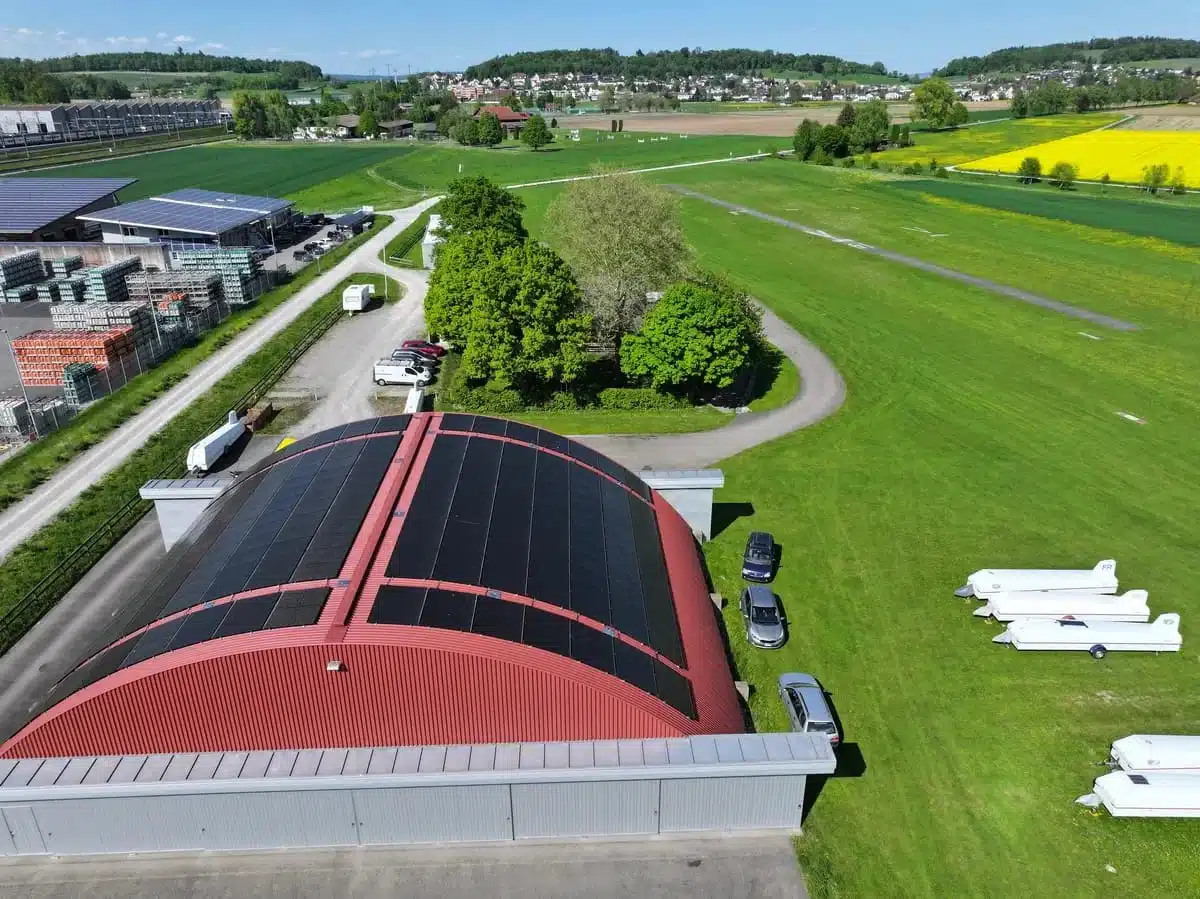
On the hangar of the Winterthur gliding airfield, we built an 89.6 kWp system in east-west orientation on trapezoidal sheet metal in 2022 – 224 modules, 110 kVA inverter, feed-in via the EKZ. It is a full feed-in system, and this shows exactly what has changed since then: today, we would first design a roof of this size for the consumption of the business and plan the charging infrastructure on the forecourt at the same time. The installation was the shortest part of the project; the time went into statics, connection request and grid registration – and there it pays to work cleanly at an early stage.
Frequently asked questions
Is photovoltaics on an industrial roof still worthwhile in 2026 if the feed-in tariff is so low?
Yes – if the electricity remains in the business. The low reference market price only affects the feed-in; self-consumed electricity replaces procurement for around 20 Rp./kWh. That is why the system is designed for the load profile rather than the roof area. Pure full feed-in systems only pay off via the auction or roof rental.
What does a 200 kWp system on a hall cost?
From 100 kWp, the guideline value is CHF 1,100–1,400 per kWp, fully installed (As of: July 2026); from 200 kWp, the price is project-specific because the transformer, connection and statics have a stronger impact on it than the number of modules. Structural analysis, scaffolding, adjustments to the main distribution board or transformer station are not included. The quote after the site visit is binding.
What incentives are available for a large system from 100 kW?
The one-off feed-in incentive (EIV) as GREIV – around CHF 300 per kWp for the system part over 30 kWp, plus basic contribution – with application before construction. In addition, there are bonuses: CHF 250 per kW for car park canopies from 100 kW and CHF 200–400 per kW for systems from 75° inclination. From 150 kW, the auction is an alternative option. The current provisions of Pronovo are authoritative.
Will a trapezoidal sheet metal roof support the system without ballast?
Usually yes: the modules are attached to the high beads with clamps, the system is light. Sheet thickness, screwing and substructure are checked – the limiting factor in older halls. On flat roofs, ballast holds the mounting structure; there, ballast plus snow load determine the usable area.
Do I soon have to cover my hall roof in the Canton of Zurich with solar?
Not yet. The federal solar obligation for new buildings over 300 m² has been in force since 2025. For existing roofs over 300 m², the Zurich Government Council proposed an obligation during roof renovation in January 2026; the proposal is before the Cantonal Council, a date for it to come into force has not been scheduled. If you are renovating anyway, it is better to plan the system voluntarily now.
From what size does the system need its own transformer station?
That depends on the existing connection, not on a fixed kW limit. Businesses with a medium-voltage connection feed in via their transformer station; transformer capacity and protection technology are then checked. For low-voltage connections, the connection request determines how much power the supply line can absorb – this clarification comes before detail planning.
Free initial consultation
Your load profile and roof plan are enough for an initial framework.
Send us the annual statement or the quarter-hourly values and the roof plan – we calculate system size, self-consumption and incentives as an indicative quote. Direct specialist company from Zurich with ESTI installation authorisation (Art. 14 NIV), no intermediary.
Prefer to talk? +41 78 830 83 35
Photovoltaic specialist for commerce and industry in the Zurich area →
Swissolar-certified specialist company · ESTI installation authorisation (Art. 14 NIV) · in Zurich since 2017 · over 150 systems completed · a personal answer from the specialist company, no call centre
Sources: Reference market price and minimum remuneration according to SFOE / Art. 12 Para. 1bis EnV (Q2 2026); one-off feed-in incentive, car park and inclination angle bonus according to EnFV Appendix 2.1 / Pronovo (as of August/September 2026); winter electricity bonus according to Art. 30c EnFV / Swissolar «2026: Was gilt neu»; facade notification procedure Art. 32abis RPV; federal solar obligation according to Energy Act / Electricity Act; Canton of Zurich: press release of the Government Council of 6 January 2026; cost guideline values according to published Swiss market data (as of July 2026); SFOE register «Elektrizitätsproduktionsanlagen» (data as of August 2026, own analysis); empirical values from large projects of ecoEn GmbH (Winterthur 2022, Fällanden 2023/2024). As of September 2026.
Last updated: 9 July 2026 · Author: ecoEn editorial team