
For businesses, a solar system is usually the simplest calculation in the entire energy sector: the business consumes during the day, the system produces during the day. Workshops, production or refrigeration typically reach 50 to 80 percent self-consumption without a battery. As a guideline, a fully installed system costs around CHF 1,400–1,700 per kWp at 30 kWp and CHF 1,100–1,400 per kWp from 100 kWp; the federal one-off feed-in incentive covers around CHF 30,000 at 100 kWp. Where this pays off particularly well in the Zurich area is shown by the installation register: in Zug, the Limmat Valley and the Glatt Valley stand the largest systems in the country – and most of the still-empty hall roofs. (As of: September 2026)
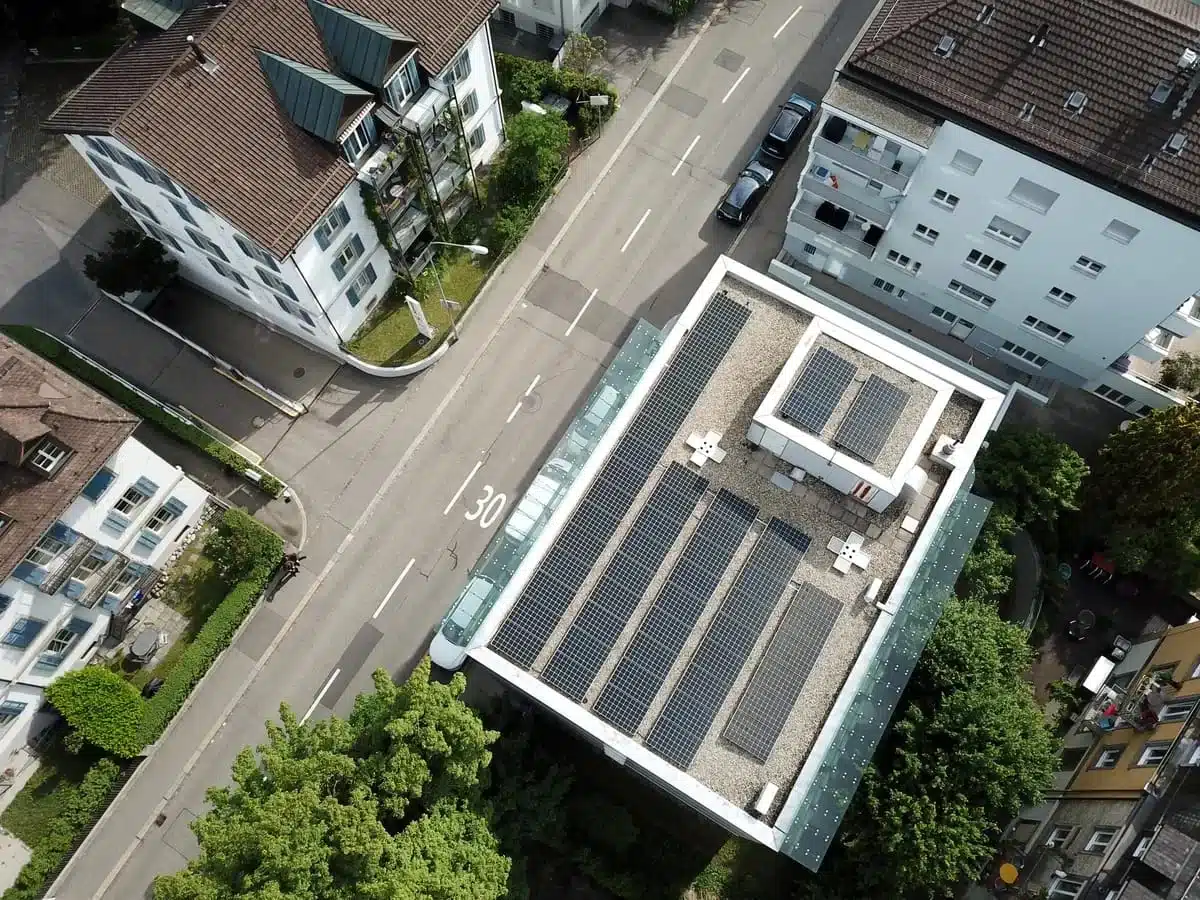
Key points in brief
- For businesses, solar power is worth three to five times more when it is self-consumed than when it goes into the grid: around 20 Rp./kWh purchase price versus around 4 to 6 Rp./kWh feed-in.
- Guideline prices, fully installed and before incentives: 30 kWp CHF 42,000–51,000, 100 kWp CHF 110,000–140,000. The price per kWp falls with size.
- Incentives: one-off feed-in incentive of around CHF 360 per kWp up to 30 kWp and around CHF 300 per kWp above; from 100 kW the application can be submitted before construction.
- For businesses, a battery rarely pays off for self-consumption, but often for peak loads or backup power.
- The technical decisions are flat-roof statics, grid connection and metering concept – not the modules.
Why does solar power pay off faster for businesses than for homes?
Because the load profile fits. A home consumes in the morning and evening, when the system delivers little; a business consumes between eight and five, when it delivers the most. This match is the whole trick – and for businesses it is simply there, without a battery, without control systems.
The second reason is the price difference between purchase and feed-in. Every kilowatt hour the business consumes itself replaces electricity that would otherwise be bought at the purchase price. Every kilowatt hour that goes into the grid earns the feed-in tariff: for systems under 30 kW legally at least 6.0 Rp./kWh, for 30 to 150 kW without self-consumption 6.2 Rp./kWh – and from 150 kW system output only the quarterly reference market price applies, around 3.90 Rp./kWh in the second quarter of 2026. What this means for large roofs is set out in the overview of feed-in tariffs. In short: self-consumption beats feeding in by a factor of three to five.
How high self-consumption turns out depends on the type of business. The following ranges are empirical values for systems sized for daytime consumption – the real load profile of your business is authoritative:
| Type of farm | Self-consumption without battery (range) | Note |
|---|---|---|
| Workshop, production (Mon–Fri daytime) | 60–80 % | Ideal case: machines run when the sun shines |
| Cold store, food, beverages | 60–80 % | Cooling load rises with the sun – see cold store guide |
| Office, services, practice | 40–60 % | Ventilation, IT and cooling carry daytime consumption |
| Retail, hospitality | 50–70 % | Seven days of operation, but also in the evening |
| Warehouse without cooling, shed | 20–40 % | Low consumption: check full feed-in with HEIV |
| Farm | 20–70 % | Depending on milk cooling, milking technology, drying – see agriculture guide |
Empirical values, as of: September 2026. The analysis of the load profile (quarter-hour values), which businesses with an annual consumption of around 100,000 kWh or more can obtain from their grid operator, is authoritative.
Added to this is a point that many businesses underestimate: anyone who draws more than 100,000 kWh a year may choose their electricity supplier freely – and therefore has supply contracts with prices that in some cases rose several-fold in 2022 and 2023. For these businesses, their own roof is the only price component they control themselves.
What does a solar system for a business cost?
On large roofs, the price per kilowatt falls significantly. Scaffolding, planning, connection and registration are incurred once, whether 30 or 100 kWp go on the roof; modules and inverters scale, the rest does not.
| System size | Guideline price per kWp (fully installed, without battery) | Order of magnitude of investment | Typical business |
|---|---|---|---|
| ~30 kWp | CHF 1,400–1,700 | CHF 42,000–51,000 | Workshop, practice, small warehouse |
| ~50 kWp | around CHF 1,500 and below | CHF 65,000–75,000 | Production business, car garage |
| ~100 kWp | CHF 1,100–1,400 | CHF 110,000–140,000 | Commercial hall, logistics, cold store |
| from 200 kWp | project-specific, further economies of scale | – | Industrial roof, major retailer |
Guideline prices based on published Swiss market data, as of: July 2026, fully installed, before incentives and before taxes. The individual quote after the potential analysis is binding.
Not included in these guideline prices are items that differ from roof to roof and therefore belong individually in the quote: fall protection and scaffolding, structural verification for flat roofs, adjustments to the main distribution board or transformer, metering technology for several tenants and – for older halls – whether the roof membrane needs to be renovated before the system. How a commercial roof breaks down into cost items is explained in the article on costs per kWp.
Incentives. The federal one-off feed-in incentive is currently around CHF 360 per kWp for the part of the system up to 30 kWp and around CHF 300 per kWp for the part above, each plus a basic contribution (EnFV Annex 2.1, as of August 2026). For a 100 kWp system, this amounts to around CHF 30,000. From 100 kW, the application runs as GREIV and can be submitted before construction – a real planning advantage for investments of this size. For very large systems from 150 kW, there is also the route via the federal PV auctions. Pronovo's current regulations are authoritative.
Taxes. For companies, the system is an investment in operating property and is usually depreciated over its useful life; the specific treatment is a matter for the fiduciary. Purchase, leasing, contracting and roof rental from a business perspective are compared in the article Financing a solar system as a company. For private individuals with a commercial share, the tax deduction for solar systems applies.
A sample calculation, non-binding
A workshop in the canton of Zurich draws 120,000 kWh a year, mostly Monday to Friday during the day. 100 kWp fit on the hall roof. In the Swiss Plateau this delivers a yield of around 1,000 to 1,100 kWh per kWp, i.e. about 100,000 kWh a year. At 65 percent self-consumption, 65,000 kWh stay in the business; at a purchase price of 20 Rp./kWh, this replaces electricity worth around CHF 13,000 a year. The remaining 35,000 kWh go into the grid at around 4 to 6 Rp./kWh – another CHF 1,500 to 2,000; the statutory minimum remuneration falls with system size, and at 100 kW the reference market price usually applies. After deducting the one-off feed-in incentive of around CHF 30,000, the investment is in the order of CHF 80,000 to 110,000. Depending on the purchase price, load profile and electricity price trend, the payback period for such businesses is typically in the range of six to nine years; the system then continues to produce for another two decades.
Sample calculation with guideline values, as of: September 2026. The calculation based on your load profile and the individual quote is binding.
Flat roof, grid connection, metering concept: the three technical decisions
With commercial systems, success is rarely decided by the modules, but by three questions that must be clarified before the quote.
The flat roof. Most commercial roofs are flat, and that's a good thing: modules can be densely laid in an east-west mounting at 10 to 15 degrees and deliver an even daily curve instead of a midday peak – exactly what a business needs. Two points must be checked in advance: the statics (ballast plus snow load on a hall that is often tightly dimensioned) and the condition of the roof membrane. A waterproofing that will be due in five years is renovated before the system, not afterwards. Distances, fire protection and permits are covered in the article on the regulations for flat-roof systems.
The grid connection. From around 30 kW, the grid operator checks in the connection request whether the supply line and transformer can absorb the feed-in – in commercial zones with many consumers this is usually not a problem, but for remote halls with a long supply line, connection capacity can become the limit. This clarification belongs at the beginning, because it helps determine which system size is economical.
The metering concept. If a single business uses the building, self-consumption runs behind the existing meter. If there are several tenants in the building – the car garage on the ground floor, the office above – the system becomes a self-consumption community, and the question of who buys the electricity at what price must be settled before construction. And if the roof belongs to the landlord but the electricity is meant to benefit the tenant, roof rental and contracting are the models for this.
Two additions that increasingly come with commercial roofs: in a business, a battery rarely pays off for self-consumption – the load profile already fits – but it can cap power peaks and thereby reduce the demand charge; when that works out is calculated in the commercial battery guide. And the company car park is the obvious second consumer: charging infrastructure for employees with load management on the same grid connection – and anyone who roofs the car park receives the federal car park bonus from 100 kW. Separate rules apply to halls from 100 kWp (market price, GREIV, transformer): Photovoltaics on industrial roofs.
Where in the Zurich area commercial roofs deliver the most
The federal public installation register shows where the large systems are – and therefore where businesses shape the built landscape. The average system size is the more telling figure for this than total capacity: where it is above 40 kWp, these are no longer single-family homes.
| Canton / location | Systems | Ø system (kWp) | What's behind it |
|---|---|---|---|
| Canton of Zug | 3’056 | 40,8 | Highest average of all cantons – commercial and apartment building roofs |
| Regensdorf ZH | 118 | 131,1 | Almost all capacity on industrial and logistics roofs |
| Schlieren ZH | 142 | 90,4 | Limmat Valley commercial axis |
| Baar ZG | 429 | 55,1 | Baar–Sihlbrugg commercial zone |
| Volketswil ZH | 302 | 52,8 | Glatt valley logistics and retail |
| Cham ZG | 281 | 49,6 | Industry on Lake Zug |
| Frauenfeld TG | 1’025 | 38,1 | Largest commercial town in Thurgau |
| Canton of Zurich total | 32’829 | 28,1 | Only rank 24 of 26 per capita – many roofs are still empty |
Own analysis of the SFOE register «Electricity production installations», data as of August 2026. All 26 cantons and 35 municipalities in the region: Photovoltaics in Switzerland in figures.
Two readings from this: first, the commercial axes of the Limmat Valley (Schlieren, Dietikon, Regensdorf), the Glatt Valley (Volketswil, Kloten, Wallisellen, Dübendorf) and the canton of Zug are the places where commercial systems have long been standard – anyone building there will find grid operators and authorities who know the procedure. Second, the canton of Zurich ranks only 24th of 26 per capita, despite having the second-highest total capacity. A canton of 1.6 million people has little roof area per person; the hall roofs that do exist therefore count double.
How does a commercial project with ecoEn work?
1. Indicative quote from the electricity bill and roof area. For an initial framework, the last annual bill and the roof dimensions are enough – from these we calculate system size, self-consumption and incentives as a first order of magnitude, without a site visit. 2. Load profile and site visit. For detailed design, we obtain the quarter-hour values from the grid operator and check the roof membrane, statics, main distribution board and cable routes on site. 3. Concept. System size, east-west or south, metering concept, incentive route (EIV, GREIV or auction) and – if desired – battery and charging infrastructure in one report that management can read without technical knowledge. 4. Permit, connection, incentives. Notification procedure or building application, connection request to the utility, incentive application strictly before construction starts – we keep to the sequence. 5. Installation and electrical work. Roof installation outside peak operating times, electrical installation by our own team with ESTI installation authorisation (Art. 14 NIV), grid registration, acceptance. 6. Operation. Monitoring set up, yield and self-consumption visible monthly, responsibilities settled in writing.
With commercial systems, the trigger is rarely climate protection and almost always one of three situations: an upcoming roof renovation, a new electricity supply contract with significantly higher prices, or the decision to electrify the company car park. All three lead to the same first question – how much fits on the roof, and how much of it stays in the business. Our larger systems, such as the 89.6 kWp in an east-west layout on the industrial roof of the Winterthur gliding airfield or the condominium project with over 100 kWp in Fällanden, have shown: installation is the shortest part of the project. The time goes into statics, the connection request and the metering concept – and that is exactly where it pays to work cleanly early on.
Frequently asked questions
Is a solar system worthwhile for an SME even without a battery?
In most cases yes – precisely without a battery. A business with daytime consumption typically reaches 50 to 80 percent self-consumption, because production and consumption coincide. For businesses, a battery pays off more for capping power peaks or for backup power than for self-consumption.
What does a 100 kWp solar system on a commercial hall cost?
As a guideline, CHF 1,100–1,400 per kWp, fully installed, i.e. in the order of CHF 110,000 to 140,000 before incentives (as of: July 2026). The federal one-off feed-in incentive of around CHF 30,000 is deducted from this. Depending on the roof, scaffolding, structural verification and adjustments to the main distribution board come on top. The individual quote is binding.
What incentives does a company get for a solar system?
The same one-off feed-in incentive as private individuals: currently around CHF 360 per kWp up to 30 kWp and around CHF 300 per kWp above, plus a basic contribution (as of: August 2026). From 100 kW, the application can be submitted before construction; from 150 kW, the auction route is open. Pronovo's current regulations are authoritative; municipal programmes are added depending on the location.
Can my hall roof carry a solar system?
A structural verification clarifies this, and it belongs before the quote. Elevated east-west systems on flat roofs are usually held in place with ballast, which acts on the structure together with the snow load – for older lightweight halls, this is the limiting factor. Lighter systems or partial coverage are then the solution.
How long does the business stand still during installation?
Usually not at all. Roof installation runs independently of operations; connecting to the main distribution board requires a short, plannable shutdown, which we schedule outside operating hours. For refrigeration businesses, this timing is coordinated with the cold chain.
The roof belongs to the landlord – is anything still possible?
Yes, via two models: the landlord builds the system and sells the electricity to the tenant (self-consumption community), or the tenant rents the roof area and builds it themselves. Both are established; the roles must be settled in writing – details in the article on roof rental and contracting.
Free initial consultation
Your electricity bill and roof area are enough for an initial framework.
Send us your last annual bill and the dimensions of your roof – we calculate system size, self-consumption and incentives as an indicative quote. A direct specialist company from Zurich, not an intermediary.
Prefer to talk? +41 78 830 83 35
Photovoltaic specialist for commerce and industry in the Zurich area →
Swissolar-certified specialist company · ESTI installation authorisation (Art. 14 NIV) · in Zurich since 2017 · over 150 systems completed · a personal answer from the specialist company, no call centre
Sources: Guideline costs based on published Swiss market data (as of July 2026); one-off feed-in incentive according to EnFV Annex 2.1 / Pronovo (as of August 2026); minimum remuneration and reference market price according to SFOE (Art. 15 EnFV, Q2 2026); SFOE register «Electricity production installations» (data as of August 2026, own analysis); experience from commercial and large projects of ecoEn GmbH (Winterthur 2022, Fällanden 2023/2024). As of September 2026.
Last updated: 9 July 2026 · Author: ecoEn editorial team