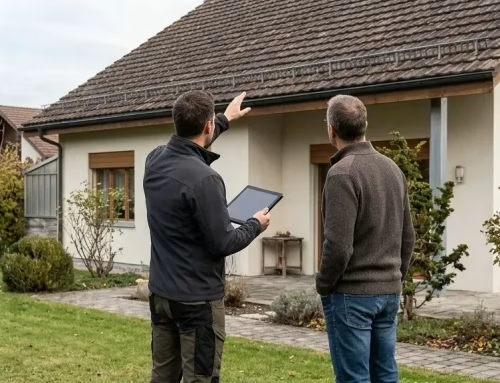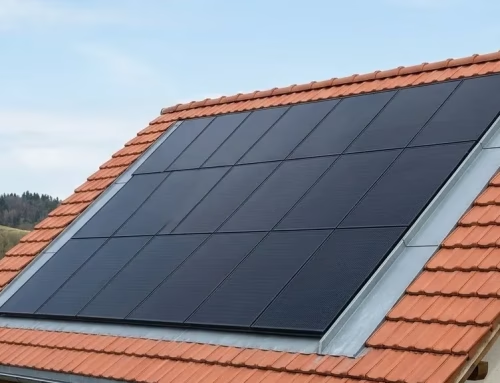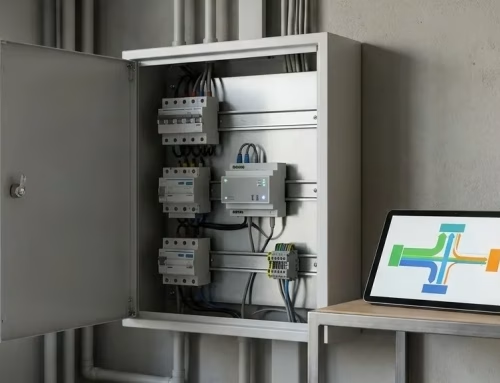
For most single-family homes, a provider with overall responsibility is the right choice: one contract for work, one contact person, one warranty – he bears the interfaces between scaffolding, roof and electrical work, not you. Individual trades are particularly worthwhile if the system is part of a larger roof renovation or an architect is already coordinating. (As of: July 2026)
Key points in brief
- Behind a «simple» solar system are four to five trades: scaffolding, installation, electrical installation, planning including applications – and roof work depending on the project.
- The general contractor bundles everything into one contract; with individual trades, you conclude several contracts and handle the coordination yourself.
- The decisive difference is not the price, but the liability at the interfaces: in the event of a roof leak, nobody wants to «have been the one» – unless there is someone with overall responsibility.
- Awarding individual contracts can pay off if renovations are taking place anyway or if you have your own relationships with tradespeople – but it costs your time and your interface risk in return.
- Check in any case what the contract covers: even «everything from a single source» is only worth as much as the scope of services stated in it.
What does general contractor mean for a solar system?
The term comes from the construction industry: a general contractor (GC) takes on the execution of an entire project in a single contract – and brings in their own people or subcontractors for it. Transferred to the solar system, this means: you sign a contract for work, and the provider is responsible for scaffolding, installation, electrical work, commissioning and applications – regardless of who they send onto the roof or to the meter box.
In practice, most established solar installers work exactly according to this model, even if «general contractor» is not written on the quote. Whether the electrician is an employee or a permanent partner company is contractually irrelevant for you – as long as the responsibility lies with the provider and is not divided among the parties involved.
The alternative is individual awarding: you commission the scaffolder, roofer, solar installer and electrician separately – each with their own contract, their own invoice and their own warranty. The whole thing is coordinated by you yourself or by an architect or specialist planner.
Which trades are involved in a solar system?
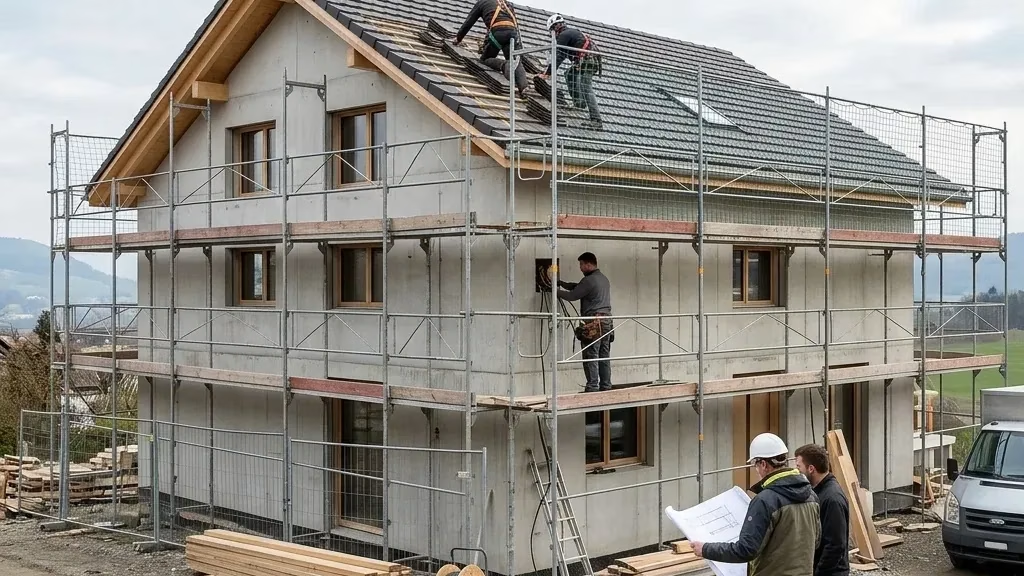
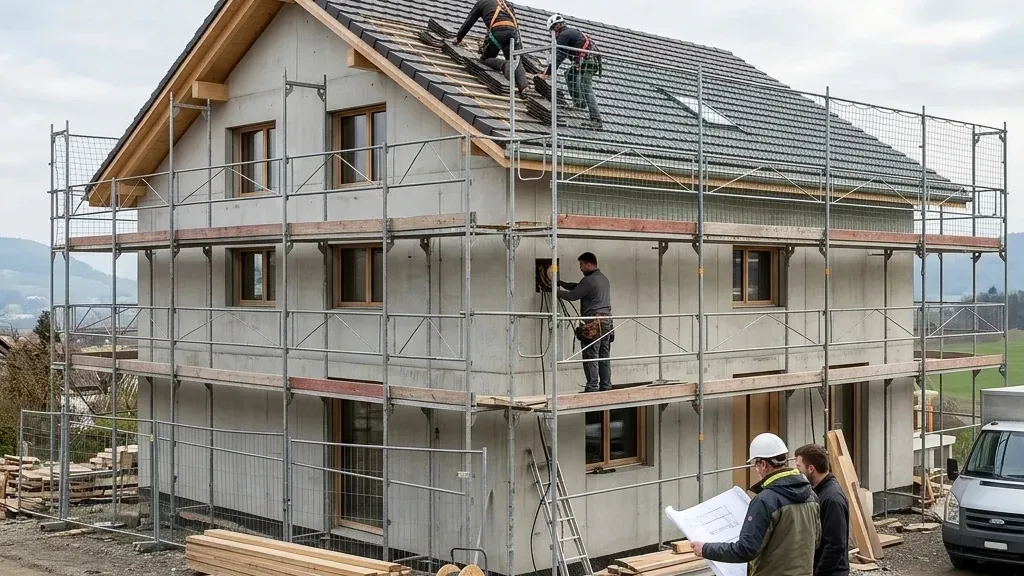
From the outside, a PV installation looks like a single operation. In reality, several areas of responsibility interlock – and every handover is a potential breaking point:
| Trade | Job | Typical interface |
|---|---|---|
| Scaffolding | Occupational safety, access | Appointment must fit installation AND electrical work |
| Installation / solar installer | Substructure, modules, roof penetrations | Roof membrane: who is liable for tightness? |
| Roof work (if necessary) | Tile replacement, renovation, in-roof covering | Transition roofer ↔ mounting system |
| Electrical installation | DC/AC wiring, inverter, meter space | Work requiring a permit, safety certificate (SiNa) |
| Planning & administration | Design, connection request, Pronovo, notification procedure | Who reports what, by when – the remuneration depends on this |
Overview simplified; the exact tailoring depends on the project. The process in 7 steps shows what is involved administratively.
Important to know: electrical installation work in Switzerland may only be carried out by companies with a corresponding installation authorisation, and at the end there is a safety certificate (SiNa). You cannot therefore give the trade to «just anyone» – and it is the reason why a reputable provider proactively discloses their electrical partners. ecoEn itself is registered with the ESTI with an ESTI installation authorisation (Art. 14 NIV) for photovoltaic systems (no. SOB-284349-1).
What speaks for the general contractor?
One warranty instead of three. That is the core argument, and it always shows in the same example: the water stain on the ceiling in the autumn after installation. With individual awarding, the interface ping-pong now begins – the roofer points to the module installation, the installer to the old roof membrane, and you stand in between with two expert reports. With the general contractor, the question of who was internally at fault is their problem. Your contact person is the same as on the first day.
Coordination included. Scaffolding, installation window, electrical appointment, grid operator acceptance: timing this chain is a daily routine for a company that does it every week – and after-work labour for you if you take it on yourself. If one link is delayed, the GC reorganises the chain; with individual awarding, you do the calling.
Applications from a single source. Connection request, Pronovo registration, guarantee of origin (GO), notification procedure at the municipality: the administration determines several thousand francs in remuneration and is part of the package with a full-service provider. With individual awarding, it must be explicitly regulated who takes it on – «the other guy will do it» is the most expensive assumption here.
Add to this a quiet advantage that is often overlooked: a single acceptance protocol, one set of documentation, one warranty dossier. In ten years' time, in the event of servicing or a house sale, you will be grateful that everything is in one folder.
When are individual trades worthwhile?
The honest answer: there are these cases, and they are not rare.
The roof renovation is due anyway. If the roof is being renovated and the PV system built at the same time – especially with in-roof solutions –, the roofer is on the construction site anyway, often along with scaffolding and an architect. It then makes sense to integrate the solar system into this existing organisation instead of placing a second general contractor alongside it. The coordination then lies with the architect or the site management – so again with a professional, not with you.
You have reliable relationships with tradespeople. Anyone who has known their electrician for twenty years and wants to give them the meter space conversion can arrange this with many solar installers – we ourselves occasionally work in such constellations. The only important thing is to draw the interface cleanly: who delivers what, who is liable for what, and who coordinates the appointments. In writing, not by handshake.
Larger or special projects. For apartment buildings, commercial buildings or complex renovations, a specialist planner often plans and tenders the trades individually. This is an established model – but requires exactly what gives it its name: a specialist planner who bears the responsibility for the interaction.
What individual awarding rarely is, however: a savings model for a normal single-family home. On paper, a few percent can be saved with four individual quotes. In return, you buy the coordination, the scheduling risk and, in the event of a dispute, the burden of proof between the trades. Whether this pays off depends less on the project than on whether you can and want to fulfil this role.
The comparison at a glance
| General contractor | Individual trades | |
|---|---|---|
| Contracts | 1 contract for work | 3–5 separate contracts |
| Warranty | one point of contact for everything | per trade – interfaces contentious |
| Coordination | with the provider | with you / architect / specialist planner |
| Time required from you | low | considerable (appointments, handovers, acceptances) |
| Price | incl. overall responsibility | individually partly cheaper, coordination unpaid |
| Typical case | Single-family home on-roof system | PV as part of a roof renovation / apartment building with specialist planner |
Simplified comparison, as of: July 2026. The specific contract content is decisive – check the scope of services in each model.
We build most systems as a full-service provider – and yet we regularly say: «Attach us to your renovation.» If the architect is already managing the scaffolding and roofer for a project, it would be nonsense to build a second command structure alongside it; we then deliver planning, material and installation as a trade under their site management, with a cleanly defined interface to the roof membrane. You have to be careful in these projects at exactly two points, always the same ones: who seals the penetrations and is responsible for them – and who does the applications. If these two questions are answered in writing before construction begins, individual awarding works well. If not, experience shows that the search for the person responsible only begins when it leaks.
For architectural offices and general contractors who outsource the solar part to a specialist company instead of planning it themselves: this is how we work with planners – including delivery for the energy certificate.
Frequently asked questions
Is the general contractor automatically more expensive?
Not necessarily. The GC calculates in coordination and overall responsibility – with individual awarding, you provide this service unpaid yourself, and uncoordinated appointments can cause additional costs that eat up the quote advantage. Therefore, compare overall packages against the sum of all individual quotes plus your effort, not just the numbers.
Can my own electrician do the connection?
Often yes, provided they have the necessary installation authorisation and the solar installer agrees. Clarify this before the quote, not on the construction site – the provider must then contractually exclude the interface (handover point, responsibility, safety certificate (SiNa)). Reputable companies go along with this, but rightly demand a clear regulation.
Who is liable if the roof is leaking after installation?
With the general contractor: they are – regardless of which of their people or partners made the mistake. With individual awarding, the trade that caused the damage is liable, which first has to be determined in the event of a dispute. Exactly for this case, it is worthwhile recording the responsibility for roof penetrations in writing before construction begins.
Do I need an architect for a solar system?
For a normal on-roof system on a single-family home no – the solar installer covers that. An architect or specialist planner makes sense if the system is part of a larger renovation or if several buildings and trades have to be coordinated.
What applies to roof renovation plus a solar system?
Here, individual awarding under site management is often the natural model: the roofer renovates, the solar installer installs, the architect coordinates. Two written stipulations are important – who is responsible for the roof penetrations and who takes care of the applications. With in-roof solutions, the roofer and solar installer need to be planned together particularly closely.
Free initial consultation
One contract, one contact person – or neatly integrated into your renovation.
We offer both: the complete system with overall responsibility or the solar trade under your site management, with clearly defined interfaces.
Want to calculate yourself first? Solar calculator with official roof data →
Prefer to talk? +41 78 830 83 35
Your partner for apartment building, condominium and commercial systems →
Swissolar member and Solarprofi · ESTI installation authorisation (Art. 14 NIV) · in Zurich since 2017 · over 150 systems completed · a personal answer from the specialist company, no call centre
Further guides
 Werkvertrag, Zahlungsplan & GarantienWeiterlesen
 In 7 Schritten zur SolaranlageWeiterlesen
 Komplettpaket oder individuelle Planung?Weiterlesen
 Indach-Photovoltaik: Wann sie sich lohntWeiterlesen
 Solar-Offerten richtig vergleichenWeiterlesen
Sources: Experience from the project and installation practice of ecoEn GmbH, Zurich region; ESTI Directive No. 220 «Anforderungen an Energieerzeugungsanlagen» (valid from 1.7.2021, replaces No. 233; permit requirement for installation work, Art. 6 NIV).
Last updated: 9 July 2026 · Author: ecoEn editorial team