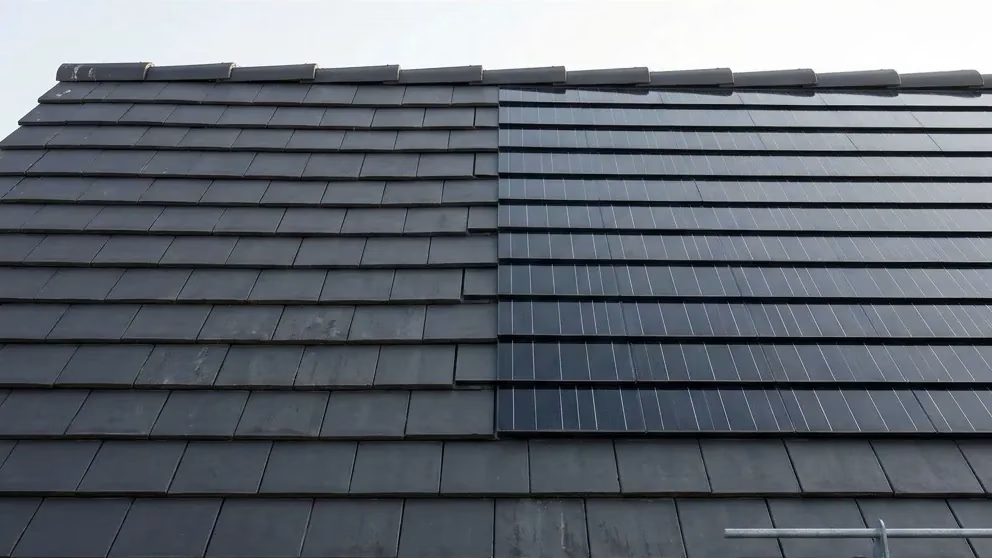
Solar tiles are roof tiles with built-in solar cells: They replace the roofing and generate electricity, almost invisibly. In return, you pay the highest price per kilowatt-peak of all designs, get less power per area and a more small-scale system. They make sense where design or monument preservation exclude everything else – for most roofs, the in-roof system is the better compromise of optics and profitability. (As of: July 2026)
Key points in brief
- Solar tiles are roofing and power plant at the same time – like the in-roof system, only on the scale of the individual tile instead of the whole module.
- The price of invisibility: highest costs per kWp, lower area output and many small plug connections instead of a few large ones.
- Their home game are protected objects, core zones and roofs with uncompromising design demands – where standard solutions fail at the building permit.
- The established middle way is called in-roof photovoltaics: flush, significantly cheaper, with large proven modules.
- As with every roof-integrated solution, the rule is: The right moment is the roof renovation or the new building – never the intact roof.
What are solar tiles – and how do they differ from the module?
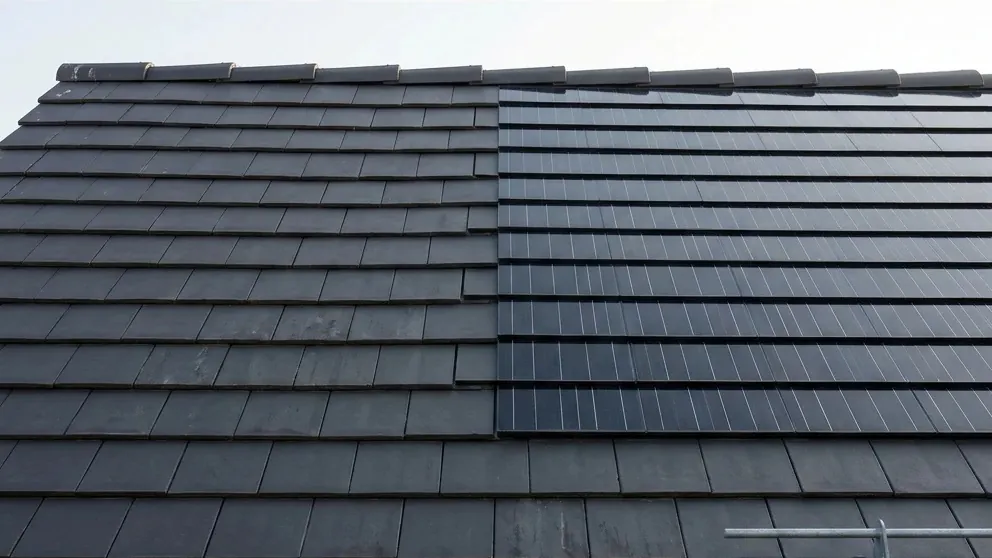
A solar tile is exactly what it sounds like: a roof tile into which solar cells are integrated. It is laid like an ordinary tile, takes over its task as a weather skin – and generates electricity on the side. From a distance, a well-made solar tile roof can hardly be distinguished from a normal roofing; that is exactly its selling point.
The solar tile thus belongs to the family of building-integrated photovoltaics: Like the in-roof system it replaces the roofing instead of sitting on it. The difference is the scale – the in-roof system works with large standard modules that are embedded flush into the roof; the solar tile breaks down the same idea into hundreds of small elements. This small-scale nature is at the same time its strength (optics, adaptation to complicated roof shapes, partial replacement of individual tiles) and its structural weakness – more on this in a moment.
What separates both integration forms from the classic on-roof system – modules on hooks above the intact roofing – is the same: on-roof is the cheapest and most flexible, but visible as technology on the roof.
The honest comparison: Solar tiles, in-roof, on-roof
| On-roof | In-roof | Solar tile | |
|---|---|---|---|
| Appearance | Technology on the roof | flush-mounted module surface | barely distinguishable from tiles |
| Price per kWp | lowest | medium | highest |
| Power per m² of roof | high | high | lower |
| System structure | few large modules | few large modules | very many small elements and connections |
| Right time | at any time | Roof renovation/new build | Roof renovation/new build |
| Typical application | most existing roofs | Renovation with design aspirations | Protected buildings, uncompromising aesthetics |
Qualitative comparison, as of: July 2026 – specific figures depend on the product and project; the individual quote is decisive.
Two rows from this deserve an explanation:
Less power per area. In a solar tile, only part of the area is an active cell – the edge, overlap and fastening are deducted, and this for every single tile. Therefore, the same roof area delivers noticeably fewer kilowatts peak with solar tiles than with large modules. Anyone who already has limited space exacerbates their space problem with the tile.
Many small connections. Hundreds of elements mean hundreds of plug contacts – each of which must be installed professionally and kept tight and conductive for decades. The systems are designed for this, but the statistics are incorruptible: more connection points mean more potential sources of error and more complex troubleshooting than with a string of large modules. This is offset by a genuine advantage: a damaged solar tile can be replaced individually like a broken clay tile – piecemeal repair instead of module replacement.
Where solar tiles are justified
There are roofs where the question is not «solar tile or module» but «solar tile or nothing at all» – and that is their real territory:
Protected buildings and core zones. Where heritage preservation or local image protection have a say, visible module surfaces regularly fail at the building permit. The solar tile, which preserves the historical appearance – partly in the shape and colour of the original roofing – is often the only viable path to solar power there. The authorisation practice remains a case-by-case matter for the municipality and heritage preservation; but the chances of success are in a different league.
Complicated, highly structured roofs. Hips, ridges, dormers, angled surfaces where large modules fail or would result in patchwork – the tile logic follows any roof geometry.
Uncompromising design aspirations. Builders for whom the visible module surface is not an option – and who consciously bear the surcharge for invisibility. This is a legitimate prioritisation; it should only be made informedly, with the in-roof system on the table as a structurally strong, significantly cheaper counter-offer.
For everyone else, the honest statement applies: on the ordinary single-family home roof, the solar tile buys a lot of surcharge for a visual gain that the in-roof system delivers at a fraction of the cost – and the on-roof system even cheaper.
When is the right moment – and what needs to be checked?
Like any roof-integrated solution, solar tiles replace the roofing – the right moment is therefore the roof renovation that is due anyway or the new build: then the solar tile competes against the costs of a new roofing instead of against «nothing», and the calculation becomes fair. Stripping an intact roof for solar tiles can hardly ever be economically justified.
In addition to the price, the review should include three points that carry more weight in this young product segment than with established modules: the system guarantees (product, performance, tightness – three different commitments), the availability of replacement tiles over the years and the experience of the specialist company – the small scale forgives little on the construction site. What applies everywhere applies here to an even greater degree: have references shown, ideally a roof that already has a few winters behind it.
Solar tile enquiries almost always start with us with a picture from the media and the question «Why does hardly anyone offer this?». The answer is unromantic: for ninety per cent of the roofs we visit, the tile would be the most expensive solution to a problem that an in-roof system solves more elegantly – flush-mounted, proven, with large modules and without a surcharge for invisibility, which from twenty metres away hardly anyone can distinguish from an in-roof surface anyway. And then there are the other cases: the protected timber-framed house, the core zone, the roof on which heritage preservation has rejected every module surface for years. There the signs reverse, and the solar tile is not the expensive alternative, but the only one. Our advice is therefore: have both worlds quoted side by side – the decision is easier when the surcharge for invisibility is on the table as a number instead of a feeling.
Frequently asked questions
What do solar tiles cost compared to a normal solar system?
Significantly more per kilowatt peak than on-roof and also in-roof systems – invisibility is the most expensive path to solar power. The comparison only becomes fair when a roof renovation is due, when the saved roofing is offset. The comparative quote for your own roof provides specific figures.
Do solar tiles last as long as a normal tiled roof?
The systems are designed as roofing and tested accordingly for tightness and weather resistance; guarantees apply to power production as with modules. The practical advice: have product, performance and tightness guarantees shown separately and pay attention to long-term spare part availability – the segment is younger than the classic module.
Can a single defective solar tile be replaced?
Yes – that is the structural advantage of the small scale: a damaged element is replaced like a broken clay tile without opening the surface. The prerequisite is that replacement tiles for the system remain available – a point for the provider check.
Does heritage preservation accept solar tiles?
More often than visible modules – that is exactly what they were developed for, partly in the shape and colour of historical roofing. This is not a guarantee: the assessment remains a case-by-case matter for the municipality and heritage preservation. The path leads via an early conversation with the authority, ideally with a material sample.
Are solar tiles less efficient than modules?
Per square metre of roof area, yes – edge and overlap losses occur with every single tile, so the same area carries less power. On generous roofs this hardly matters; on limited areas it also speaks in favour of large modules.
Free initial consultation
Invisible, integrated or classic – with numbers instead of feelings.
We offer you the variants side by side: solar tile, in-roof, on-roof – with an honest comparison of area, yield and price for your roof.
Prefer to talk? +41 78 830 83 35
Your photovoltaic system from a specialist company →
Swissolar member and Solarprofi · ESTI installation authorisation (Art. 14 NIV) · in Zurich since 2017 · over 150 systems completed · a personal answer from the specialist company, no call centre
Further guides
 Indach-Photovoltaik: Wann sie sich lohnt
 Dachsanierung und Photovoltaik
 Baubewilligung für Solaranlagen in Zürich
 Fassaden-Photovoltaik
 Referenzen richtig prüfen
Sources: Manufacturer system documentation (solar tiles, roof-integrated PV – general); empirical values from the consulting and project practice of ecoEn GmbH, Zurich region.
Last updated: 9 July 2026 · Author: ecoEn editorial team