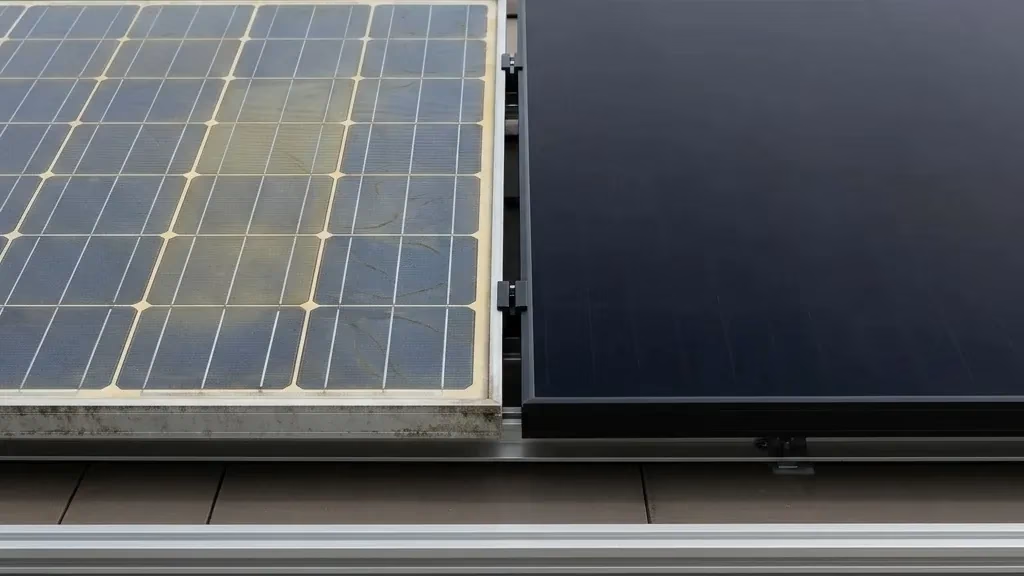
Over the years, solar modules lose a small, even share of their output – that's called degradation. Roughly a quarter to half a per cent per year is usual. After 25 to 30 years, manufacturers usually still guarantee well over 80 per cent of the initial output. A sudden drop in yield, by contrast, is not degradation but a matter for monitoring.
Key points in brief
- Degradation is a normal, gradual loss of output over decades – not a defect.
- Roughly a quarter to half a per cent loss of output per year is usual.
- Performance warranties usually still assure well over 80% of the initial output after 25–30 years; the exact values are in the respective module's warranty document.
- A sudden or sharp drop in yield is not degradation, but belongs in monitoring or troubleshooting.
How quickly do solar modules lose output?
Very slowly. Crystalline silicon modules, as installed on most Swiss roofs, typically lose roughly a quarter to half a per cent of their rated output per year. That's not a snapshot but an average over decades – in individual years, actual electricity production can fluctuate more with weather and hours of sunshine than through degradation anyway.
Something special happens right after commissioning: within the first weeks of operation the cell stabilises slightly – a one-off, small drop in output that doesn't occur again afterwards. Manufacturers know this effect and already build it into their warranty values. So don't be surprised if the system delivers minimally less in the very first weeks than on day one – that's normal operation, not a warning sign.
The distinction from the rated output on the data sheet is important: that is measured under laboratory conditions. In real operation on a Zurich roof, orientation, shading and temperature also play a role – that has nothing to do with degradation but is part of the normal yield calculation from the start.
What does the output curve look like over 25 years?
The curve runs flat and predictably – no plunge, no jump. That is exactly what distinguishes degradation from any other problem that can occur on a solar system.
| Time | typical condition (qualitative) | what to look out for |
|---|---|---|
| Commissioning | full output after a short initial stabilisation | record the first months' yields as a reference in monitoring |
| after ~10 years | output minimally but measurably below the starting value | compare yield trends over the years, not individual days |
| after ~25 years | performance warranty applies, system continues to produce reliably | consult the module's warranty document for the exact residual value |
Classification from practice, as of: July 2026 — the values are deliberately kept qualitative because warranty curves differ between manufacturers; the warranty document of the specific module installed is what counts.
How do you tell the difference from a genuine defect?
Degradation is slow, even and spread across the whole module field. A real problem looks different: a sudden drop in yield within a few weeks, a single string running clearly worse than the rest, or an error message on the inverter. That isn't ageing but a concrete reason to look at the monitoring or to bring in a specialist.
We recommend comparing the annual yield with previous years once a year – ideally in the same month, to roughly factor out weather effects. If the curve stays within the expected range, all is well. If a value deviates clearly and persistently downwards, a closer look is worthwhile – possibly at shading, soiling or a fault that has nothing to do with degradation (the most common causes).
What does degradation mean for cost-effectiveness and the inverter?
Reputable yield forecasts factor degradation in from the start. If someone shows you a 25- or 30-year forecast without this factor, caution is in order. The consequence for you is unspectacular: in year 25 the system still produces electricity, just a bit less than at the start – replacing the modules is therefore not compulsory, at most an economic consideration for later.
The inverter is a different matter. It is an active electronic component and doesn't age in the form of degradation but more like other electronics – over the system's lifetime it is typically replaced once. More on this in the article Inverter lifespan.
In our system checks in the Zurich region we almost never see degradation as a topic in its own right – customers are more likely to ask whether a visible drop in yield is normal. In the vast majority of cases it can be put in context with a look at the monitoring history; behind it there is often shading from grown trees or simple soiling rather than actual ageing.
Frequently asked questions
How quickly do modules lose output?
Roughly a quarter to half a per cent per year is usual for crystalline modules. After a small one-off stabilisation in the first weeks of operation, the curve runs flat and even. Exact values depend on the module and are in the manufacturer's respective performance warranty.
How do I recognise excessive degradation?
By comparing the yield over several years in the monitoring, ideally in the same month. If the system is clearly below the expected trend, it can be a warranty case. A single weak month is usually weather; a lasting downward trend deserves a closer look.
Do little-used or shaded modules age more slowly?
No. Degradation depends on time and material, not on use. A module lying in shade doesn't age more slowly – it just produces less electricity, which is a separate topic. The two effects shouldn't be mixed up.
Do I have to replace modules after 25 years?
No, that isn't a technical must. The system keeps producing beyond the warranty period, just with somewhat lower output. Whether a replacement pays off at some point is an economic question – depending on module prices, roof condition and electricity yield – and not a safety question.
Free initial consultation
Wondering how degradation affects your planned system?
We calculate transparently which warranty values you can use for the modules we install. Free of charge and without obligation.
Prefer to talk? +41 78 830 83 35
Photovoltaic installer for your region →
Swissolar member and Solarprofi · ESTI installation authorisation (Art. 14 NIV) · in Zurich since 2017 · over 150 systems completed · a personal answer from the specialist company, no call centre
Further guides
 Produkt- vs. Leistungsgarantie
 Lebensdauer von Wechselrichtern
 Monitoring
 Wenig Ertrag: Ursachen
Sources: EnergieSchweiz, Swissolar, manufacturer documentation.
Last updated: 9 July 2026 · Author: ecoEn editorial team