
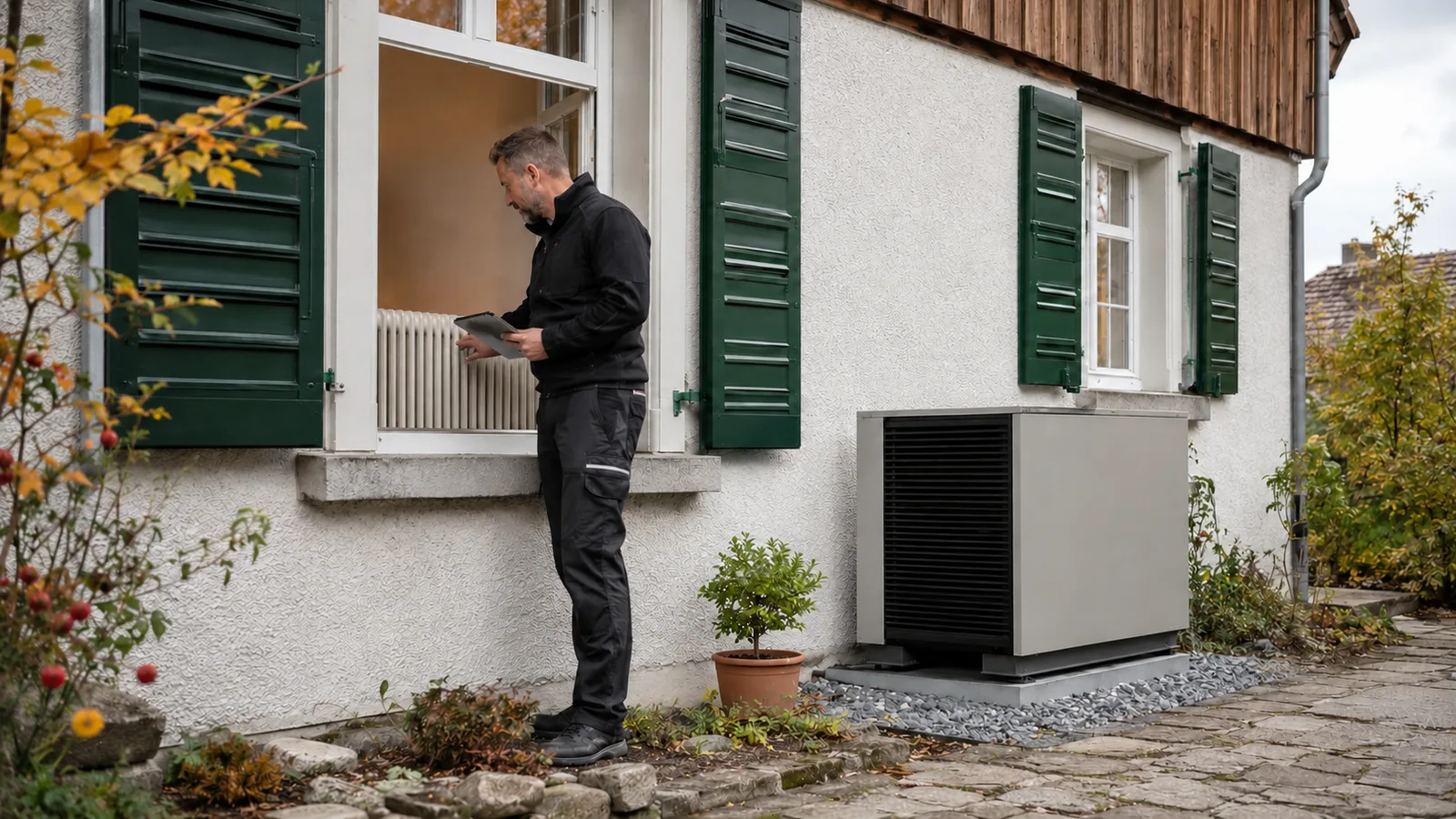
More often than its reputation suggests: A heat pump works in many old buildings with the existing radiators – the decisive factor is the necessary flow temperature, not the year of construction. A simple practical test on the existing heating system shows whether your house is ready. A complete renovation is not a prerequisite; in stubborn cases, targeted measures are often sufficient instead of the whole package. (As of: July 2026)
Key points in brief
- The benchmark is the flow temperature: The lower it can be, the more efficiently the heat pump works – the year of construction alone says little.
- Radiators are not an exclusion criterion; many old buildings cope fine with the existing heat distribution.
- The practical test costs nothing: Lower the flow temperature of the old heating system and observe whether the house stays warm.
- A complete renovation is not a prerequisite – targeted measures such as individual larger radiators or cellar ceiling insulation are often sufficient.
- There are honest borderline cases: An uninsulated house with limited heating surfaces is sometimes better off if it is insulated first and then replaced.
Does a heat pump even work in an old building?
In most cases, yes – and the prejudice that heat pumps are only for new buildings with underfloor heating comes from a generation of devices that no longer exists in that form. What has not changed is the physics behind it, and that is worth understanding because it answers the entire old building question.
A heat pump works all the more efficiently the smaller the temperature lift it has to provide – i.e. the lower the flow temperature with which the heating water is sent into the radiators. A new building with underfloor heating gets by with very low flow temperatures; an old building with radiators needs more. But – and this is the point that regularly gets lost in the discussion – «more» does not mean «too much». Many older houses were built with generously dimensioned radiators or have received new windows and insulation here and there over the years. The result: The heating runs with a flow temperature that is set high out of habit, not necessity.
Therefore, the right question is not «How old is the house?», but «What flow temperature does it really need?». And exactly this question can be answered without spending a single franc.
The practical test: Is your house ready?
The test is unspectacular and exactly for that reason so useful: In a cold winter, lower the flow temperature of your existing heating system as a trial and observe whether the house remains comfortable. If it stays warm, a heat pump will also cope with the existing heat distribution – your own house as a test bench, completely without an expert report. How this test is embedded in the heating replacement process is explained in a separate article; the definitive design is ultimately done by the specialist company.
In addition to the test, a few features of the house provide quick initial guidance:
| Feature | speaks for the heat pump | requires a closer look |
|---|---|---|
| Radiators | generously dimensioned, several per room | small and already at the limit today |
| Windows | replaced (2-/3-pane) | original single glazing |
| Insulation | roof or facade partially renovated | completely uninsulated |
| Previous flow temperature | house stays warm even when lowered | comfortable only with a very hot flow |
| Heat distribution | underfloor heating or mixed forms | individual under-supplied rooms |
Initial guidance, As of: July 2026. The definitive design for the specific building by the specialist company is authoritative.
Important for context: No single criterion decides on its own. A house from the sixties with replaced windows and decent radiators is often a better heat pump candidate than its year of construction suggests – and the column on the right does not mean «impossible», but rather «calculations are needed here before the decision».
Do I have to do a complete renovation first?
No – a complete renovation as an admission ticket is a misunderstanding that unnecessarily delays many heating replacements. What counts is the flow temperature, and this can also be lowered with targeted, manageable interventions instead of the whole package:
1. Enlarge individual radiators. Usually, not all rooms are the limiting factor, but one or two critical ones – typically the bathroom or the room on the weather side. Using a larger radiator or a low-temperature type there is a small intervention with a large effect. 2. The simple insulation measures first. The cellar ceiling and the attic floor are the classic interventions with a good ratio of effort to effect – without scaffolding, without a facade project. 3. Heating curve and balancing. Much can also be adjusted on the existing distribution; a hydraulic balancing ensures that every radiator gets what it needs – and no more.
The sequence has a second advantage: Each of these measures also improves the subsequent efficiency of the heat pump, because the seasonal performance factor reacts more strongly to the flow temperature than to the brand of the device. Those who first make the distribution fit and then replace it get the same heat pump with better operating costs.
Which heat pump is suitable for an old building?
Fundamentally the same systems as everywhere else – but the choice between air-to-water and brine-to-water with a geothermal probe in an old building is based on a slightly different weighting. The old building typically has a higher heat demand, and the more heat is needed throughout the year, the more the higher efficiency of the geothermal probe pays off. In addition: The brine-to-water machine delivers its power constantly in mid-winter, whereas the air-to-water heat pump operates least efficiently exactly when the old building demands the most.
This does not make the air-to-water heat pump the wrong choice – it remains the most common and mostly suitable case in old buildings too, especially since drilling for a geothermal probe is not possible on every plot. But the balance shifts with the heat demand, and in the Canton of Zurich the canton provides significantly higher incentives for geothermal probes – in an old building, the double calculation is therefore worthwhile more often than in an economical new building. Those who are planning or already have a solar system anyway should calculate the combination of heat pump and photovoltaics right along with it – the extra consumption of an old building makes your own roof electricity all the more valuable.
The honest borderline cases: When do we (still) advise against it?
They exist, and they should be named instead of advised away. The classic borderline case is the completely uninsulated house with tightly dimensioned radiators, which only becomes comfortable with a very hot flow. A heat pump works there, admittedly – modern devices also achieve higher flow temperatures – but it does so with poor efficiency and corresponding electricity costs. In such houses, the honest recommendation is often: first the simple insulation measures and the critical radiators, then the replacement – the sequence requires a year or two of patience and pays off over the entire lifespan of the new heating system.
The second borderline case is the unplanned emergency: If you have to make a decision in January with a dead boiler, there is no time left for a practical test and targeted preparatory work. This is another reason why what applies to every heating replacement applies even more to old buildings: Planning begins while the old heating is still running. And those replacing electric heating in the Canton of Zurich have a deadline in mind anyway – the legal deadlines turn «someday» into a specific date.
The houses we deal with in these conversations are located everywhere in the region: built between the fifties and eighties, radiators, partially replaced windows. The most frequent surprise for the owners is how often the lowering test is positive – the old heating simply ran hotter than the house required. More interesting, however, are the cases in which we advised against it: an uninsulated house with small radiators, where we first recommended cellar ceiling insulation and two radiators and installed the heat pump only a year later. This is commercially uncomfortable – we postpone our own order – but it saves the customer from a system that works against their own house for years. A replacement that comes a year later and then runs properly is the better order for both sides.
Frequently asked questions
Does a heat pump work with old radiators?
Often yes – the decisive factor is the necessary flow temperature, not the age of the radiators. The practical test with a lowered flow temperature on the existing heating system gives a good initial answer; the definitive design is undertaken by the specialist company. Frequently, only individual critical radiators need to be replaced at most, not all of them.
Do I need underfloor heating for the heat pump?
No. Underfloor heating is ideal because it works with very low flow temperatures – but it is not a prerequisite. Radiators work as long as they get the rooms warm even with a moderate flow temperature. Retrofitting underfloor heating just for the heat pump is rarely necessary and rarely proportionate.
Will the heat pump in an old building consume a lot of electricity?
More than in a new building because the heat demand is higher – but how much depends on the efficiency, and you help control this via the flow temperature. As a guideline value, a heat pump increases the electricity consumption of a single-family home by several thousand kilowatt hours a year, depending on the building, insulation and system. Your own solar system will absorb some of this.
Do I have to insulate the house before replacing the heating?
Not necessarily – a complete renovation is not a prerequisite. The sequence only makes sense in a borderline case: If the house is uninsulated and only gets warm with a very hot flow, simple measures such as cellar ceiling insulation are worthwhile before the replacement. In most partially renovated houses, the heat pump can be installed directly.
Are there incentives for a heat pump in an old building?
Yes – the replacement of fossil and electric heating systems with heat pumps is subsidised, in the Canton of Zurich with fixed contributions and significantly higher rates for geothermal probes. The sequence is important: The incentive application must be submitted before construction begins, not afterwards. The details are in the article on heat pump incentives.
In which houses does the heat pump fail?
Rarely because of the house, usually because of the planning. It becomes critical if the existing heating system needs very high flow temperatures even in cold weather – for example with small old radiators in an uninsulated building – and nobody checks this beforehand. Then the heat pump runs inefficiently or the house does not get warm. The solution is almost never a complete renovation, but the practical test on the old heating system, individual larger radiators or a high-temperature heat pump.
Free initial consultation
Is your house ready for the heat pump?
We take an honest look at the heat distribution, flow temperature and building – and also tell you if two targeted measures are worthwhile before the replacement. Consultation from the region, without sales pressure.
Prefer to talk? +41 78 830 83 35
Swissolar-certified specialist company · ESTI installation authorisation (Art. 14 NIV) · in Zurich since 2017 · over 150 systems completed · a personal answer from the specialist company, no call centre
Sources: Canton of Zurich (Energiegesetz, incentive programme – via linked articles); general design practice for heat pumps in existing buildings; empirical values from the planning and installation practice of ecoEn GmbH, Zurich region.
Last updated: 9 July 2026 · Author: ecoEn editorial team