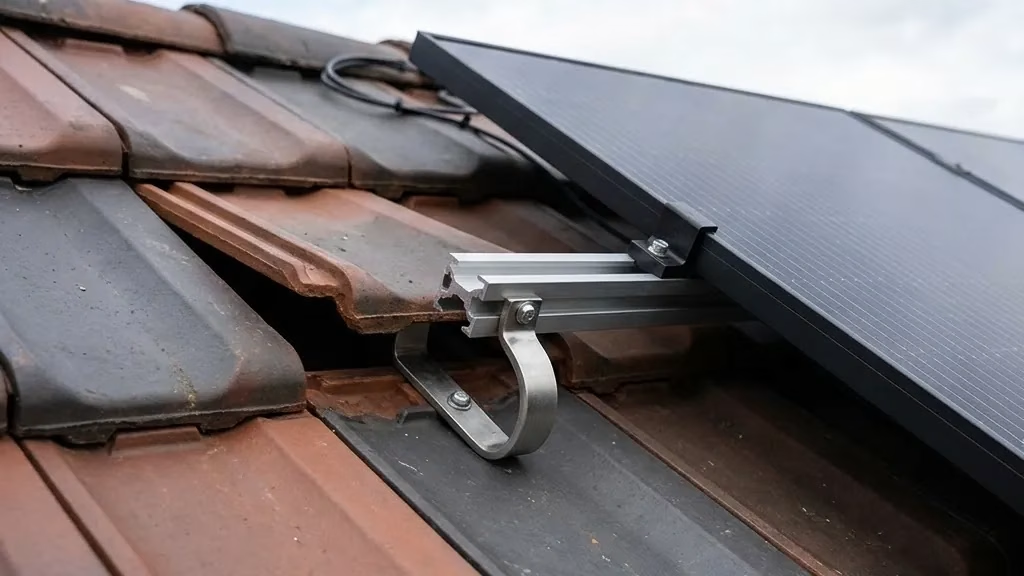
The mounting system – roof hooks, rails, clamps – is the least advertised and most heavily stressed component of the system: it carries the modules through three decades of storms, snow and temperature cycles. What matters is not brand names but three things: the structurally calculated design, a clean roof connection – and an installer who follows the system specifications. (As of: July 2026)
Key points in brief
- No component of the system works mechanically harder: the mounting system withstands wind suction, snow load and daily temperature movement – maintenance-free, for three decades.
- The chain has four links: the roof connection (hooks/screw anchors), the rails, the module clamps – and, as a silent fifth, the roof skin that everything passes through.
- Material means aluminium and stainless steel – corrosion protection is no side issue for a 30-year component.
- The most common weak points arise during installation, not in the catalogue: wrongly placed hooks, clamps outside the specified zones, fixing points skimped on.
- Your check as a layperson: the system stated in the quote, the design documentation – and the responsibility for water-tightness, in writing.
Why the least visible component has the toughest life
In advertising, modules and inverters shine; the mounting system appears, at best, as a footnote. Yet mechanically it's the other way round in terms of attention: modules sit there and age slowly, the inverter works electrically – but the mounting system holds without a break: the wind suction trying to lift the system off, the snow load pressing down, and the daily expansion and contraction of metal under sun and frost. It does this without maintenance, without spare parts and without a second chance – a failure of the fixings is the one kind of system damage that doesn't just cost yield.
The good news: established systems are built for exactly this life and prove themselves millions of times over. The differences that matter lie less between manufacturers than between correct and incorrect installation – and that's exactly where you, as the building owner, can look.
The chain: from the roof batten to the module clamp
For the common pitched roof with tiles, the system is a chain, and every link has its job:
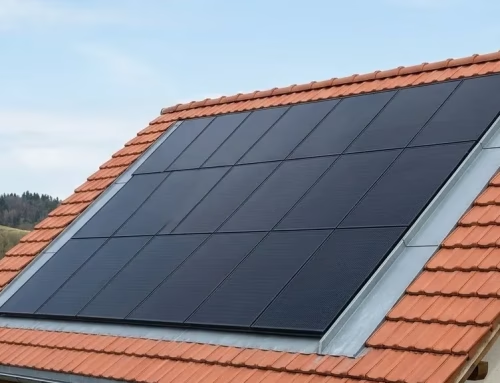
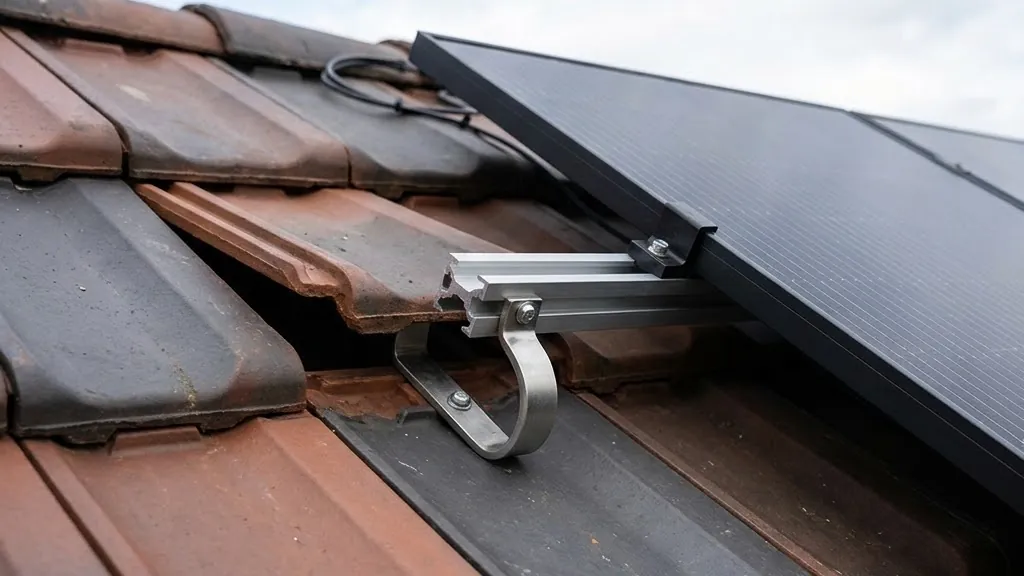
The roof connection. Roof hooks reach under the tiles onto the counter-battens or the rafters – they route all the forces into the roof's load-bearing structure. On metal and fibre-cement roofs, screw anchors or clamp solutions take over; every roof covering has its matching connection, and choosing it is part of the trade.
The rails. Aluminium profiles distribute the loads from the modules to the connection points. Their sizing follows structural calculation – spans and profile strengths are calculated, not guessed.
The module clamps. End and middle clamps grip the modules – exclusively within the clamp zones defined by the module manufacturer, because outside them the tested load capacity drops noticeably. The clamp is also the interface of the warranties: wrongly clamped, it can jeopardise module claims.
And the roof skin. The silent fifth link: where hooks pass through the covering, clean workmanship decides the water-tightness of the coming decades – fitted tiles instead of forced penetrations, and clearly assigned responsibility for the penetrations. On a flat roof, ballasted, aerodynamic tilt frames replace penetration – the roof skin stays intact, but the structural calculation then has to account for the ballast. And with in-roof systems, the mounting system itself becomes part of the water-carrying layer – the most demanding discipline.
Material and corrosion: the 30-year question
For a component with no fallback plan, material quality is not a fine detail: standard is aluminium for rails and clamps and stainless steel for hooks and fasteners – both designed for decades outdoors. What planning watches for: no unsuitable material pairings (contact corrosion), the right execution in special environments – and integrating the substructure into the equipotential bonding.
Translated for you: a named branded system from an established manufacturer meets these requirements consistently – anonymity is the warning sign, not the choice of brand. "Substructure: aluminium, included" with no system stated is about as verifiable as "branded modules" with no type given.
Where it really goes wrong: the installation weak points
The failure patterns the industry knows keep repeating – and almost all of them originate on installation day:
- Fixing points skimped on, especially in the suction-loaded edge and corner zones – invisible until the storm finds them.
- Clamps outside the zones or with the wrong torque – the silent warranty and stability issue.
- Damaged roof skin: broken tiles under the system, crushed instead of neatly cut penetrations – the cause of later water stains.
- Hooks on rotten timber: the best clamp is useless if the battens underneath have reached the end of their service life – a roof condition check belongs before every installation.
The pattern is the same as with fire safety and with storm resistance: the components are good – it's decided on the roof. That's why installation quality is the real selection criterion, and it depends on the crew, not the brochure.
What you as a layperson can check
You don't need to become a structural engineer – four checkpoints are doable without technical expertise:
1. The system stated in the quote. Manufacturer and system named? Belongs among the minimum information along with module type and inverter. 2. The design documentation. On request, the company should be able to show that fixing spacings are designed for your wind and snow load zone – a sheet from the system software is enough. 3. Responsibility for water-tightness. Who is liable for the roof penetrations – in writing, in the works contract. 4. The look after installation. Straight rows, even spacing, no broken tiles on the ground, tidy cable routing – care is visible from below too, as with reference systems.
Almost nobody asks about the mounting system in a consultation – yet after twenty years of system life, it's often, in hindsight, the most important item. What we find under the modules when taking over other people's systems tells the whole story of the industry: mostly solid standard work, occasionally craftsmanship – and in the problem cases almost always the same two findings: too few hooks where the wind pulls, and broken tiles where someone was in a hurry. Neither is visible on the day of sale, and both have their price years later. Our response is unspectacular: we document every fixing design and photograph the roof connection before laying the modules – not for a brochure, but for the customer's file. It's the component you never see again. That's exactly why it deserves a second look before it disappears.
Frequently asked questions
Do I have to decide on a mounting system brand?
No – the specialist company chooses the system to suit the roof and region, and the quality differences between established manufacturers are small. Your checkpoint is a different one: the system must be named in the quote, and the design must match your local wind and snow conditions.
How long does a mounting system last?
It's designed for the service life of the system – aluminium and stainless steel survive the modules' 25 to 30 years maintenance-free. It's only checked on an ad-hoc basis: after severe storms and as part of professional inspections.
Can the mounting system damage my roof?
With proper workmanship, no – the connection is solved for every covering type, and penetrations are executed cleanly. The real damage cases (broken tiles, leaks) are installation errors; that's why responsibility for water-tightness belongs in the contract and a roof condition check belongs before installation.
What's different on metal and fibre-cement roofs?
The roof connection: instead of tile hooks, screw anchors, clamp or seam solutions are used – every covering has its matching detail. With older fibre-cement, the asbestos question comes first; a reputable company clarifies it before anyone drills.
Does the substructure rust over the years?
With the usual materials (aluminium, stainless steel), practically not – corrosion protection is built into the systems. What planning watches for are material pairings and special environments; visible rust on a young system would be a clear case for rework.
Free initial consultation
The component you never see again – with us, you see it beforehand.
A named system, documented design for your local wind and snow conditions, a photographed roof connection for the file. That's how we build substructures.
Want to calculate yourself first? Solar calculator with official roof data →
Prefer to talk? +41 78 830 83 35
Photovoltaics Switzerland – installation by a specialist company →
Swissolar member and Solarprofi · ESTI installation authorisation (Art. 14 NIV) · in Zurich since 2017 · over 150 systems completed · a personal answer from the specialist company, no call centre
Further guides
 Dachlast: Trägt mein Dach eine Solaranlage?
 Sturmsicherheit & Befestigung
 Schneelast auf Solarmodulen
 Technische Mindestangaben einer Offerte
 Indach-Photovoltaik
Sources: Mounting system manufacturers (system documentation, general); empirical data from ecoEn GmbH's installation and handover practice, Zurich region.
Last updated: 9 July 2026 · Author: ecoEn editorial team