
Solar systems very rarely cause fires – and when they do, there is almost always an installation error behind it, not a technology failure. The most important fire protection is therefore built on the day of installation: clean plug connections, professional electrics. During operation, there is little left for you to do – take monitoring seriously, no DIY interventions, and you can safely forget the rumour about the fire brigade not extinguishing PV houses. (As of: July 2026)
Key points in brief
- The statistics are reassuring: system fires are rare isolated cases – a vanishingly small quota measured against hundreds of thousands of installed systems.
- If there is a fire, the cause is almost always human: sloppy DC plug connections and installation errors dominate the case reports – not the module or inverter as a product.
- The best fire protection is therefore the choice of provider: professional mounting by authorised companies beats any retrospective protection concept.
- The fire brigade also extinguishes houses with a solar system – with adapted tactics; the opposite is a persistent myth.
- Your contribution during operation: take fault messages seriously, have them checked after events (storm, marten, conversion), never handle the DC side yourself.
How often do solar systems really burn?
The honest answer begins with the scale: hundreds of thousands of systems are installed in Switzerland, and documented fire cases caused by the PV system are in the range of rare isolated cases per year. The most comprehensive investigation in the German-speaking world – the research project by TÜV Rheinland and Fraunhofer ISE, completed in 2015 – identified around 210 fires in Germany that verifiably originated from the PV system, with over 1.5 million systems in operation at the time; in 130 of these cases, the damage remained limited to the system itself, only in around 80 cases was the building affected. A separate Swiss PV fire statistic does not exist: the Advisory Board for Fire Prevention identifies electricity as a whole as one of the most frequently recognised causes of fire – almost a quarter of the damage sum (period 2006–2025) –, and the solar system is one circuit among many in this, from the tumble dryer to the charger. It is part of the electrical installation and exactly as safe or unsafe as its execution.
This sets the framework in which everything else takes place: it is not about taming a large risk – but keeping a small one where it belongs. And for this, a look at the causes is worthwhile.
Why systems burn – if they do
The case analyses by experts paint a uniform picture, and it is uncomfortable for a certain type of provider: the TÜV/Fraunhofer project names installation errors as the most frequent cause of fire, followed by product and planning defects. Specifically, errors in the direct current wiring dominate – above all sloppy or incorrectly crimped plug connectors, mixed plug types from different manufacturers and cables that were laid on sharp edges or unprotected. A contact resistance can grow over years at a poor DC connection until an electric arc occurs – and this is stubborn with direct current.
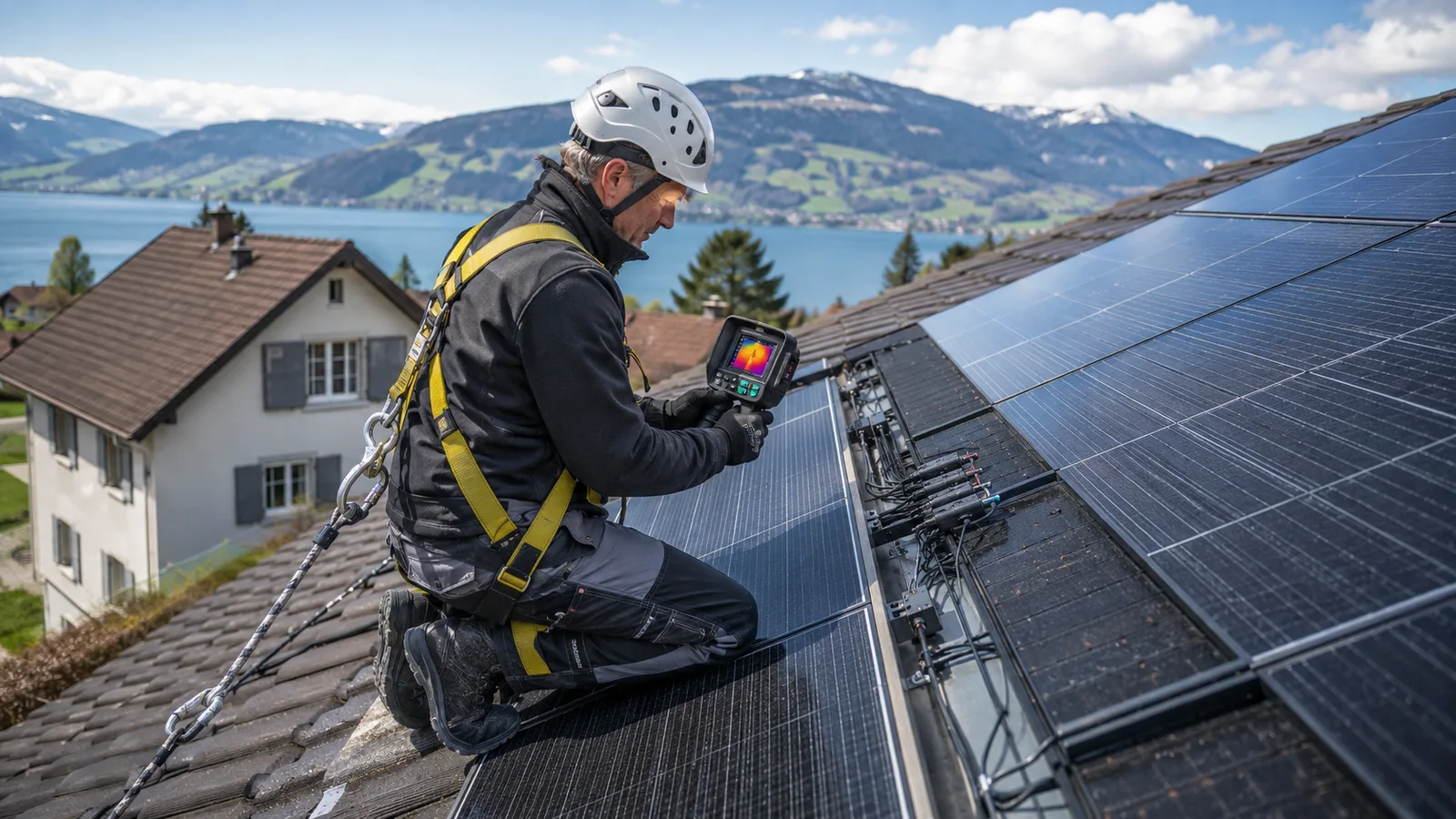
The products themselves – modules, inverters, cables – are tested series technology with very low failure rates. Translated, this means: The fire risk is decided on the day of installation. A careful installation by an authorised specialist company – with cleanly crimped original connectors, protected cable routing and documented acceptance – is the most effective fire protection there is. The budget provider who saves on installation time ultimately saves exactly here; it is one of the strongest arguments for careful provider checking.
Two supporting roles in the statistics are worth mentioning: Marten damage to cables, which goes unnoticed and becomes a weak point (which is why cables should be checked if traces appear) – and subsequent interventions by unauthorised persons, from DIY accessories to a «briefly self-patched» cable.
The myth: «The fire brigade does not extinguish PV houses»
Hardly any solar rumour is so persistent – and so wrong. The truth is: The fire brigade also extinguishes buildings with a solar system; they do it with adapted tactics. The background: modules cannot be «switched off» as long as light falls on them – the DC cables can therefore be live. The emergency services are trained for this: safety distances for the extinguishing jet, defined procedures, and targeted disconnection in case of doubt. This is operational routine, not a reason to just watch.
What you as an owner can contribute to this is information: a system labelling at the house connection (reference to the PV system including the location of the disconnection points) is part of a professional installation and helps the emergency services to orient themselves quickly. The system documentation in the dossier – diagram, location of the cables – also provides silent service in an emergency.
Your contribution during operation: little, but done right
Ongoing operation has three fire-relevant points – all small, all effective:
Take fault messages seriously. Modern inverters monitor the system continuously; several even detect arc signatures and switch off. An acknowledged but never clarified fault message is therefore more than a cosmetic flaw – recurring errors should be reported to the specialist company, not clicked away.
Have checked after events. Storms with roof damage, visible marten traces, renovation work on the roof by third parties – these are the moments when intact wiring can become a weak point. The targeted check afterwards costs little; the same logic as for the annual check.
No DIY interventions. The DC side is live as long as it is light – every «minor repair» done on your own is exactly the kind of error that case reports are made of. The boundary remains the same as everywhere else in operation: you observe, the professional intervenes.
And the battery storage? It has its own safety chapter – cell chemistry, battery management, installation location – and its own guide; the short version there is also: tested systems, professionally installed, are safe everyday technology.
Fire protection begins at purchase: the checklist
| Time | What counts |
|---|---|
| Choice of provider | authorised specialist company, verifiable references, no budget warning signals |
| Installation | Original connectors cleanly crimped, protected cable routing, no mixed connectors |
| Acceptance | Safety certificate, documentation, system labelling |
| Operation | Fault messages actively taken seriously, check after events |
| Always | no DIY interventions on the DC side and electrics |
As of: July 2026 – the points align with the general logic of care: those who build and observe cleanly have the small residual risk under control.
Interested parties often ask us the fire question quietly, almost apologetically – as if the concern were outdated. It is not; it just deserves a precise answer instead of an appeasing one. Ours is: we cannot promise the risk is zero – no one can do that with electrical systems –, but we can show where it arises and where it is kept small: at the plug connections, on the day of installation, in the documentation. When taking over third-party systems, we therefore look first under the modules and in the cable routing – and there you can see the difference between careful and rushed installation with the naked eye: secured connectors and clean bends here, hanging cables over sheet metal edges there. The reassuring thing at the end: in all these years, the fire-relevant findings we have made can be counted on one hand – and every single one was rectified at the next appointment. This is exactly how a small risk should be treated: seriously, but without drama.
Frequently asked questions
Does a solar system increase the fire risk of my house?
Hardly measurably – system fires are rare isolated cases, and the system is part of the electrical installation like any other circuit. The small residual risk depends almost entirely on the installation quality; with professional installation, it remains where it belongs: in the realm of the everyday.
Is it true that the fire brigade does not extinguish houses with PV?
No – that is a myth. The fire brigade also extinguishes PV buildings, with adapted tactics for the live DC cables; the emergency services are trained for this. A system labelling at the house connection helps them to orient themselves quickly.
Can I disconnect the system from the power supply myself in an emergency?
You can switch off the inverter and the AC fuse – the installer will show you both during handover. The DC cables from the roof still carry voltage when there is light; complete disconnection is a matter for specialists or the emergency services. In an emergency, the same applies to you as without PV: get out and dial 118.
Does the inverter detect a cable fault?
Often yes – modern devices monitor insulation values and sometimes arc signatures and switch off in the event of a fault. Rely on this as a second line of defence, not the first: the first is and remains the clean installation.
Does my system need to be retrofitted for fire protection?
For professionally constructed systems, usually no – there is no general retrofitting obligation. A check makes sense if the system is of doubtful installation quality, events (storm, marten) have had an impact or the documentation is missing; a one-off specialist check will clarify this.
Free initial consultation
Safety is built on the day of installation.
Clean plug connections, protected cable routes, complete documentation – that is how we build. And we are happy to check existing systems with the same eye, regardless of who installed them.
Prefer to talk? +41 78 830 83 35
Photovoltaic installer for your region →
Swissolar-certified specialist company · ESTI installation authorisation (Art. 14 NIV) · in Zurich since 2017 · over 150 systems completed · a personal answer from the specialist company, no call centre
Sources: TÜV Rheinland / Fraunhofer ISE, research project «Bewertung des Brandrisikos in Photovoltaik-Anlagen» (final report/guideline 2015); Fire Prevention Advisory Office (BFB) (Swiss fire statistics); experience from the installation and handover practice of ecoEn GmbH, Zurich region.
Last updated: 9 July 2026 · Author: ecoEn editorial team