A warranty claim rarely fails due to the entitlement – mostly due to the processing. The clean way: first diagnose (not every reduced yield is a defect), then document (photos, monitoring data, annual values), then address the right warranty – product, performance or installation have three different debtors. The first point of contact is your installer; without them, you can also go directly to the manufacturer if necessary. (As of: July 2026)
Key points in brief
- Three warranties, three debtors: product warranty (manufacturer), performance warranty (manufacturer, as degradation lower limit) and installation warranty (your company, from the contract for work and services).
- The diagnosis comes before reporting: weather, soiling and normal ageing are not warranty claims – the cause check saves false starts.
- Your strongest piece of evidence is the system dossier: noted annual values, fault message history, acceptance protocol.
- Defects should be reported promptly and in writing – anyone who waits for months weakens their position.
- The sore point of many warranties are the ancillary costs: scaffolding, removal and installation, transport – who bears them is in the small print and should be clarified before purchase.
Which warranty claim is it anyway? The three responsibilities
The most frequent processing mistake happens in the first step: the case is reported to the wrong person. Because behind the word «warranty» lie three different promises with three different debtors:
The manufacturer's product warranty applies if a component fails as a product – the module with cell damage, the inverter that no longer starts, the optimiser with no signal. The manufacturer is responsible; it is processed via the supply chain.
The manufacturer's performance warranty applies if modules age faster than guaranteed – it defines the lower limit of the residual power over the years. Important for expectations: it is a degradation promise, not a yield promise – a bad weather year is not a performance warranty claim.
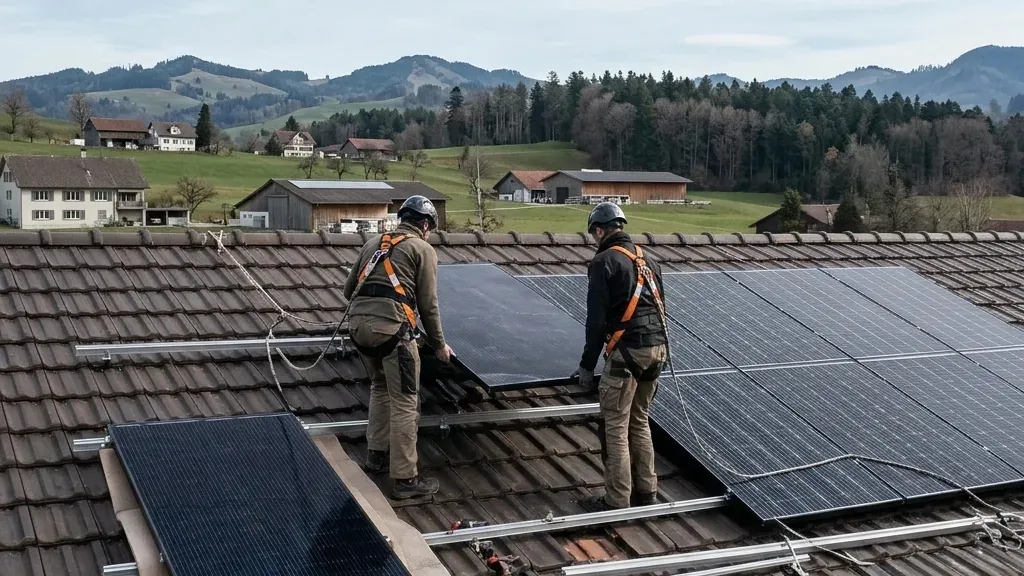
Your company's installation warranty applies to defects in the work: the leaking roof penetration, the chafing cable, the slipped fastening. The basis is the contract for work and services – here the installer themself is liable, not a manufacturer in the Far East.
The good news: you do not have to make the assignment alone. But you should know that it exists – because it explains why the question «Who is my contact person?» has different answers depending on what is broken.
Before reporting: the honest diagnosis
Not every disappointment is a warranty claim – and anyone who starts with a non-case burns time and goodwill. Therefore, the cause check for reduced yield should be run through before reporting: rule out weather (annual comparison instead of gut feeling), check fault messages, string comparison, visual inspection from the ground. Normal degradation, grown shading and a gloomy year are not warranty claims; the dead string and the silent inverter are.
This preparation has a second benefit: it produces exactly the documents that support the processing afterwards.
Documenting: your dossier is your lawyer
Warranty claims are won with evidence, not with conviction. What counts:
- The annual values. Anyone who notes the annual production since commissioning can prove a drop in performance instead of asserting it – in the case of a performance warranty, this is half the battle.
- The monitoring history. Fault messages, date of the failure, screenshots of the conspicuous curves – export before someone resets something.
- Photos. Photograph visible damage from the ground, with the date – and do not touch anything: the roof belongs to the professional, even in a warranty claim.
- The system documents. Acceptance protocol, component list with serial numbers, invoice, warranty conditions – everything that belonged in the dossier at the handover pays off now.
The processing: first the installer, then the chain
The normal case leads via your installer. They make a binding diagnosis, assign the case to the right warranty and process manufacturer claims via their supply chain – for you they are the one contact person, the rest is their trade. Exactly for this, the company with a functioning service organisation pays off, and exactly here the monitoring approval pays off: remote diagnosis instead of a journey on suspicion.
The special case: your installer no longer exists. In that case, the installation warranty effectively lapses – but the manufacturer warranties on modules and inverters remain in force. The route leads directly to the manufacturer or its Swiss representative or importer; with the serial numbers and proof of purchase from the system file, this is feasible. To carry out the repair, you commission another specialist company – reputable companies also take on third-party systems. We do so too; what we take on for such systems and what we do not is set out on the page Service for solar systems from other installers.
Form and deadline: Report defects promptly and in writing (e-mail is sufficient), with date, description and evidence. Defect rights under contracts for work and services have notification periods, and with manufacturer warranties too, a long wait weakens the position – the damage noticed in spring and reported in autumn raises questions that you do not need.
The sore point: who pays for scaffolding, removal, transport?
This is where the generous warranty separates from the cheap one: the manufacturer warranty typically covers the product – replacement or repair of the component. The ancillary costs of the case – scaffolding or fall protection, removal and installation, transport, sometimes even the working time – are covered, partially covered or your responsibility depending on the warranty conditions. With a module in the middle of the roof, these ancillary costs can far exceed the value of the module.
That is why the question belongs before the purchase, not in the event of a claim: Which additional costs do the guarantees cover – and what does the company's installation guarantee cover? In an ongoing case, the following applies: clarify the assumption of costs in writing before the repair, do not negotiate afterwards.
If there is a hitch: escalating with a system
Most cases proceed unspectacularly – everyday industry business. If not: first the factual written enquiry with a deadline, then the escalation levels – in the case of the manufacturer via their Swiss representation, in the case of the installer via the defect rights under the contract for work and services. For the legal enforcement of larger cases, legal advice is required; this guide does not replace it. But what can be said is: cases with a clean dossier rarely escalate – the evidence decides discussions before they begin.
The guarantee cases that we handle – our own as well as those taken over – sort themselves according to a pattern that has little to do with technology: There are the cases with a dossier and those without. With a dossier, the process is almost boring – serial number, annual values, fault history, the manufacturer sees the situation and delivers. Without a dossier, archaeology begins: Which module is installed? When did the yield drop? Does the acceptance protocol still exist? Every missing answer costs weeks. The second finding is more uncomfortable for our industry: The most contentious cases are almost never about the defective part, but about the scaffolding and working hours – additional costs that no one mentioned during the sale. Our advice from this is the same that we give at every handover: Note down five numbers a year, papers in a folder – and ask the uncomfortable additional costs question once when purchasing. That is all the guarantee precaution that is needed.
Frequently asked questions
My yield is lower than promised – is that a guarantee case?
Usually not directly: yield forecasts are forecasts, not guarantees, and weather years fluctuate. It becomes a case if the diagnosis shows a defect (product guarantee) or modules provably degrade faster than assured (performance guarantee) – for this, documented annual values are needed instead of a gut feeling.
My installer no longer exists – are the guarantees gone?
The installation guarantee de facto yes, the manufacturer guarantees no: claims on modules and inverters continue to exist and can be asserted directly with the manufacturer or their Swiss representation using serial numbers and proof of purchase. The repair is then carried out by another specialist company.
Who pays for the scaffolding when replacing a module?
The guarantee conditions regulate that – and exactly there, a look before the purchase is worthwhile: some guarantees only cover the product, others also removal/installation and transport. In the event of a claim, the following applies: clarify the assumption of costs in writing before installation.
How quickly do I have to report a defect?
Promptly – defect rights under the contract for work and services have notification periods, and waiting also weakens the position with manufacturer guarantees. In practice this means: discover, document, report in writing within days – not just at the next annual check.
Does the guarantee expire if another company maintains the system?
Generally not – manufacturer guarantees depend on the product, not on the maintenance company, as long as the work is carried out professionally. Caution only with DIY interventions: work by unauthorised persons on the electrics or modules can actually jeopardise claims.
Free initial consultation
In a guarantee case, what counts is who takes care of it.
We handle guarantee cases – for our own systems anyway, for orphaned third-party systems against fair billing. With diagnosis, manufacturer contact and a clear statement of costs before the repair.
Prefer to talk? +41 78 830 83 35
Photovoltaic installer for your region →
Swissolar member and Solarprofi · ESTI installation authorisation (Art. 14 NIV) · in Zurich since 2017 · over 150 systems completed · a personal answer from the specialist company, no call centre
Further guides
 Solarmodul-Garantien verstehen
 Werkvertrag, Zahlungsplan & Garantien
 Anlage liefert zu wenig? Die Ursachen
 Ertrags-Monitoring richtig nutzen
 Der Jahres-Check für Anlagenbesitzer
Sources: Manufacturer guarantee conditions (structure, general); empirical values from the service and processing practice of ecoEn GmbH, Zurich region.
Last updated: 9 July 2026 · Author: ecoEn editorial team