
Photovoltaics for businesses in the Canton of Zug: where Switzerland's largest roofs are
No canton has larger solar systems on average than Zug: 40.8 kWp per system, 55.1 in Baar and 49.6 in Cham – these are commercial and industrial roofs, not single-family homes. The Baar–Sihlbrugg commercial zones, the industry on Lake Zug and the Rotkreuz economic area have hall roofs that match a business's load profile exactly. ecoEn plans and builds photovoltaic systems for businesses in the Canton of Zug – designed around the load profile, with the connection application to WWZ, federal, cantonal and city incentives and our own electrical installation with ESTI installation authorisation (Art. 14 NIV). A direct specialist company from Zurich, half an hour from Zug, not a broker.
Commercial and large roofs we have built
Our large references are in the Canton of Zurich – half an hour from Zug, the same installation crew, the same processes:
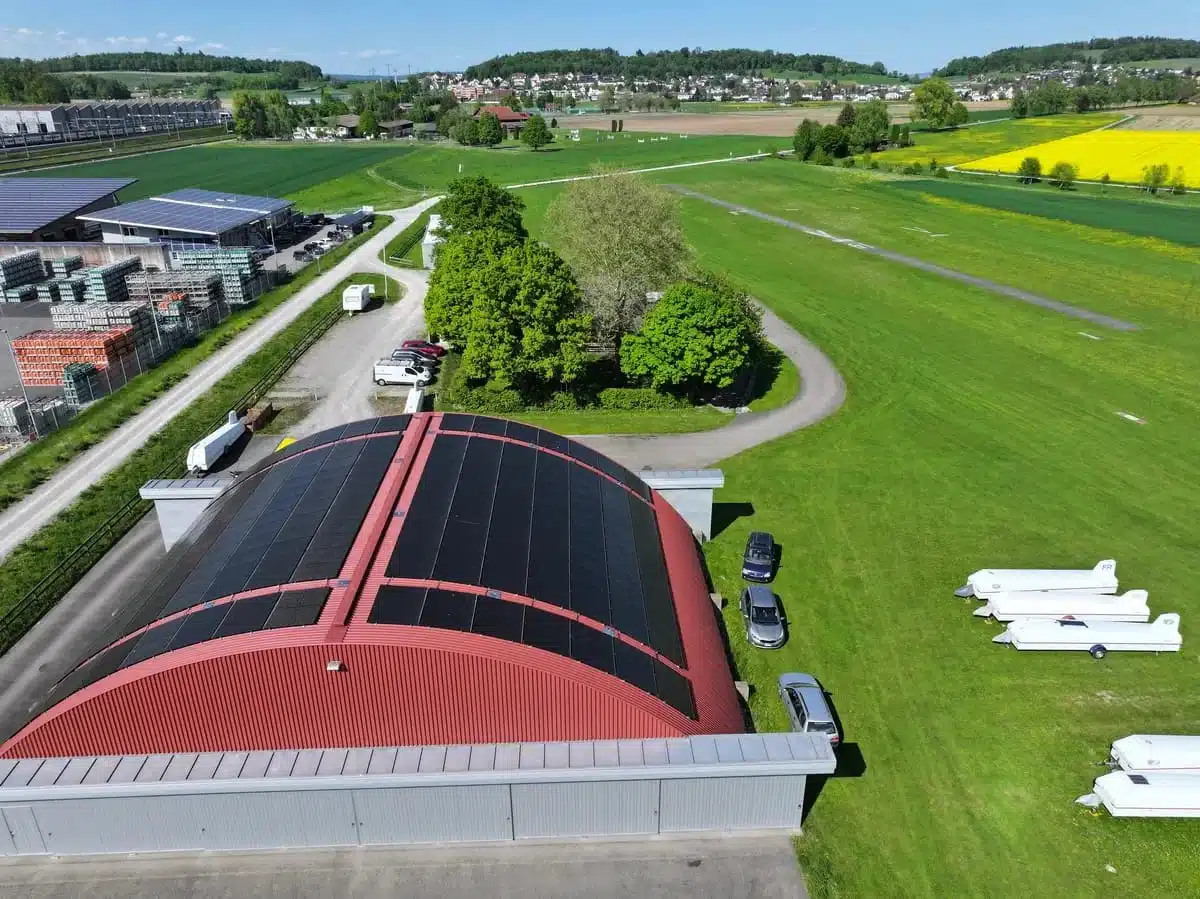
Industrial roof, gliding airfield, Winterthur
- 89.6 kWp · 224 modules · 110 kVA
- East-west layout on trapezoidal sheet metal
- Commissioned 2022
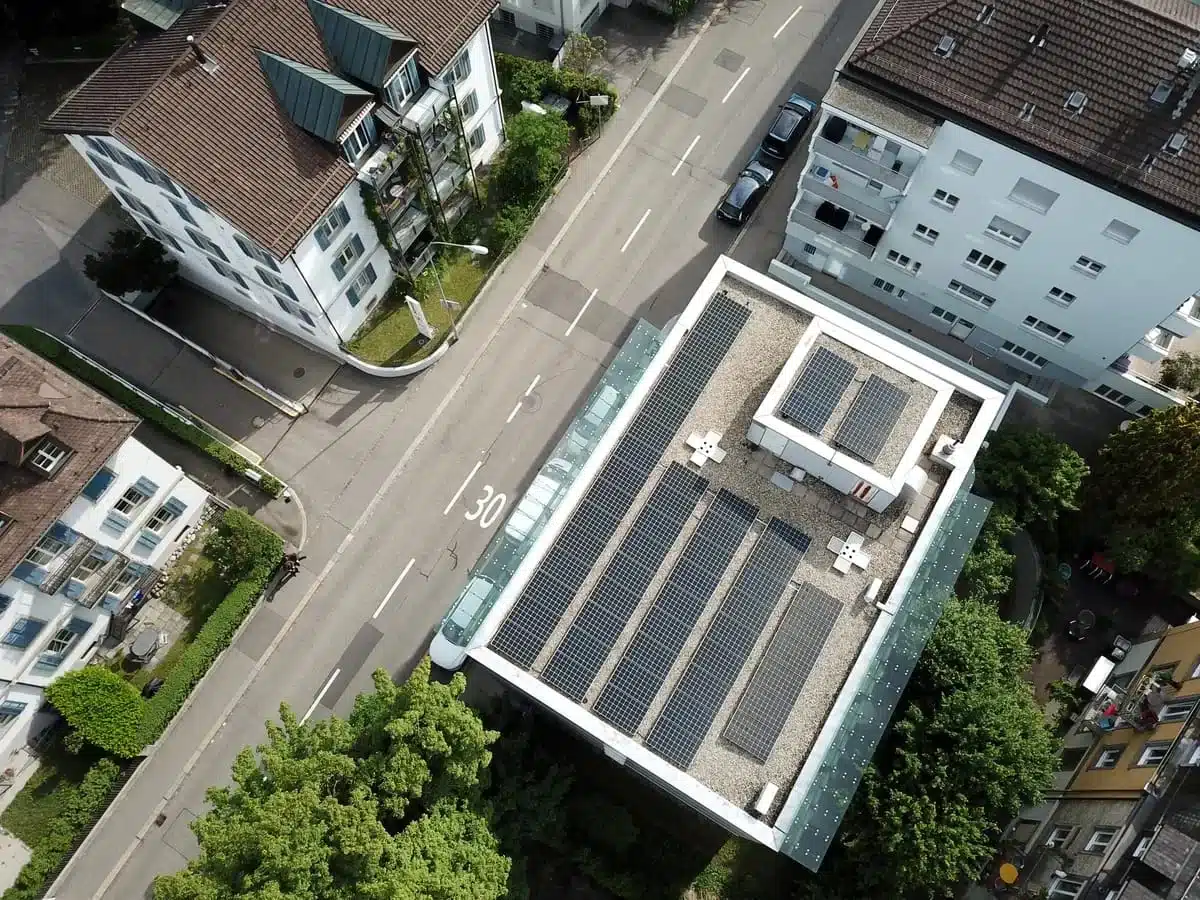
Commercial flat roof, Zurich
- 19.25 kWp · 55 modules
- Flat-roof mounting
- Commissioned 2020
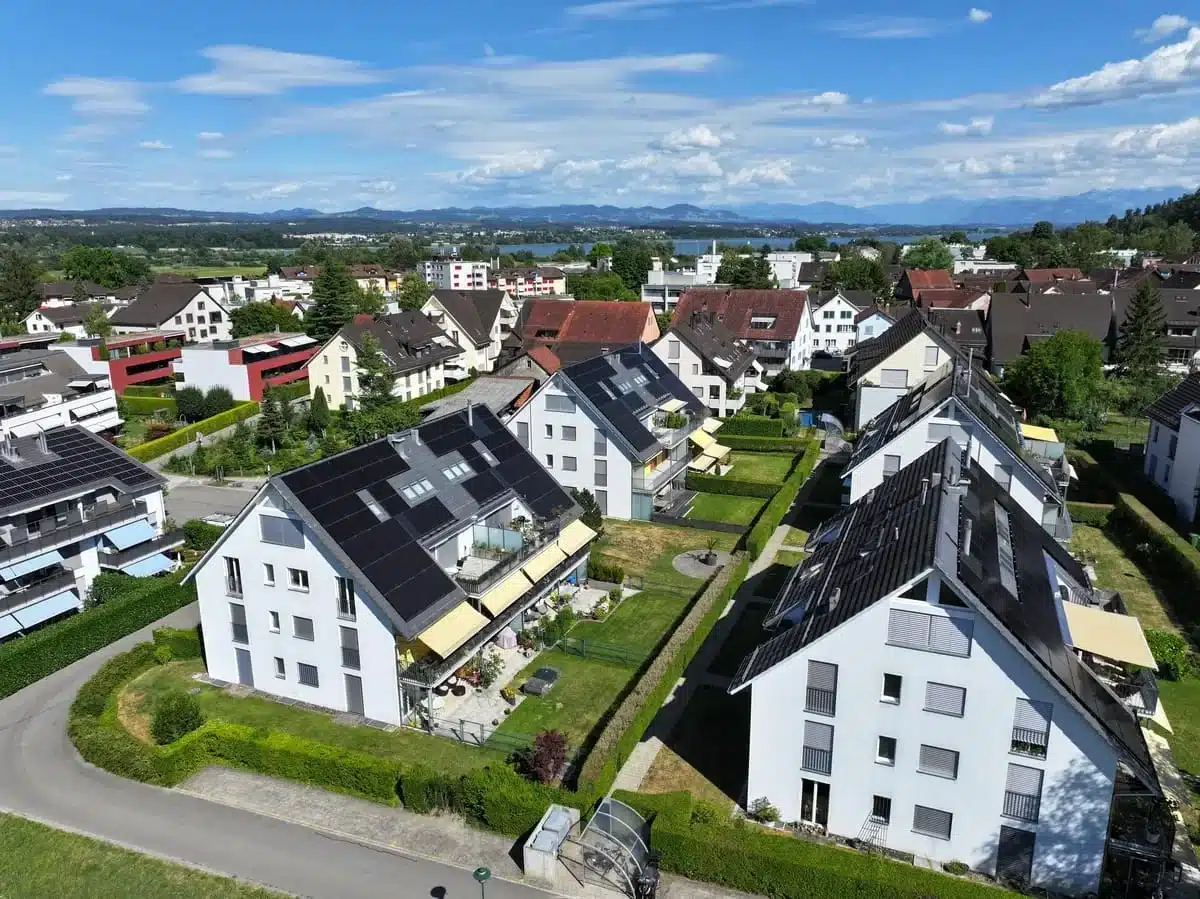
Large-scale system over 100 kWp, Fällanden
- over 100 kWp · 274 modules · 2 buildings
- Self-consumption optimisation · EV load management
- Commissioned 2023/2024
All completed systems with key data: Projects & references.
How a commercial project in the Canton of Zug works
- Guideline quote from your electricity bill and roof plan. The annual bill – from 100,000 kWh, the quarter-hour values – and roof dimensions are enough for an initial framework: system size, self-consumption, incentive route.
- Site visit and structural analysis. Roof skin, fastening (trapezoidal sheet metal or ballast), main distribution board, transformer station, cable routes – the structural verification comes before sizing.
- Concept. Layout, inverters, metering concept for multiple tenants, incentive route (EIV, GREIV, supplements or auction), storage and charging infrastructure on request.
- Permit, connection, incentives. Notification procedure or building application with the municipality, connection application to WWZ, incentive applications to Pronovo and the City of Zug before construction.
- Installation and electrical work. Roof installation outside peak operating times, electrical installation and grid registration by our team with ESTI installation authorisation, acceptance.
- Operation. Monitoring set up, yield and self-consumption visible monthly, responsibilities agreed in writing.
Zug in numbers: the canton of large systems
The federal public plant register shows why Zug is a special location for commercial photovoltaics – not because of total capacity, but because of system size:
| Canton / location | Systems | Ø system (kWp) | What's behind it |
|---|---|---|---|
| Canton of Zug | 3’056 | 40,8 | Highest average of all cantons – commercial and apartment building roofs |
| Baar | 429 | 55,1 | Baar–Sihlbrugg commercial zone |
| Cham | 281 | 49,6 | Industry on Lake Zug |
| Canton of Zurich (comparison) | 32’829 | 28,1 | Per capita rank 24 of 26 |
Our own analysis of the SFOE register «Electricity production plants», data as of August 2026. All cantons and municipalities: Photovoltaics Switzerland in numbers.
What this means for businesses: in Baar, Cham, Steinhausen and Rotkreuz, commercial systems are standard – grid operators and building authorities know the process, and anyone there who still has an empty hall roof is in the minority. In the WWZ area, the calculation is carried not by export but by self-consumption: workshops, production and cooling typically reach 60 to 80 percent without storage, offices and services 40 to 60 percent – ranges and worked examples in the article Solar systems for businesses and SMEs.
Why self-consumption carries the calculation in the WWZ area
In 2026, WWZ passes on the federal quarterly reference market price – backed by the statutory minimum remuneration for small systems – and additionally pays 1.00 Rp./kWh for the guarantee of origin for systems up to 100 kW (WWZ feed-in tariff). For the typical roof system that's currently around 7 Rp./kWh; the minimum remuneration falls with system size and disappears completely from 150 kW – leaving the pure market price of around 3.90 Rp./kWh (Q2 2026). A business typically buys its electricity for around 20 Rp./kWh: every kilowatt-hour that stays in the hall is worth three to five times as much as an exported one. The system is therefore designed around the load profile, not the roof area; storage pays off more for peak shaving (commercial storage) than for self-consumption.
What does a commercial system in the Canton of Zug cost?
With large roofs, the price per kilowatt drops significantly – scaffolding, planning, connection and registration are one-off costs:
| System size | Typical market guideline (fully installed, without storage) |
|---|---|
| ~30 kWp (workshop, practice, small warehouse) | CHF 1,400–1,700 per kWp |
| ~50 kWp (production business, car garage) | CHF 1,500 per kWp and below |
| ~100 kWp (commercial hall, logistics, cold store) | CHF 1,100–1,400 per kWp |
| from 200 kWp (industrial roof) | project-specific – transformer, connection and structure determine the price |
Guideline values based on published Swiss market data, as of July 2026, fully installed, without storage, before incentives and taxes; the individual quote based on the load profile and site visit is binding. Not included: structural verification, scaffolding, changes to the main distribution board or transformer station, metering for multiple tenants.
A Zug detail for financing: the low cantonal tax rates make depreciation of the system less effective in francs than elsewhere – input VAT deduction for VAT-registered businesses and the one-off feed-in incentive are unaffected. The models compared: Financing a solar system as a business. Detailed worked examples: Businesses and SMEs, Industrial roofs from 100 kWp, Cold stores.
Incentives in the City and Canton of Zug
Federal. The one-off feed-in incentive is around CHF 360 per kWp for the part of the system up to 30 kWp and around CHF 300 per kWp above that, plus a base contribution (as of August 2026); from 100 kW as GREIV with an application before construction, for car park canopies from 100 kW an additional CHF 250 per kW.
City of Zug. For roof systems, the city pays a municipal contribution broadly in line with the federal one-off incentive (maximum CHF 5,000), for facade systems up to CHF 10,000, plus a green roof bonus of CHF 200 per kWp; it subsidises battery storage from 6 kWh with 20 percent of the costs (maximum CHF 10,000). The Canton of Zug pays no contribution per kWp but has a special route: anyone who insulates the roof or facade and at the same time installs a full-coverage PV system receives a PV bonus of a further CHF 60/m² on top of the insulation contribution of CHF 60/m² – a real amount when renovating a hall. All details and which programmes apply to commercial buildings: Incentives in the Canton of Zug. The current regulations of the city, municipality and canton apply.
A second roof area: the company car park
The car park in front of the hall is the obvious second consumer: employees charge during the day when the system is producing, and canopies from 100 kW receive the federal car park bonus. We plan charging infrastructure with load management on the same service connection right from the start.
- Photovoltaics over the company car park: car park bonus & costs
- Electrifying company car parks: the practical guide
- Solar panels Zug: cost, incentives and installation (residential)
Frequently asked questions
Does ecoEn also build in the Canton of Zug?
What does a 100 kWp system on a hall in Baar or Cham cost?
What incentives are available for commercial buildings in the Canton of Zug?
What does WWZ pay for exported solar power?
Does the system pay off at all with Zug's low taxes?
Can a trapezoidal sheet or flat roof carry the system?
Guides for business and industry
- Solar systems for businesses and SMEs: cost, self-consumption, process
- Photovoltaics on industrial roofs: large-scale systems from 100 kWp
- Solar systems for cold stores
- Photovoltaics over the company car park
- Financing a solar system as a business
- Incentives in the Canton of Zug
- WWZ feed-in tariff
- Photovoltaics for business and industry in Zurich
Your electricity bill and roof plan are enough for an initial framework.
Send us your annual bill or quarter-hour values and the roof plan – we'll calculate system size, self-consumption and incentive route as a guideline quote. A direct specialist company, half an hour from Zug, not a broker.