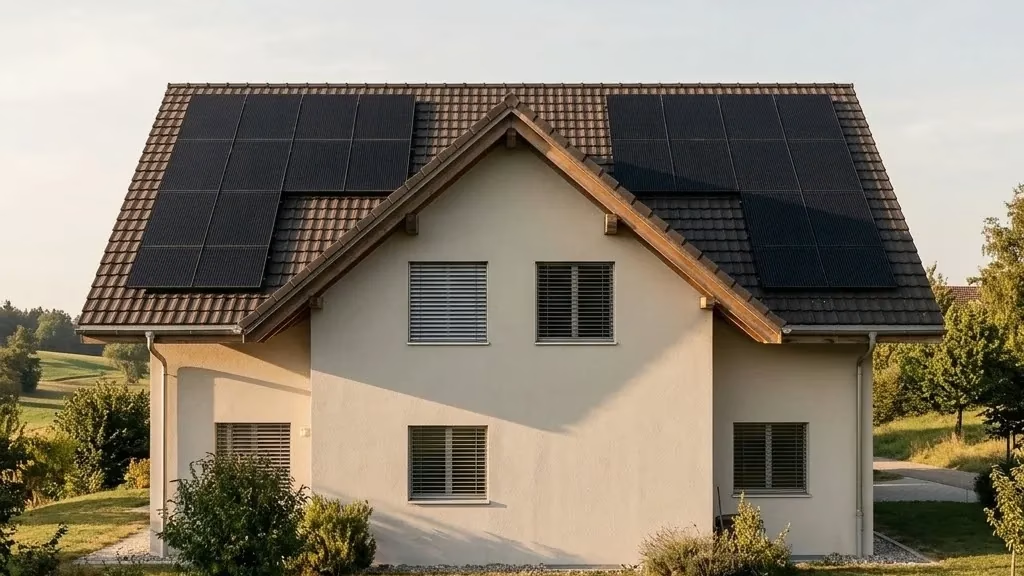
The theoretically best orientation in Switzerland is south with a roof tilt of around 30 degrees. In practice, however, east-west roofs and deviations to the southeast or southwest also deliver very good yields – the differences are smaller than many think. Usually, whether the roof is free of shading is more decisive than the perfect location.
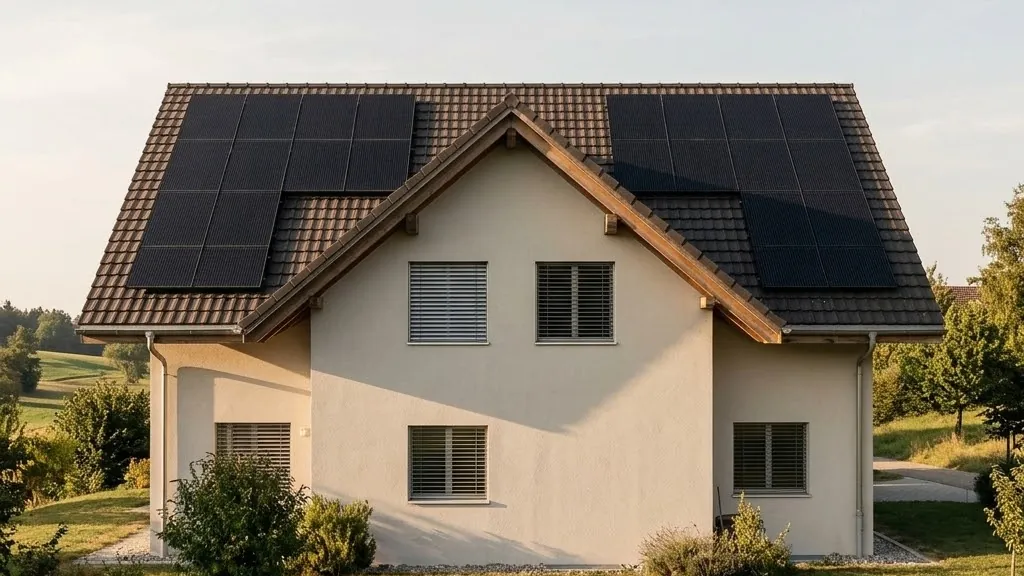
Key points in brief
- Optimal is south with a tilt of about 30 degrees – but that is an ideal, not a must.
- East-west roofs produce distributed over the day and often fit self-consumption better.
- Deviations from the ideal location usually only cost a single-digit percentage range in yield.
- Shading has a stronger impact than an orientation that is not quite ideal.
- Almost every roof is suitable – the question is not if, but how to cover it.
Which orientation is theoretically best?
If you want the maximum annual yield per module, you orient the system in Switzerland to the south, with a tilt of around 30 degrees. In this constellation, the most solar energy hits the modules over the year. This is the reference value against which all other orientations are measured.
Only: very few roofs are oriented exactly to the south and tilted exactly 30 degrees – and that is not a problem. Because the yield curve around the optimum is flat. A deviation to the southeast or southwest, a slightly steeper or flatter tilt: all this usually costs only a few percent in practice.
How much yield does a deviation really cost?
Here is the rough orientation of how different locations relate to the south optimum:
| Orientation | Yield compared to south optimal (guideline value) |
|---|---|
| South, ~30° | 100 % (reference) |
| South-east / south-west | around 90–95 % |
| East / West (per surface) | around 80–85 % |
| flat roof (elevation freely selectable) | near optimum |
Guideline values, As of: July 2026. The exact values depend on location, tilt and shading; a location-based yield calculation is binding.
You can see: even a pure east roof still delivers a large part of the maximum. So if you have a roof that does not point south, you should by no means forego a system. The question is not whether it is worthwhile, but how the roof is best covered.
Why east-west roofs are often the smarter choice
A south-facing roof produces its electricity concentrated around midday – exactly when many households consume little because no one is at home. An east-west roof, on the other hand, delivers in the morning on the east side and in the evening on the west side. The electricity is distributed over the day, with peaks in the morning and in the evening – i.e. when electricity is actually needed in the household.
For self-consumption this is a real advantage: less excess flows into the grid, more solar electricity is used directly. All in all, an east-west roof can compete economically, although its pure annual production is slightly lower. The article Flat roof: east-west or south orientation? deepens this thought for flat roofs, where you can freely choose the orientation.
What role does the tilt play?
The roof tilt influences how steeply the sun hits the modules over the course of the year. Around 30 degrees are ideal for the annual yield, but here too the range is generous: tilts between about 20 and 45 degrees consistently deliver good results.
Steeper roofs have an underestimated side effect: they deliver relatively more in winter, because the low winter sun falls more flatly, and snow slides off better. For the connection between season and yield, it is worth looking at Photovoltaics in winter.
What is more important than the perfect orientation?
A point that often gets lost in the discussion about degrees and compass direction: Shading weighs heavier than orientation. A perfectly south-facing roof on which the neighbour's tree falls from the afternoon can perform worse than an unshaded east roof. Shadow has a disproportionate effect, because it can affect not only individual modules, but depending on the wiring, entire areas – more on this under Shading.
The correct order when assessing a roof is therefore: first check shading, then orientation and tilt, then plan the layout. A first clue is provided by sonnendach.ch – the site visit is binding.
We hardly hear a concern as often as "My roof does not point south, is it even worthwhile?". Almost always the answer is: yes. We have built countless east-west and southwest systems in the region that satisfy their owners – often precisely because the electricity fits the daily routine better. The perfect south orientation is a nice bonus, but not an exclusion criterion. Anyone who hesitates because of the compass direction usually just gives away time and yield.
Frequently asked questions
Is a solar system on a north-facing roof worthwhile?
A pure north surface is the only case where we advise restraint – the yield is significantly lower. Often, however, another roof surface can be used, or the roof is an east-west roof, whose north part you simply do not cover.
Is south always better than east-west?
For pure annual production yes, for economic viability not necessarily. East-west often fits consumption behaviour better and increases self-consumption – which can compensate for the small production disadvantage.
How much does a flat or steep tilt hurt?
Between about 20 and 45 degrees the differences are small. Very flat or very steep roofs deviate a little more, but are still very usable. On flat roofs, the tilt is adjusted via the elevation anyway.
Can I mount modules in different directions on the same roof?
Yes, that is common – for example with east-west roofs or angled roofs. Modern inverters and module-wise optimisation cope well with differently oriented surfaces.
How do I know how much my roof specifically delivers?
sonnendach.ch gives a first impression. A reliable number requires a location-based yield calculation that combines orientation, tilt, shading and module selection – that is part of our consultation.
Free initial consultation
How much does your roof get out?
Whether south, east-west or angled – we calculate the yield for your specific roof situation. Free of charge and without obligation.
Prefer to talk? +41 78 830 83 35
Your photovoltaic system from a specialist company →
Swissolar member and Solarprofi · ESTI installation authorisation (Art. 14 NIV) · in Zurich since 2017 · over 150 systems completed · a personal answer from the specialist company, no call centre
Further guides
 Flachdach: Ost-West oder Süd?
 Verschattung
 Ertrag pro kWp in der Schweiz
 sonnendach.ch richtig lesen
Sources: EnergieSchweiz (sonnendach.ch), Swissolar, SFOE.
Last updated: 9 July 2026 · Author: ecoEn editorial team