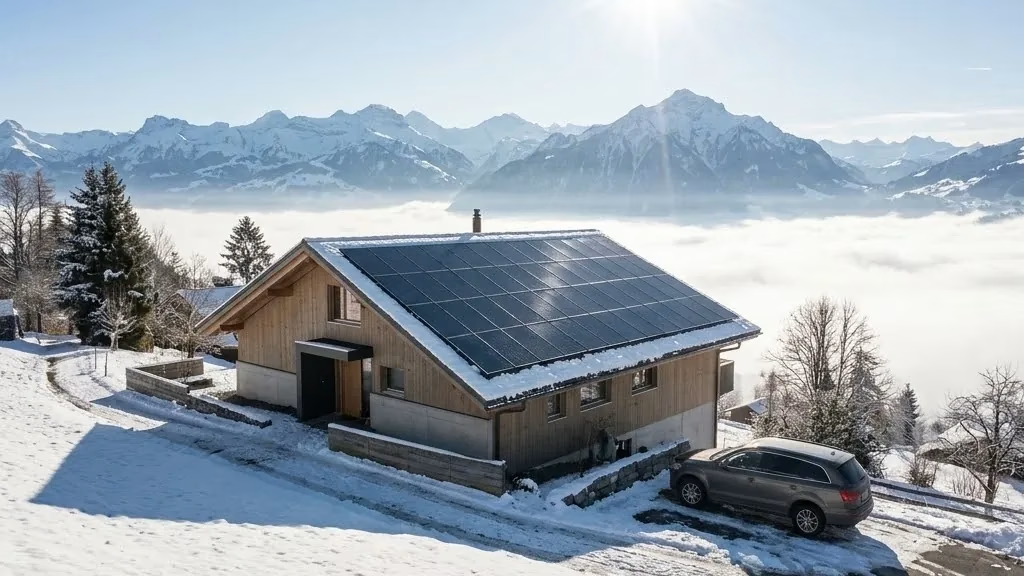
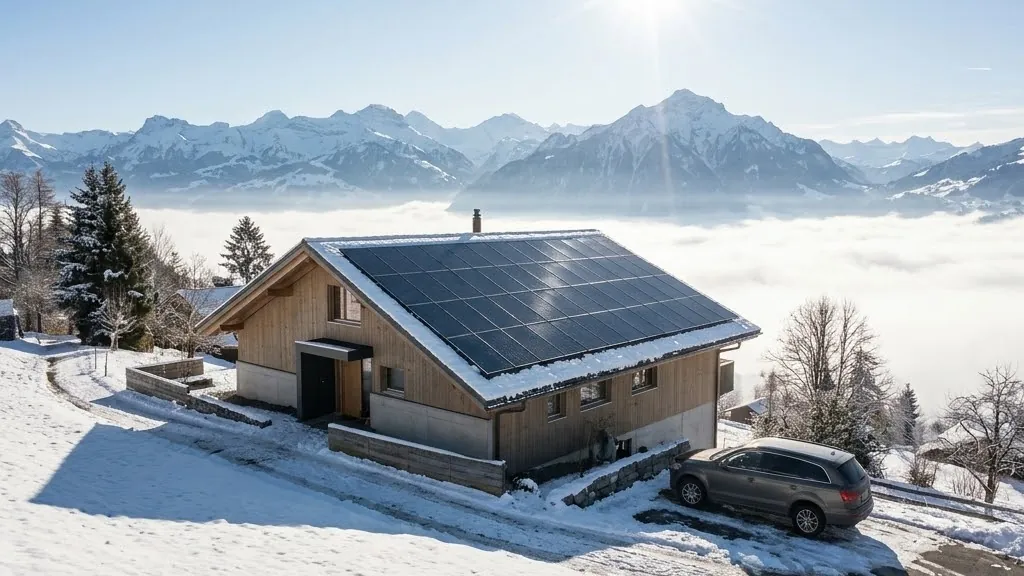
Yes, a solar system also produces in winter – but significantly less: The larger part of the annual yield falls into the summer half-year. The culprits are the low position of the sun, short days and the high fog in the Swiss Plateau – not the cold, which even helps the modules. The annual yield counts for profitability; those who measure the system by the winter measure it wrong. (As of: July 2026)
Key points in brief
- The winter yield is real, but small: In the Swiss Plateau, the winter half-year delivers around a quarter of the annual yield as a guideline value – slightly more depending on orientation and location, significantly less in the darkest months.
- Cold is not an enemy: Solar modules work more efficiently at low temperatures – a clear, cold winter day can deliver an astonishing amount.
- The real winter opponent in the Swiss Plateau is high fog, not snow.
- Snow on the modules: leave it lying – on pitched roofs it usually slides off by itself, and clearing is not worth it.
- Steeper roofs deliver relatively more in winter; the system is dimensioned over the year anyway, never over January.
How much yield does a solar system deliver in winter?
The honest figure first: Looked at over the year, the greater part of production falls into the summer half-year. For the winter half-year, around a quarter of the annual yield remains as a guideline value in the Swiss Plateau – the SFOE study 'Winterstrom Schweiz' estimates the winter share of typical Swiss Plateau systems at around 25 to 26 percent; steep, well-orientated surfaces fetch slightly more, and of this the darkest weeks around the winter solstice contribute the smallest part (as of: July 2026). A December day and a July day of the same system can differ many times over in daily production; those looking into the monitoring app for the first time in winter should know this before calling the installer.
Three causes work together, and none of them is a defect: The sun is low and hits the modules at a flat angle, the days are short – and in the Swiss Plateau, high fog intervenes in many weeks. All three are astronomy and meteorology, not technology. The system does exactly what it should in winter; there is simply less light to harvest.
For profitability, this is priced in: Every serious yield prognosis – such as the guideline values per kWp for the Region of Zurich – is an annual value in which the dark months are already included. The winter is therefore not a hidden risk in the calculation, but its included component.
Why cold even helps the modules
The most widespread winter misconception concerns the temperature: Many assume modules need warmth. The opposite is true – solar modules like light, but not heat. With increasing cell temperature, the output drops slightly; in the cold, the cells work more efficiently. This temperature effect is the reason why cool, clear spring days regularly belong to the highest-yielding of the year – and why a clear, cold winter day with snow-free modules can deliver an astonishing amount.
For the winter, this means: It is not the minus temperatures that cost yield, but the missing light. A sunny January day at minus ten degrees is a good day for the system – short, but efficient.
The real opponent: High fog in the Swiss Plateau
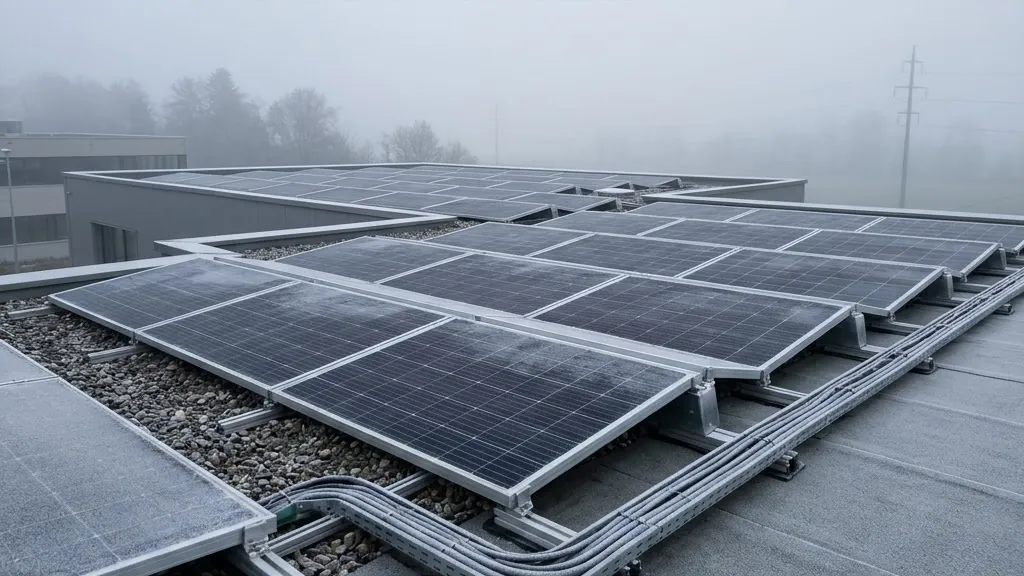
What really depresses the winter yield in the lowlands is the grey blanket that settles over the Swiss Plateau in late autumn. Modules also use the diffuse light of an overcast sky – so the system does not stand still under high fog – but the output drops to a fraction of the maximum on cloudy days. Weeks with closed fog cover are therefore the lowest-yielding time of the year, poorer than many a snow day with a clear sky afterwards.
This also explains why winter values differ more strongly regionally than summer values: Locations above the fog line or with early clearing see significantly more sun in November and December than classic fog holes. This changes little about the annual yield – but it explains why the acquaintance's system on the hill ridge shows more in December than your own in the valley, without there being anything wrong with either of them.
Snow on the modules: clear or leave lying?
If there is snow on the modules, production rests until it slides off or thaws away – on pitched roofs, thanks to the smooth module surface, this usually happens by itself, often faster than on the rest of the roof. And then the simple rule applies: leave it lying. The days affected contribute so little to the annual yield that the risk of clearing – for humans and modules – does not pay off in any proportion. The detailed justification including the one relevant exception (roof avalanches over walkways) can be found in the article Snow on the solar system.
A side effect for planning: Snow slides off earlier on steeper roofs – one of two reasons why steep roofs stand relatively better in winter.
What does this mean for planning and expectations?
Four consequences from winter physics, from planning to operation:
Steeper pitch helps the winter – but does not decide. The low winter sun hits steep surfaces more favourably, and the snow slides off better; steep roofs deliver relatively more in winter. So rebuild a roof because of this? No – the differences over the year are small, and dimensioning is based on the annual yield.
Rethink shading in winter. The low winter sun casts long shadows: A tree or neighbouring house that is harmless in summer can cover a lot in winter. When planning, the shadow course of both seasons belongs on the table – not just the June view.
Calculate large consumers realistically. Heat pump and e-car need the most in winter when the system delivers the least – the combination pays off over the year, but not as January self-sufficiency. And the home battery works part-time in winter, simply because there is less surplus to store. Both are normal, both belong in the consultation – beforehand.
Self-sufficiency remains a summer word. The basic problem of complete independence is precisely this annual asymmetry: plenty of surplus in summer, too little in winter. The grid connection remains the sensible way; the system reduces the purchase, but does not replace it.
Monitoring in winter: What is normal – and what is not?
The most important winter rule for the app: Compare December with December, never with July. Low absolute values in winter are physics; it only becomes conspicuous if the winter is significantly below the previous years' winters without the weather explaining it – then the same test steps apply as always, from the fault log to the string comparison.
Two special winter cases that are not defects: Days with zero production under a closed snow cover – and the apparently 'hanging' value on days when only a part of the modules is free of snow. Both resolve themselves with the weather. Anyone who is unsure takes a photo of the roof (from the ground) and puts it with the annual log – when in doubt, this is exactly the information that saves the installer remote diagnosis.
In the consultation, we now ask the winter question ourselves before the customer asks it – and with the annual curve on the table instead of an annual figure. The reason: An annual production of such-and-such a number of kilowatt hours sounds abstract, but the curve honestly shows that December is a narrow line and June a mountain. Those who have seen this before buying do not call anxiously in January – and instead rejoice in February about the first clear cold day when the system suddenly shows values like in autumn. Also striking is what we observe in the region: For systems in typical fog locations, the November-December yield almost completely determines when the fog cover clears – the same system, the same month, two completely different years. This is another reason why a single winter month is not suitable as a yardstick for anything.
Frequently asked questions
Does a solar system also produce at minus temperatures?
Yes – and even more efficiently than in summer heat, because solar cells work better at low temperatures. The decisive factor is the light, not the temperature: A clear, cold day is a good production day, a mild foggy day a bad one.
Should I clear the snow from the modules?
No – on pitched roofs it usually slides off by itself, and the few affected days hardly contribute to the annual yield. The risk of clearing is disproportionate; the exception are roof avalanches over paths, and they are a safety, not a yield issue.
Why does my app show so little in December?
Because the low position of the sun, short days and high fog come together – that is physics, not a defect. Compare winter values with the previous years' winters instead of with the summer; only an unexplained deviation from winter to winter is a reason to check.
Wouldn't alpine systems be the solution to the winter problem?
For the power supply of Switzerland, systems above the fog line are indeed an issue – for the single-family home not: Your roof is where it is. For the home, the realistic answer is: calculate the annual yield, calibrate the winter expectation, keep the grid connection.
Does an east-west system bring more in winter?
No, rather in the summer half-year: East-west distributes the production over the day, which helps self-consumption. In winter, the basic problem remains the lack of light – no orientation helps decisively there, not even the perfect south-facing location.
Free initial consultation
What does your roof deliver – over the whole year?
We show you the honest annual curve for your situation, winter included – instead of a beautiful summer figure. Free of charge and without obligation.
Prefer to talk? +41 78 830 83 35
Have a photovoltaic system installed →
Swissolar member and Solarprofi · ESTI installation authorisation (Art. 14 NIV) · in Zurich since 2017 · over 150 systems completed · a personal answer from the specialist company, no call centre
Further guides
 Wie funktioniert Photovoltaik?
 Hitze und Leistung: der Temperatureffekt
 Schnee auf der Solaranlage
 Ausrichtung und Neigung
 Verschattung: Wirkung und Lösungen
Sources: SFOE study 'Winterstrom Schweiz' (winter half-year share Swiss Plateau ~25–26 %); EnergieSchweiz / SFOE (basics yield and annual course); empirical values from the installation and service practice of ecoEn GmbH, Region of Zurich. (As of: July 2026)
Last updated: 9 July 2026 · Author: ecoEn editorial team