
Photovoltaics converts sunlight directly into electrical electricity. In the solar cells on the roof, the light particles trigger a charge – direct current is generated. The inverter turns this into the alternating current that your sockets need. What you do not use immediately flows into the grid. There are no moving parts. (As of: July 2026)
Key points in brief
- The photovoltaic effect generates electricity as soon as light hits a solar cell – entirely without movement, fuel or noise.
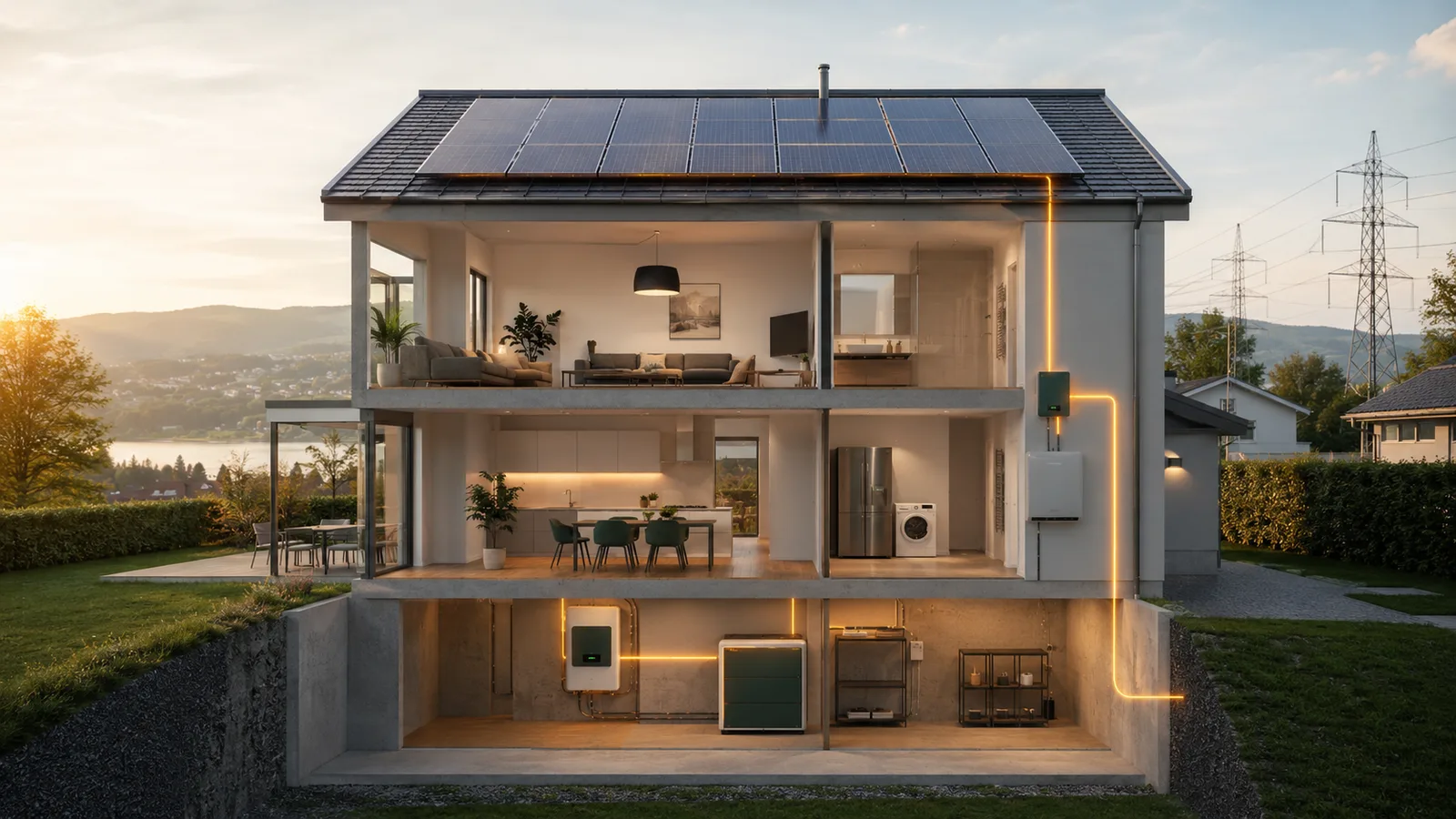
- At its core, a system consists of solar modules, inverter, mounting system and meter; a battery storage and energy management are added as needed.
- The modules deliver direct current, the inverter turns this into standard household alternating current with 230 volts.
- Economically, it is primarily self-consumed electricity that counts; the surplus goes to the grid and is remunerated.
- As a guideline value for the Zurich region, a well-oriented system delivers around 950 to 1,100 kWh per kWp and year – depending on orientation and shading (As of: July 2026).
How is electricity generated from sunlight?
The core is a physical effect that manages without a single moving part: the photovoltaic effect. When sunlight hits a solar cell, an electrical voltage is created inside it – and as soon as a consumer is connected, electricity flows.
A solar cell mostly consists of silicon, a so-called semiconductor. During production, the silicon is divided into two wafer-thin layers with slightly different properties. An internal electrical field forms at their boundary. The light particles of the sun, the photons, carry energy. When they hit the cell, they knock electrons free from their bonds. The internal field ensures that these electrons migrate in a specific direction instead of simply fizzling out. If the front and back of the cell are connected via a conductor, a directed flow of electrons is created – electrical current.
Important for understanding: nothing is burned and nothing is moved. A solar cell has no motor, no turbine, no piston. It works as long as light falls on it, and is therefore extremely durable and low-maintenance. The effect itself is not a new invention; it was already discovered in the 19th century. What is new is how cheaply and efficiently the technology has developed in recent years.
A single cell only delivers a small voltage. Only many cells, connected in series and packed weatherproof behind glass, produce a solar module as you know it from the roof. Several modules together form the system.
What parts does a photovoltaic system consist of?
A system is more manageable than many think. Four components form the basic framework, plus a battery storage and a control system if desired.
| Component | Job |
|---|---|
| Solar modules | convert light into direct current; sit on the roof |
| Inverter | turns direct current into standard household alternating current |
| Mounting system | anchors the modules wind- and rain-proof on the roof |
| Meter | measures what you draw and what you feed in (bi-directional meter) |
| Battery storage (optional) | stores surplus for the evening |
| Energy management (optional) | controls consumers so that as much of your own electricity as possible is used |
The modules are the visible centrepiece. The article Monocrystalline or polycrystalline? deals with which cell technology is standard today and how the types differ; you can find the complete overview of all components under Structure of a solar system.
The mounting system is often underestimated. It has to hold the modules securely for decades, must not make the roof leak and must fit the roof type – a tiled roof is fastened differently than a flat or sheet metal roof. This is exactly where serious work separates from quick work in practice. On older Eternit roofs, for example, we clarify the asbestos issue first, before a rail is even laid.
What module types are there – and what is standard today?
The vast majority of modules on Swiss roofs consist of crystalline silicon. Within this family, the monocrystalline design has prevailed, recognisable by the uniformly dark, often black appearance.
A rough distinction is made between two crystalline types. Monocrystalline cells consist of a uniform crystal, work somewhat more efficiently and define the market today. Polycrystalline cells with their shimmering bluish structure used to be widespread, but hardly play a role in new systems anymore. Besides this there are thin-film modules, which are rarely found on residential buildings, however.
In practice, this means: the module type is rarely the decisive question. Quality, warranty conditions and coordination with the roof and inverter are more important. A modern module today yields around 400 to 450 watts and measures almost two square metres; its efficiency, i.e. the proportion of sunlight that is converted into electricity, is in the range of about 20 to 22 percent – with an upward trend over the years. The article Monocrystalline or polycrystalline? delves deeper into the differences between the cell types, and the article Efficiency of solar modules classifies the efficiency.
Why does the system deliver direct current – and what is the inverter for?
For physical reasons, solar cells always generate direct current (DC): current that flows constantly in one direction. However, your home grid and the public grid work with alternating current (AC) – in Switzerland with 230 volts and 50 hertz. So that the solar electricity can be used in the household, it must be converted. This is the main task of the inverter.
But the inverter can do more than just convert. It ensures that the modules always run at the optimum operating point, so it gets the maximum out of every light condition. It monitors the system and reports faults. And it assumes a safety function: if the public grid fails, it automatically disconnects the system so that no electricity flows into a supposedly dead grid and no one is endangered. Why this also means that a standard system does not continue to run in the event of a power failure, we clarify further below.
The inverter is the component that is most likely to be replaced at some point in the life of the system – the modules generally last longer. You can read how it works in detail and what is important when making a selection under The inverter explained.
What happens to the electricity you do not consume immediately?
The electricity produced takes a clear path, and this path decides the economic viability of the entire system. First, the solar electricity covers current consumption in the house: fridge, stove, washing machine, home office, a heat pump or the charging e-car. Only what goes beyond this leaves the house.
This surplus flows via the meter into the public grid. The grid operator, i.e. your local utility, remunerates it with the feed-in tariff. Conversely, the following applies: if the system delivers too little at night or on cloudy winter days, you draw electricity from the grid as normal. The bi-directional meter records both directions separately.
The economic point behind this is crucial, and it is often misunderstood. Self-consumed electricity is worth more than fed-in electricity. Because a self-used kilowatt hour replaces expensive grid electricity, while the fed-in kilowatt hour only yields the – mostly lower – feed-in tariff. That is why it is worthwhile to use as much of your own electricity yourself as possible. The article Overview of feed-in tariffs compares the feed-in tariffs of the utilities in our region; the article Optimise self-consumption shows which levers increase self-consumption.
The self-consumption rate describes how large the self-used proportion is. In a typical single-family home without battery storage, the guideline value is around a quarter to a third of annual production – the rest is fed in. With a battery storage and controllable consumers such as a heat pump or charging station, this proportion can often be raised to half or more. There are no fixed numbers here either: the value depends heavily on when the electricity is needed during the course of the day.
This is where the battery storage comes into play. It absorbs the midday surplus and releases it in the evening when the sun is gone and consumption rises. This allows the proportion of self-used electricity to be significantly increased. Whether this pays off in an individual case is a separate question – the article Battery storage in Switzerland provides the classification for this.
How much electricity does a solar system produce in Switzerland?
As a guideline value for the Swiss Plateau and the Zurich region, a well-planned system delivers around 950 to 1,100 kilowatt hours per installed kilowatt of output and year. A 10 kWp system therefore roughly produces 9,500 to 11,000 kWh annually. This is an order of magnitude, not a promise: the actual yield depends on orientation, roof inclination, shading and weather.
| Orientation / inclination | Yield (relative to optimum) |
|---|---|
| South, around 30° inclination | highest annual yield (reference) |
| East-west roof | somewhat lower, but more evenly distributed over the day |
| Flat roof (elevated) | good, with optimised inclination and row spacing |
| heavy shading | significantly reduced – it is worth looking closely here |
Guideline values, as of: July 2026. The individual site assessment is decisive; a yield calculation for your roof provides binding values.
Two things regularly surprise homeowners. Firstly, an east-west roof is often better than its reputation: Although it delivers somewhat less in total than an ideal south-facing roof, it distributes the electricity more flatly over the day – in the morning and evening, i.e. when it is actually consumed in the household. This is an advantage for self-consumption. Secondly, shading weighs heavier than the compass direction. A single chimney or a tree can noticeably cost yield in an unfavourable location.
An example makes the order of magnitude tangible: a system of about 8 to 10 kWp can often be accommodated on a single-family home with around 50 square metres of easily usable roof area. As a guideline value, this roughly corresponds to 8,000 to 11,000 kWh annual production – mathematically more than many households consume in a year. The catch lies in the distribution: the electricity is generated unevenly over the year and over the day, not always when it is needed. How much of it actually stays in the house is decided by the consumption profile – and this is exactly where battery storage, heat pump and e-car come in.
How much area you need can be roughly estimated: Per kilowatt of output, one currently calculates with approximately 5 to 7 square metres of roof area, depending on the module output. The official portal sonnendach.ch offers a free initial assessment for practically every building in Switzerland – how you read the information correctly is explained in the article Using sonnendach.ch correctly. What ultimately comes together in terms of investment and yield is classified in the article What does a solar system cost?.
Does photovoltaics also work in cloudy conditions, in winter and with snow?
Yes – but with a significantly different yield. Solar modules not only use direct sunlight, but also the diffuse light of a cloudy sky. On a cloudy day, however, the output drops sharply, to a fraction of the maximum depending on the cloud cover. The system still delivers electricity, just less of it.
Viewed over the year, the greater part of the yield falls in the summer half-year. The sun is higher, the days are longer. In winter it is the other way around: lower sun position, short days, frequent fog in the Swiss Plateau. A small consolation from physics: cold is good for the modules, because they work more efficiently at low temperatures than in the summer heat. On a clear, cold winter day, a snow-free system can deliver surprisingly much.
If there is snow on the modules, production is idle until it slips off or thaws away. On inclined roofs, this usually happens by itself. We advise against clearing snow from modules by hand – the risk to people and the system is disproportionate to the yield of the few affected days. More on this in the article Snow on the solar system.
What is the difference between photovoltaics and solar thermal?
These two are often confused, and the distinction is fundamental. Photovoltaics generates electrical electricity from sunlight. Solar thermal generates heat: collectors heat a liquid that supports hot water or heating. One delivers electricity, the other heat – two different technologies on the same roof.
In practice this leads to the legitimate question of what belongs on a single-family home. Our experience: for most houses today, photovoltaics is the more flexible choice. Electricity can be used in many ways – for the household, for a heat pump and for the EV. A heat pump running on your own solar power ultimately covers heat too, and often more economically than a separate solar thermal system. Solar thermal has its place, for example with high, steady hot-water demand, but it has become the more specialised case.
How do photovoltaics, battery storage, heat pump and e-car interact?
A photovoltaic system delivers its benefit most strongly when it doesn't stand alone. The reason is its daily rhythm: the most electricity is generated around midday – often exactly when the least is going on in the household. The art lies in bringing this production and consumption together.
There are several building blocks for that. The battery shifts electricity from midday into the evening. A heat pump is a large, well-controllable consumer: it can run during the day and use the building or the hot-water tank as a buffer. An EV ideally charges when the sun is shining. Together these building blocks raise self-consumption – and with it the economic core of the system.
You don't have to implement everything at once. Many start with the photovoltaic system and add to it later. What matters is to plan the later extension in from the start, so that, for example, the cabling for a wallbox is already prepared. How the individual parts work together is covered in depth in the articles Combining a heat pump with photovoltaics and Charging an EV with solar power.
How does the system get onto the grid? Notification procedure, meter and commissioning
Before a system may supply electricity, a few formal steps are needed – the specialist company takes care of most of them. At the core are registration with the grid operator, the right meter and clearance for commissioning.
First the installer submits a connection request to the responsible utility. The utility checks whether the house connection can handle the feed-in. Then, if not already present, a bidirectional meter is fitted that records consumption and feed-in separately. After installation, an authorised professional inspects the installation and issues the safety certificate; only then does the system go on the grid. For funding, an application for the one-off feed-in incentive is additionally submitted to Pronovo – that runs independently of the grid connection.
That sounds like a lot of paperwork, and some of it is. In practice the installer coordinates the dates with the utility, and the administrative process is well established. The individual steps, including typical durations, are described in the article Step by step to a solar system; the funding details are under Registering with Pronovo and Funding at a glance.
How durable and low-maintenance is the technology?
Because a solar system has hardly any moving parts, it's robust. Modules are designed for 25 to 30 years and more, and manufacturers give long performance warranties. Their output declines only slowly over the years – this effect, called degradation, is around half a per cent per year for modern modules. After 25 years a module therefore typically still delivers most of its original output. Details in the article Degradation of solar modules.
In operation the effort is small. On tilted roofs, rain largely cleans the modules by itself. A regular look at the monitoring shows whether everything is running. The inverter is, as mentioned, the component with the shorter service life and is usually replaced once. What maintenance and operation look like in practice is described in the article Servicing a solar system.
In consultations we keep noticing that the technology is less often the hurdle than expected – the questions almost never revolve around whether photovoltaics works, but whether your own roof is suitable and whether it pays off. That's exactly why every project with us starts with a look at the roof: orientation, shading from neighbouring trees or chimneys, condition of the covering and existing electricity consumption. These four points say more about a sensible system than any general yield table.
Frequently asked questions
Does photovoltaics need direct sunlight?
No. Modules also convert the diffuse light of a cloudy sky into electricity, though at noticeably lower output. Direct sunlight gives the highest yield, but it isn't indispensable.
Does my solar system work during a power outage?
Not in the standard version. The inverter disconnects automatically in a grid outage for safety reasons. Anyone who wants to use electricity during an outage too needs a battery with an explicit backup or emergency power function – that's a deliberate additional decision.
What do kWp and kWh mean?
The kilowatt-peak (kWp) describes the system's output under standard conditions, i.e. its size. The kilowatt-hour (kWh) is the energy actually produced or consumed. Simplified: kWp is the engine, kWh the distance driven.
How loud is a photovoltaic system?
Practically silent. The modules have no moving parts. Only the inverter can produce a quiet hum or have a fan; it's therefore usually mounted in the basement, a utility room or the garage.
Can I become completely independent of the grid with photovoltaics?
For a normal house that's hardly economical in practice. The basic problem is the season: in summer a lot of surplus arises, in winter too little. To be completely self-sufficient you'd need an enormously large battery. The grid connection therefore generally remains the more sensible route – the system lowers consumption from the grid but doesn't replace it completely.
Do the modules lose output over time?
Yes, but very slowly. Annual degradation for modern modules is around half a per cent. That's why manufacturers give performance warranties of 25 years and more.
How long does installing a system take?
The actual installation on the roof is often done in a few days for a single-family home. Planning, registration with the grid operator and scheduling take more time. From quote to a running system, experience shows a few weeks pass, depending on workload and utility.
Do I need a permit for a solar system?
On many roofs, systems are subject to notification rather than a building permit – for example with adapted, roof-parallel installation outside protected zones. In core and protected zones or on raised flat-roof systems, stricter rules apply. Your municipality's assessment is decisive, and we clarify it before installation.
Free initial consultation
From theory to your own system
Whether your roof is suitable and what a system realistically brings you is shown by a look on site: we check orientation, shading and your consumption – free of charge and without obligation.
Prefer to talk? +41 78 830 83 35
Photovoltaics Switzerland – installation by a specialist company →
Swissolar-certified specialist company · ESTI installation authorisation (Art. 14 NIV) · in Zurich since 2017 · over 150 systems completed · a personal answer from the specialist company, no call centre
Sources: Swiss Federal Office of Energy SFOE, EnergieSchweiz, Swissolar, sonnendach.ch (SFOE / swisstopo).
Last updated: 9 July 2026 · Author: ecoEn editorial team