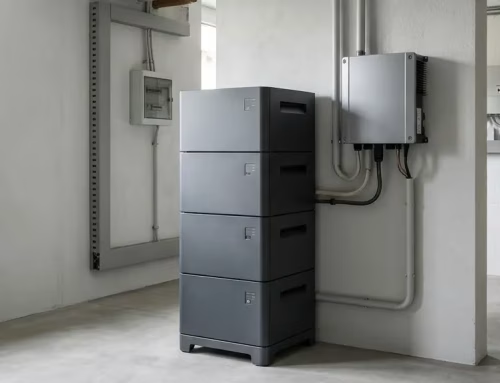
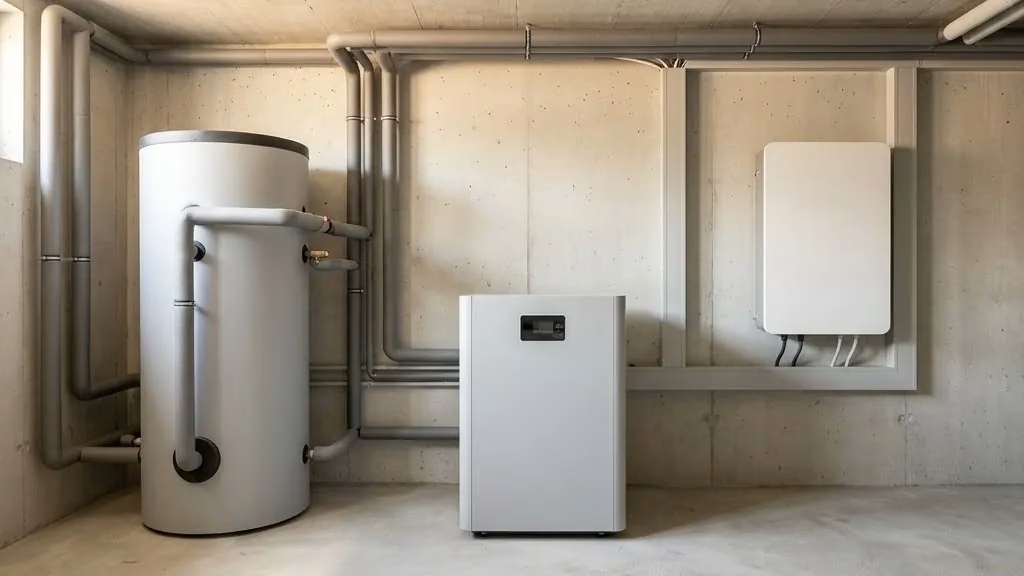
Battery storage and heat pump compete less than many think – they share the work: The heat pump transforms the midday surplus into heat for the boiler and the house, the battery saves the rest for light and appliances in the evening. The correct sequence is: first the heat pump control (cheap), then the battery (investment). And an honest limit belongs to this: In winter, the battery storage hardly charges the heat pump. (As of: July 2026)
Key points in brief
- Division of labour instead of competition: Heat is stored thermally (boiler, building), electricity electrically (battery) – each medium for its purpose.
- The hot water boiler is the cheapest «storage» in the house: It already exists and buffers midday energy until the evening – as heat.
- Sequence counts: The solar-managed heat pump control costs little and comes first; the battery is then calculated based on the remaining evening consumption.
- Buying a larger battery because of the heat pump is usually a mistake – in winter the surplus is missing, in summer the heating does not run.
- An energy management system coordinates the priorities – and is a condition for the new battery storage incentives in the City of Zurich.
Do battery storage and heat pump compete for solar electricity?
The concern is obvious: Two large consumers, one roof – do they take the electricity away from each other? The answer from practice: rarely. The two actually want the surplus for different things and at different times.
The heat pump transforms midday electricity into heat – hot water and, in the heating season, building heat. This energy is needed as heat and is also cheapest to store as heat. The battery saves electricity for consumers that absolutely need electricity: Light, cooking, appliances, entertainment in the evening. Correctly coordinated, there is no rivalry, but a relay: The boiler is charged at midday, the battery fills up in parallel or afterwards – and in the evening the house draws from both, each medium for its purpose.
Where it does get tight – on mixed days with little surplus –, the priority sequence of the energy management system regulates who is served first. More on this below.
The boiler: the cheapest storage is already in the basement
Before discussing battery capacity, it is worth looking at the storage that is already there: the hot water boiler. If it is heated with solar electricity over midday – via heat pump or immersion heater –, it buffers energy until the evening bath, without anyone having bought a battery. In the heating season, the building itself is added: A slightly raised buffer or room temperature at midday carries through to the evening – the house as heat storage.
The limit of this thermal storage is just as clear: Heat remains heat. The boiler does not make light in the evening and does not charge a mobile phone. Therefore it does not replace the battery – but it reduces it: What is thermally buffered no longer has to be carried by the battery. That is exactly why in the levers sequence the heat pump control comes before the battery purchase: It handles the largest energy item of the house at the lowest price.
The correct sequence: first control, then battery
For planning, a clear three-step process follows from this:
1. Control heat pump solar-managed. Put hot water and buffer charging into the sunny hours – the stages from time programme to energy management cost little and have an immediate effect. 2. Then measure the true evening consumption. After the changeover, it becomes apparent how much electrical consumption remains in the evening – from experience less than estimated before the optimisation. 3. Dimension the battery to this rest. Not to the total consumption, not to the system size – to the remaining evening and night consumption.
Whoever reverses the sequence and buys the large battery first, pays for capacity for energy that the heat pump will later take over thermally – the classic route to an oversized battery storage.
Does the heat pump run from the battery storage in the evening and at night?
Yes – proportionately, and here belongs the honest classification that is often missing in the sales pitch. The battery supplies the whole house in the evening, thus also the heat pump. Only the proportions are uncomfortable: A heat pump in heating mode quickly draws more over the night than a typical home battery holds – the battery is then empty early, and the rest of the night runs on grid electricity anyway.
Added to this is the seasonal gap: In winter, when the heat pump needs the most, the roof delivers the lowest surplus – the battery storage often does not even get full. In summer, when the battery storage works daily, nobody heats; the heat pump only makes hot water, and it does that directly at midday. The consequence for planning is the same as in the dimensioning question: The battery is not bought larger «because of the heat pump». Its job is the electrical evening consumption; it cannot and should not handle the heating work of the winter.
The strongest joint time of the two is the transition period: Spring and autumn deliver surplus while heating is still (or again) running – then thermal and electrical storage actually interlock, and the combination shows what it can do.
Who gets the surplus first? Energy management
As soon as heat pump, battery – and perhaps also a wallbox – hang on the same roof, the surplus needs traffic regulation: the energy management system (EMS). It measures what the system delivers beyond the house consumption, and distributes according to adjustable priorities.
A proven pattern: first the hot water (small item, quickly done, must happen anyway), then in parallel battery and other consumers, finally the feed-in. That is no dogma – the sequence can be adapted to everyday life, for instance if the e-car is to have priority at midday. The decisive factor is that one instance coordinates, instead of three devices reacting independently to the same surplus.
A tangible secondary reason for the EMS in the City of Zurich: The battery storage incentives valid since August 2026 require the combination of the battery storage with PV system and energy management system – the coordination centre is therefore not an option there, but an incentive condition.
The most frequent sentence with which heat pump owners come into the battery storage consultation is roughly: «I want the heat pump to run at night on my solar electricity.» The desire is understandable – and we have to break it down into two halves every time. In winter it fails due to the surplus: What is not left over during the day cannot come out of the battery in the evening. In summer the heating does not run. What remains is the transition period – and that is good, but it does not support battery storage dimensioning «because of the heat pump». Interestingly, the conversation rarely ends in disappointment: As soon as the midday boiler charging is set up and the real evening figures are on the table, most buy a smaller battery storage than planned – and are more satisfied with it, because it works daily instead of waiting expensively.
Do you live in the Canton of Zurich? You will find local costs and incentives under Heat pump in Zurich.
Frequently asked questions
Can the battery storage supply my heat pump in winter?
Hardly – in winter the solar surplus for charging is missing, and the night consumption of a heating heat pump quickly exceeds typical home battery capacities. The battery storage helps the heat pump above all in the transition period; the winter heating electricity remains predominantly grid electricity.
Do I absolutely need an energy management system?
For the interaction of several large consumers, it is the cleanest solution – and in the City of Zurich a condition for the battery storage incentives. In simple constellations (only heat pump, time programme) it also works without; at the latest with battery and wallbox, central coordination is worthwhile.
What should I purchase first: control or battery storage?
The control – it costs little, has an immediate effect and incidentally provides the data with which the battery storage can later be dimensioned correctly. Whoever buys the battery storage first calculates it for an evening consumption that the heat pump control subsequently reduces.
Is an immersion heater in the boiler also sufficient instead of the battery?
For the heat side, the boiler is indeed the cheaper buffer – whether charged via immersion heater or more efficiently via heat pump. But it only replaces the battery where heat is needed; for light and appliances in the evening, the battery remains the suitable medium. Many houses do best with the combination of both.
Does the battery storage have to be larger because I have a heat pump?
As a rule no – rather the opposite: With solar-managed heat pump control, the electrical evening demand that the battery has to cover decreases. The decisive factor remains the measured evening and night consumption, not the size of the consumers in the house.
Free initial consultation
Boiler, battery, heat pump – in the correct sequence.
We first set up the control, measure the true evening consumption and dimension the battery storage to what remains. Honestly calculated, with an incentives check for your location.
Want to calculate yourself first? Solar calculator with official roof data →
Prefer to talk? +41 78 830 83 35
Your battery storage system from a specialist company →
Swissolar member and Solarprofi · ESTI installation authorisation (Art. 14 NIV) · in Zurich since 2017 · over 150 systems completed · a personal answer from the specialist company, no call centre
Further guides
 Combining a heat pump and photovoltaics
 Die richtige Speichergrösse
 Eigenverbrauch optimieren: Die sechs Hebel
 Stromspeicher im Winter
 Lohnt sich ein Stromspeicher?
Sources: EnergieSchweiz (Basics of self-consumption and battery storage); City of Zurich (Battery storage incentives regulations, in force since 1 August 2026); Empirical values from the planning and consulting practice of ecoEn GmbH, Zurich region.
Last updated: 9 July 2026 · Author: ecoEn editorial team