
Solar Panels Winterthur: Photovoltaics from a Regional Specialist
A turnkey solar system for a single-family home costs, as a guideline, CHF 2,100–2,700 per kWp. Of particular interest in Winterthur: Stadtwerk Winterthur remunerates solar power under a contract model with seasonal fixed prices – 13.00 Rp./kWh in the winter quarters, 10.00 Rp. in summer, each including guarantee of origin. In the region, ecoEn has completed, among others, the 89.6 kWp system for the Winterthur gliding club. (As of July 2026)
Winterthur and its surroundings are part of our core area: short distances for site visits, installation and service. This page summarises what matters at this location – cost, incentives, Stadtwerk Winterthur's seasonal feed-in tariff and real projects from the region. New buildings in the Canton of Zurich are subject to a self-generation obligation: solar obligation at a glance. Our services in detail: Photovoltaics by ecoEn.
What does a solar system cost?
Whether an old building in the old town or a new build in Neuhegi – cost depends on system size, roof covering and household electrics. Guideline prices per kilowatt of capacity (kWp):
| System size | Guideline price per kWp | Typical use |
|---|---|---|
| 3–5 kWp | CHF 2,400–3,000 | small roofs, partial coverage |
| 5–10 kWp | CHF 2,100–2,700 | classic single-family home |
| 10–15 kWp | CHF 2,000–2,500 | larger single-family home, with heat pump or EV |
| 15–30 kWp | CHF 1,800–2,300 | large single-family roofs, small apartment buildings |
| from 30 kWp | CHF 1,500–2,000 | apartment buildings, businesses |
Guideline prices as of July 2026, turnkey incl. installation and VAT, before incentives. The binding figure is the individual quote.
The solar calculator uses the official roof data for your building.
Incentives in Winterthur
The basis is the federal one-off feed-in incentive (around CHF 360 per kWp, as of July 2026) plus the full tax deduction of the investment. On top of that, the City of Winterthur adds a 50 percent surcharge on the confirmed one-off incentive for systems under 30 kWp – around CHF 1,800 extra for a 10 kWp system. The application goes to the Energie Winterthur incentive programme within 6 months of the Pronovo decision; a separate model applies from 30 kWp. Worked examples and deadlines: Solar incentives in Winterthur. (Source: Stadtwerk Winterthur, «Förderung Photovoltaik-Anlagen», as of September 2026)
The Canton of Zurich does not pay its own blanket PV incentive – cantonal funds go primarily to heating replacement and renovation: Canton of Zurich incentives. For neighbouring municipalities outside the city, check additional contributions for your exact address – the guide finding municipal incentives shows how. We check the incentive situation for your address as part of the quote.
What does Stadtwerk Winterthur pay for solar power?
Stadtwerk Winterthur remunerates solar power in 2026 under a contract model with seasonal fixed prices: for the typical system under 100 kW with self-consumption, there are 13.00 Rp./kWh in the winter quarters and 10.00 Rp./kWh in the summer quarters – each including guarantee of origin. Without a contract, the federal quarterly reference market price applies with the statutory minimum remuneration. Details: Stadtwerk Winterthur tariff.
In the surrounding EKZ municipalities, the reference market price plus guarantee of origin applies, with a minimum remuneration of 6.0 Rp./kWh up to 30 kWp: EKZ tariff. Comparison of all grid operators: feed-in tariffs in the region.
Photovoltaics in Winterthur: the numbers
In Winterthur, 2,514 photovoltaic systems with 74.65 MW of capacity are in operation, an average of 29.7 kWp – more systems than in the City of Zurich (2,445), with significantly fewer residents. In the cantonal comparison, Zurich still ranks only 24th of 26 per capita (566 watts): there's plenty of free roof space in Winterthur too. (Source: Swissolar, Statistik Sonnenenergie 2025; as of August 2026)
All cantons and the largest municipalities compared: Photovoltaics Switzerland in numbers.
Permits and notification: how it works in Winterthur
In Winterthur, the Building Permits Office is responsible. Reasonably adapted roof systems and facade systems up to 11 m building height do not need a building application, just a notification via the cantonal «Solaranlage melden» (report a solar system) platform (§ 2a BVV, Canton of Zurich).
- Deadline: if nothing else is ordered within 30 days of receipt of the notification, the system may be built. The office confirms receipt and states the processing period.
- Documents: 1:500 site plan with the system marked in red, roof plan, gable and eaves elevation (sketch or photo), product description with module image and orientation plan according to the VKF fire safety fact sheet.
- Building application required: in core zones, for properties in the townscape or heritage protection inventory, within the ISOS-A perimeter and for facade systems on buildings over 11 m (except single-family homes).
- Commercial advantage: in industrial and commercial zones, even non-adapted systems only require notification; free-standing systems there require notification with no area limit, in other building zones up to 20 m².
We handle the notification, the connection application to Stadtwerk Winterthur (or EKZ in neighbouring municipalities) and the Pronovo registration. The Zurich rules in detail: planning permission for solar systems in Zurich; the dossier: notification procedure for solar systems. (Sources: City of Winterthur, «Solarenergie – Bewilligung», as of 25 August 2026; Canton of Zurich, «Solaranlage melden»)
References from the Winterthur region
From single-family homes to large-scale systems – two examples:
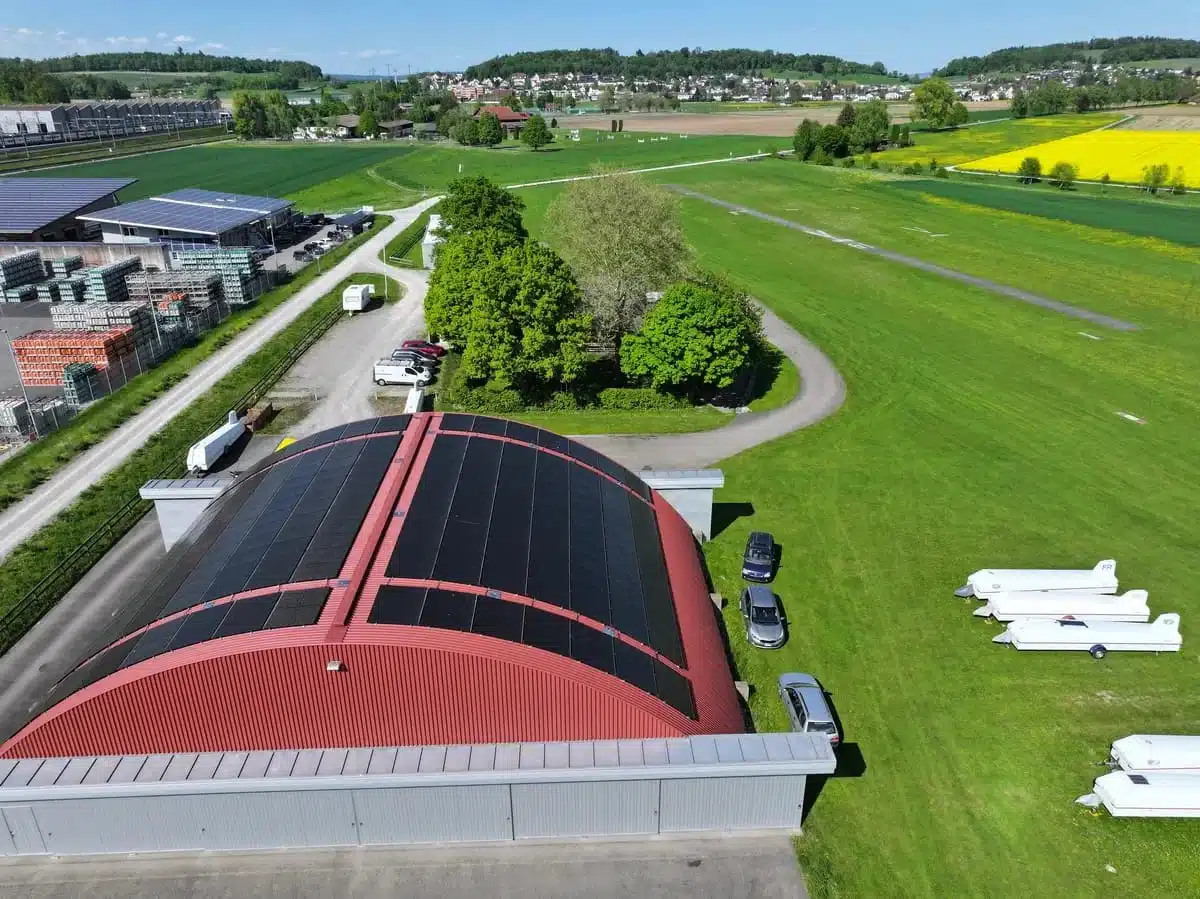
Large-scale system, gliding hangar, Winterthur
- Riedbachweg · club building
- 89.6 kWp · east-west layout on trapezoidal sheet metal
- Commissioned 2022
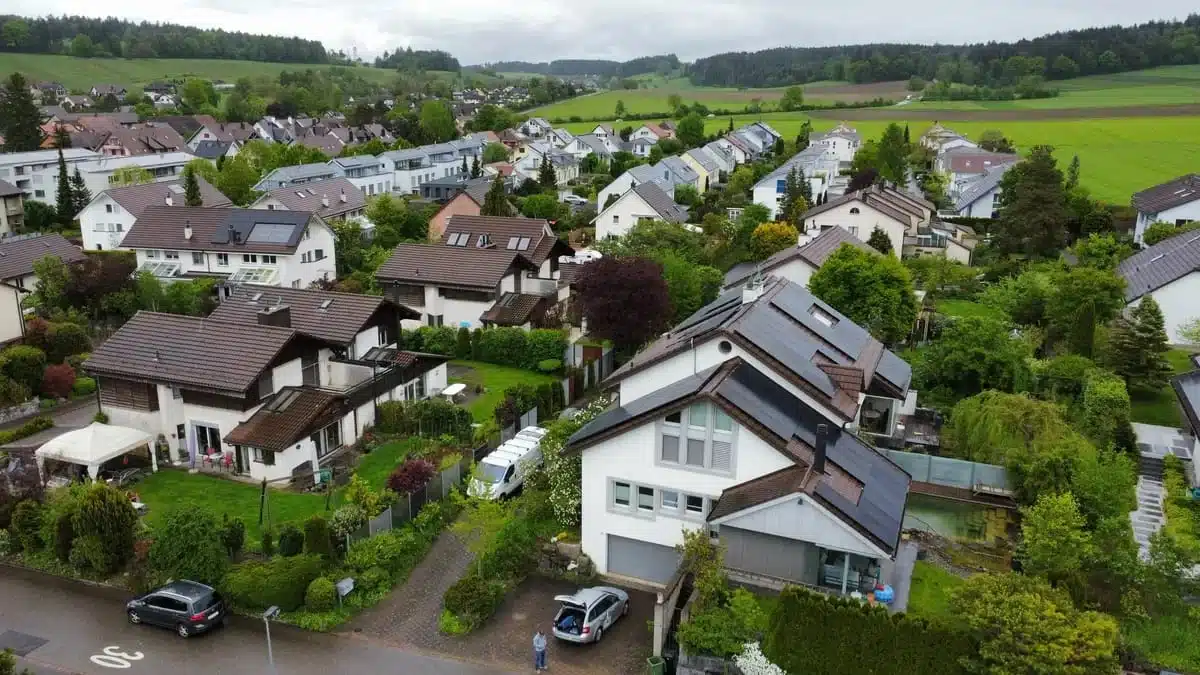
ZEV across two houses, Wiesendangen
- Brunnenwiesstrasse · 2 single-family homes
- 44.15 kWp · self-consumption community (ZEV)
- Commissioned 2023
All completed systems with key data: Projects & references.
How your project works
- Initial consultation. Free and without obligation – on site or by phone.
- Site visit & planning. Roof, meter box and consumption: we design the system to suit your building.
- Quote. Transparently itemised – every item traceable.
- Permit & registration. We handle the notification procedure, grid operator and Pronovo for you.
- Installation. By our own team – no passing the job on to subcontractors.
- Commissioning & service. Acceptance, instruction and monitoring – we remain your point of contact.
What our quote includes – and what it doesn't
The most common worry before signing isn't the price but the question of what gets added at the end. That's why we show both.
Included: planning and design, materials (modules, inverter, mounting system, cabling), scaffolding, installation, the electrical connection by our own specialist company, commissioning and measurement, registration with the grid operator and the incentive application to Pronovo – we submit it for you.
Shown separately: anything added in individual cases appears as its own item in the quote, not in a lump sum. The most common case: if the existing meter distribution board – the fuse box – is not suitable for the system and needs to be adapted, we invoice this separately. Depending on the property, official fees and work provided by the client may also apply.
Payment in stages, linked to project progress. Under our terms and conditions (AGB), that's 30% on placing the order, 50% on delivery of the main components and 20% after commissioning and acceptance. We agree different terms on a project basis; the arrangement in your quote always applies.
Who is liable for what
After the company bankruptcies in the Swiss solar industry, this is the question that counts in the end – and it has three different answers:
- Product and performance warranties lie with the manufacturer of the modules, inverter and storage. A manufacturer's warranty is only ever as reliable as the manufacturer behind it – that's why, when choosing products, we also consider who will still be reachable if something goes wrong.
- The installation warranty lies with us: installation, electrical work, commissioning. That's the part we honour directly.
- Business liability insurance: as an installation company, we carry liability insurance.
In the event of a fault, you have one point of contact – us – regardless of whose component is affected.
Frequently asked questions
What does a solar system cost in Winterthur?
How much does Stadtwerk Winterthur pay for exported power?
What incentives are available in Winterthur?
Does ecoEn also realise large roofs and commercial systems?
What is a ZEV – and is it worth it for an apartment building?
Do I need planning permission?
Guides for the Winterthur region
- What does a solar system cost? The complete cost guide
- Stadtwerk Winterthur feed-in tariff 2026
- Incentives in the Canton of Zurich
- Finding municipal incentives
- Forming a ZEV: the process
- Solar systems on apartment buildings
- Does a solar system pay off?
- Solar obligation: what applies to new buildings?
- Solar systems for businesses and SMEs: cost and self-consumption
- Photovoltaics for business and industry in Zurich
Free quote for your address
Site visit, incentive check and a transparently itemised quote – without obligation and without sales pressure.